
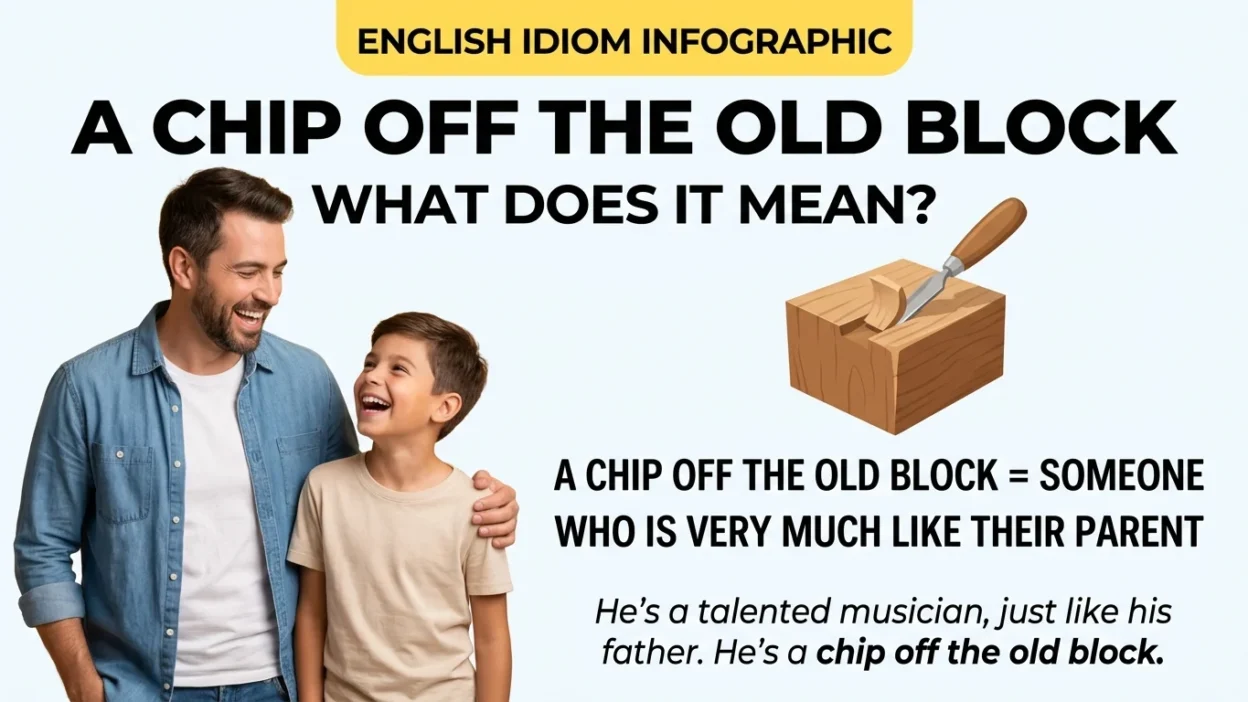
“A chip off the old block” is a common English idiom used to describe someone who is very similar to one of their parents, especially in personality, behavior, appearance, skills, or abilities.
In simple terms:
A chip off the old block = someone who is very much like their parent
For example:
Daniel is a talented musician just like his father. He’s a chip off the old block.
This means Daniel inherited or developed qualities that strongly resemble his father.
Quick Answer
A chip off the old block means a child who is similar to their parent in character, appearance, behavior, or abilities.
Example
She is a chip off the old block. Her mother was an excellent artist too.
Meaning:
She is very similar to her mother.
The expression is usually positive or affectionate, although the context can sometimes make it negative or humorous.
What Does “A Chip Off the Old Block” Mean?
The idiom describes a person, usually a child, who resembles a parent in some noticeable way.
The similarity might involve:
- Personality
- Appearance
- Habits
- Talents
- Interests
- Values
- Behavior
- Skills
For example:
Like his father, he loves working with his hands. He’s a chip off the old block.
The phrase suggests that the child is like a small piece taken from the same original “block.”
“Chip Off the Old Block” in Simple English
You can understand the idiom as:
A child who is very much like their parent.
For example:
Her daughter is just a chip off the old block.
This means:
Her daughter is very similar to her.
A modern equivalent might be:
She takes after her mother.
or:
She’s just like her mother.
Examples of “A Chip Off the Old Block”
Here are some natural examples:
John is a great basketball player, just like his father. He’s a chip off the old block.
Emma loves painting just like her mother. She’s a chip off the old block.
His father was a successful businessman, and now his son is following the same path. He’s a chip off the old block.
She’s confident and outspoken, just like her mother. Definitely a chip off the old block.
The young chef has the same passion for cooking as his father. He’s a chip off the old block.
“A Chip Off the Old Block” for Appearance
The idiom can describe physical resemblance.
He has the same eyes and smile as his father. He’s a chip off the old block.
This means he looks very much like his father.
However, take after is often more natural when specifically talking about physical appearance:
He takes after his father.
“A Chip Off the Old Block” for Personality
The expression can also describe personality.
Her daughter is just as determined as she is. She’s a chip off the old block.
This means the daughter has inherited or developed a similar personality.
For example:
His father was known for his patience, and his son is a chip off the old block.
“A Chip Off the Old Block” for Skills
The idiom is frequently used when a child has the same talent as a parent.
His father was a brilliant musician, and he’s a chip off the old block.
Her mother was an excellent athlete, and she’s a chip off the old block.
The young painter is clearly a chip off the old block.
Here, the expression highlights a shared ability.
“A Chip Off the Old Block” for Habits
The idiom can also refer to habits or behaviors.
He drinks coffee every morning just like his father. He’s a chip off the old block.
She loves gardening just like her mother. She’s a chip off the old block.
The similarity doesn’t have to be a major talent or personality trait.
Is “A Chip Off the Old Block” Positive?
Usually, yes.
It is often used as a compliment or affectionate observation.
For example:
Your son is a chip off the old block!
This generally means:
Your son is just like you.
However, the meaning depends on what quality is being discussed.
If the parent’s behavior is negative, the expression can also be negative:
Unfortunately, he’s a chip off the old block.
Here, the speaker may mean that the child has inherited an undesirable habit or characteristic.
“Chip Off the Old Block” for a Daughter
The expression can absolutely be used for daughters.
She is a chip off the old block, just like her mother.
Sarah is a chip off the old block. She has the same determination as her father.
The idiom is not limited to sons.
“Chip Off the Old Block” for a Son
It is also commonly used for sons:
He’s a chip off the old block, just like his dad.
The boy is definitely a chip off the old block.
Historically, the phrase has often been associated with sons, but modern English uses it for children generally.
A Chip Off the Old Block vs Take After
These expressions are very similar.
A Chip Off the Old Block
Emphasizes that someone is very much like a parent.
He’s a chip off the old block.
Take After
Means to resemble a family member, either physically or in personality.
He takes after his father.
She takes after her grandmother.
Take after is more flexible because you can use it for parents, grandparents, and other relatives.
A Chip Off the Old Block vs Like Father, Like Son
These expressions are closely related.
A chip off the old block
means a child resembles a parent.
Like father, like son
suggests that a son has characteristics or behavior similar to his father.
For example:
His father was a talented guitarist, and he’s a chip off the old block.
His father loves music, and now his son does too. Like father, like son.
A chip off the old block can be used for both sons and daughters, while like father, like son specifically refers to a father and son.
A Chip Off the Old Block vs Spitting Image
These are not exactly the same.
A chip off the old block can refer to:
- Personality
- Behavior
- Skills
- Interests
- Appearance
Spitting image primarily refers to someone who looks extremely similar to another person.
She’s the spitting image of her mother.
This focuses much more strongly on physical appearance.
Origin of “A Chip Off the Old Block”
The expression comes from the image of splitting or cutting a small piece, or “chip,” from a larger block of wood or stone.
The small piece comes from the same material as the original block, so it naturally resembles it.
The idiom uses this physical image as a metaphor:
Old block → parent
Chip → child
The idea is that the child is a small “piece” of the parent because they share similar characteristics.
The expression has been used in English for centuries.
Why Is It Called a “Chip”?
A chip is a small piece broken or cut from a larger piece of material.
A block is the original larger piece.
So imagine:
Large block → small chip
The chip comes from the same material as the block.
The idiom applies this idea to families:
Parent → child
The child may resemble the parent because they share similar characteristics.
Can You Say “A Chip Off the Old Block” About Adults?
Yes.
The person doesn’t have to be a child.
For example:
His father was a famous architect, and now he’s an architect too. He’s a chip off the old block.
The expression can describe an adult who continues to resemble a parent in personality, career, skills, or behavior.
Can You Use It for Grandparents?
Usually, a chip off the old block most naturally refers to a child resembling a parent.
However, the expression can sometimes be used more broadly for family resemblance.
For a grandparent, take after may be more natural:
She really takes after her grandmother.
Grammar of “A Chip Off the Old Block”
The expression normally functions as a noun phrase.
He is a chip off the old block.
She is a chip off the old block.
They are chips off the old block.
Notice that when referring to multiple people, the plural form can be:
chips off the old block
For example:
Both children are chips off the old block.
Is It “Chip Off the Old Block” or “A Chip Off the Old Block”?
The full idiom is:
a chip off the old block
For example:
He is a chip off the old block.
In some contexts, especially headlines or informal speech, the article a may be omitted:
He’s a real chip off the old block.
But when using the idiom as a standard noun phrase, a chip off the old block is the most natural form.
Common Mistakes
Mistake 1: Thinking it only refers to appearance
The idiom can describe appearance, but it can also refer to personality, talents, interests, habits, or behavior.
She’s a chip off the old block because she’s an excellent musician.
Mistake 2: Using it only for sons
The expression can describe sons or daughters.
She is a chip off the old block.
Mistake 3: Thinking it always means something positive
Usually it is positive, but context determines the tone.
He’s a chip off the old block.
can be praise.
But:
Unfortunately, he’s a chip off the old block.
can suggest an undesirable similarity.
How to Use “A Chip Off the Old Block” Naturally
Use the expression when:
- A child resembles a parent.
- The similarity is noticeable.
- You are talking about personality, appearance, skills, interests, or behavior.
- You want to emphasize a family resemblance.
For example:
Her mother was a talented writer, and she’s a chip off the old block.
This sounds natural because the daughter shares her mother’s talent.
Easy Way to Remember
Imagine a large piece of wood:
OLD BLOCK → CHIP
The chip comes from the same block, so it resembles the original.
In a family:
PARENT → CHILD
The child resembles the parent.
Therefore:
A chip off the old block = a child who is like their parent.
Quick Comparison
| Expression | Meaning |
|---|---|
| A chip off the old block | A child who resembles a parent |
| Take after someone | Resemble a family member |
| Like father, like son | A son resembles his father |
| Spitting image | Look extremely similar |
| Runs in the family | A characteristic is common among family members |
Final Verdict
“A chip off the old block” means a child who is very similar to a parent in appearance, personality, behavior, talents, interests, or other characteristics.
For example:
His father was a talented musician, and he’s a chip off the old block.
This means the son has a similar musical talent.
The idiom comes from the image of a small chip being cut from a larger block of wood or stone. Since the chip comes from the same material as the block, it resembles the original.
The easiest way to remember it is:
Old block = parent
Chip = child
So, a chip off the old block means someone who is very much like their parent.
FAQs
What does “a chip off the old block” mean?
It means a child who is very similar to their parent, especially in personality, appearance, behavior, skills, or interests.
Is “a chip off the old block” an idiom?
Yes. It is a common English idiom describing a strong resemblance between a child and a parent.
Is “a chip off the old block” a compliment?
Usually, yes. It is often used affectionately or positively, although it can be negative when the parent’s characteristic being copied is undesirable.
Can you use “a chip off the old block” for a daughter?
Yes. The idiom can describe either a son or a daughter.
She’s a chip off the old block, just like her mother.
What is an example of “a chip off the old block”?
His father was an excellent athlete, and he’s a chip off the old block.
This means the son has similar athletic ability.
What is another way to say “a chip off the old block”?
You can say take after someone, be just like someone, or, when referring specifically to appearance, be the spitting image of someone.
Does “a chip off the old block” refer only to appearance?
No. It can describe appearance, personality, behavior, talents, interests, habits, and other characteristics.
Can an adult be a chip off the old block?
Yes. The expression can describe an adult who strongly resembles a parent.
What is the origin of “a chip off the old block”?
The phrase comes from the literal idea of a small chip being cut from a larger block of material. The chip comes from the same material as the block, creating the metaphor of a child resembling a parent.
Is “chip off the old block” informal?
Yes. It is a familiar idiom commonly used in everyday conversation and informal writing.
What is the difference between “a chip off the old block” and “take after”?
Both describe family resemblance. A chip off the old block emphasizes that someone is very much like a parent, while take after can refer to resemblance to a wider range of relatives.
Conclusion
The idiom “a chip off the old block” describes someone who is very much like their parent.
The resemblance can involve appearance, personality, behavior, interests, talents, or habits.
For example:
She is a chip off the old block; her mother was an excellent artist too.
The expression comes from the idea of a small piece, or chip, being taken from a larger block. Because the chip comes from the same material, it resembles the original.
Remember:
A chip off the old block = a child who is like their parent.
It is usually a warm or complimentary expression, although its meaning can become negative when the parent has an undesirable characteristic that the child has also adopted.

Joseph Richard is the administrator and a dedicated author at DrameyHut, overseeing the platform’s operations and content quality. Alongside his administrative role, he writes insightful articles on dream meanings, helping readers understand their subconscious mind. His work supports the mission of providing clear, meaningful, and engaging dream interpretations.