A nonfinite verb is a verb form that does not change according to the subject or tense of a sentence. Unlike finite verbs, nonfinite verbs cannot normally act as the main verb of an independent clause by themselves. Instead, they can function as nouns, adjectives, or adverbs within a sentence.
Nonfinite verbs are an important part of English grammar because they allow us to make sentences more concise and natural. Forms such as to eat, eating, eaten, and written can all be nonfinite verb forms depending on how they are used.
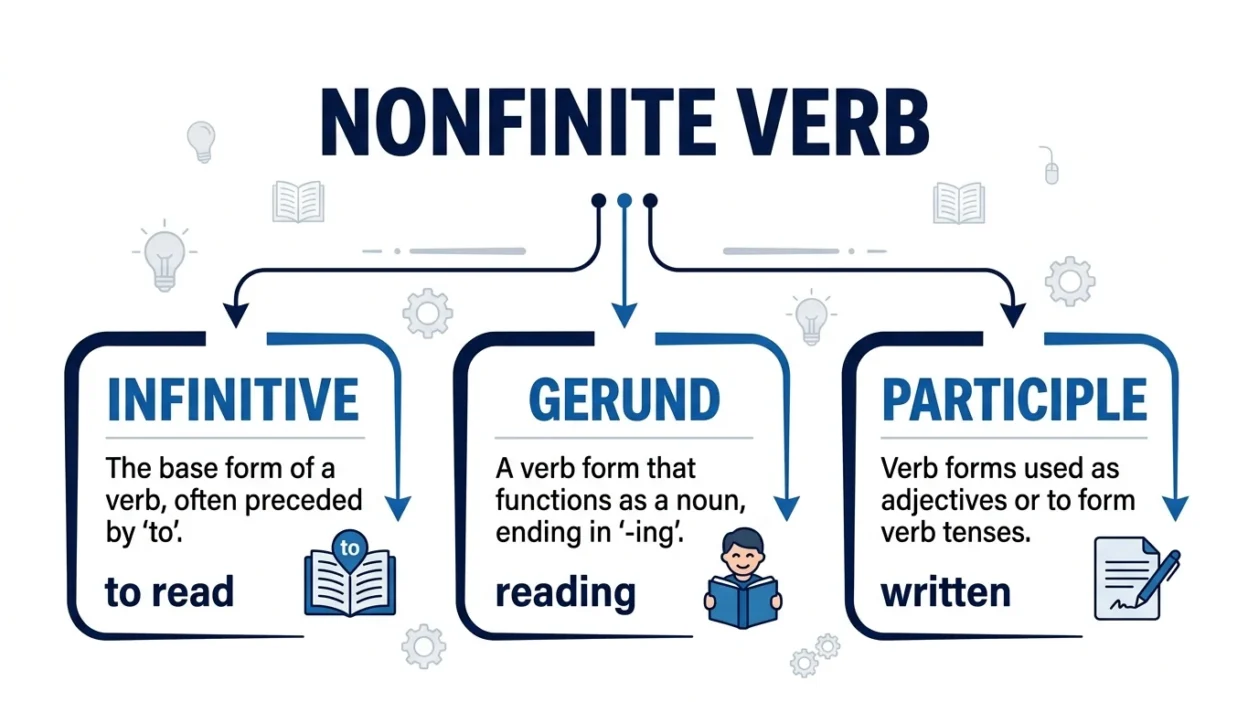
Understanding nonfinite verbs becomes much easier when you learn their three main types: infinitives, gerunds, and participles. In this article, we will explain what a nonfinite verb is, explore its types, look at plenty of examples, and compare nonfinite verbs with finite verbs.
Quick Answer: What Is a Nonfinite Verb?
A nonfinite verb is a verb form that does not show tense, person, or number by itself. It does not change according to the subject. Common nonfinite forms include to run, running, run, written, and eaten.
For example:
She wants to leave.
Here, wants is finite because it agrees with the subject and shows present tense. To leave is nonfinite because it does not change according to the subject.
What Does Nonfinite Verb Mean?
The word nonfinite means “not limited” or “not restricted.” In grammar, a nonfinite verb is not limited by grammatical features such as tense, person, or number in the same way a finite verb is.
Consider these examples:
I work every day.
She works every day.
The verb work changes to works depending on the subject. This is a finite verb.
Now look at:
I want to work every day.
She wants to work every day.
The verb wants changes according to the subject, but to work remains unchanged. Therefore, to work is a nonfinite verb.
Nonfinite verbs often depend on another verb or function as another part of speech.
Types of Nonfinite Verbs
There are three major types of nonfinite verbs in English:
- Infinitives
- Gerunds
- Participles
Each type has a different grammatical function.
1. Infinitives
An infinitive is usually formed with to + base form of a verb.
Examples include:
to eat
to sleep
to study
to write
to travel
to learn
These are nonfinite because they do not change according to the subject.
For example:
I want to travel.
She wants to travel.
They want to travel.
The main verb changes from want to wants, but to travel remains the same.
Examples of Infinitives as Nonfinite Verbs
He hopes to win the competition.
She decided to leave early.
We need to finish the project.
They plan to visit London.
I want to learn Spanish.
In each sentence, the infinitive does not indicate who performs the action or when the action happens by itself.
Bare Infinitives
An infinitive can sometimes appear without to. This is called a bare infinitive.
For example:
She made me laugh.
I heard him sing.
They let us leave.
You should study harder.
Here, laugh, sing, leave, and study are base forms functioning as nonfinite verbs.
2. Gerunds
A gerund is the ing form of a verb that functions as a noun.
Examples include:
Swimming is good exercise.
Reading improves vocabulary.
I enjoy cooking.
She likes dancing.
In these sentences, swimming, reading, cooking, and dancing come from verbs but perform noun like functions.
Examples of Gerunds
Running is my favorite exercise.
She enjoys painting.
Learning English takes practice.
He dislikes waiting.
Writing helps me relax.
The words running, painting, learning, waiting, and writing are based on verbs, but they function as nouns.
Gerund vs Present Participle
Both gerunds and present participles usually end in ing, which can make them confusing.
The important difference is their function.
A gerund functions as a noun:
Swimming is fun.
Here, swimming is the subject of the sentence.
A present participle functions as an adjective or forms part of a verb phrase:
The swimming child waved at us.
Here, swimming describes the child, so it functions as an adjective.
3. Participles
Participles are another important type of nonfinite verb.
There are two main types:
Present participles
Past participles
Present Participles
Present participles usually end in ing.
Examples:
running
eating
laughing
crying
sleeping
They can function as adjectives or be used with auxiliary verbs.
For example:
The crying baby needs attention.
Here, crying describes the baby.
In:
The baby is crying.
The word crying is part of the verb phrase is crying. The finite verb is is, while crying is nonfinite.
Past Participles
Past participles are often formed with ed for regular verbs, although many irregular verbs have different forms.
Examples:
worked
played
finished
written
eaten
broken
gone
Past participles can function as adjectives or occur in perfect and passive constructions.
For example:
The broken window needs repair.
Here, broken describes the window.
In:
She has written a letter.
has is the finite verb, while written is a nonfinite past participle.
Finite Verb vs Nonfinite Verb
The easiest way to understand nonfinite verbs is to compare them with finite verbs.
| Feature | Finite Verb | Nonfinite Verb |
|---|---|---|
| Shows tense | Yes | Not by itself |
| Changes according to subject | Sometimes | No |
| Can be the main verb of an independent clause | Yes | No |
| Can function as a noun | No | Yes, in gerund form |
| Can function as an adjective | No | Yes, in participle form |
| Examples | runs, ran, is, was | to run, running, run |
Consider this sentence:
She is reading a book.
There are two verb forms:
is = finite verb
reading = nonfinite verb
The word is shows present tense and agrees with the subject she. The word reading does not change according to the subject.
How to Identify a Nonfinite Verb
You can use a few simple questions to identify a nonfinite verb.
Step 1: Look for a verb form
Find the words that express an action, state, or process.
Step 2: Ask whether the verb shows tense
If the verb itself shows tense, it may be finite.
For example:
She walked home.
walked shows past tense, so it is finite.
Step 3: Check whether it changes with the subject
Compare:
He works hard.
They work hard.
The verb changes from works to work, so it is finite.
Now compare:
He wants to work.
They want to work.
to work stays unchanged, so it is nonfinite.
10 Examples of Nonfinite Verbs
Here are some simple examples:
- I want to learn English.
To learn is a nonfinite infinitive. - Swimming is healthy.
Swimming is a nonfinite gerund. - The broken chair was repaired.
Broken is a nonfinite past participle. - She is studying for her exam.
Studying is a nonfinite present participle. - He decided to stay.
To stay is a nonfinite infinitive. - Reading improves your vocabulary.
Reading is a nonfinite gerund. - The smiling woman greeted us.
Smiling is a nonfinite present participle. - They have finished the work.
Finished is a nonfinite past participle. - I heard him sing.
Sing is a bare infinitive and functions as a nonfinite verb form. - She hopes to become a doctor.
To become is a nonfinite infinitive.
Nonfinite Verb Examples in Different Functions
Nonfinite verbs can perform different grammatical roles.
Nonfinite Verb as a Noun
To exercise is important.
Swimming is enjoyable.
Here, to exercise and swimming function as nouns.
Nonfinite Verb as an Adjective
The damaged car was expensive to repair.
The crying child needs help.
Here, damaged and crying describe nouns.
Nonfinite Verb as Part of a Verb Phrase
She is cooking dinner.
They have finished the project.
The house was built in 1990.
In these sentences, cooking, finished, and built are nonfinite forms that work with finite auxiliary verbs.
Common Mistakes With Nonfinite Verbs
Nonfinite verbs can cause several common grammar mistakes.
Mistake 1: Treating an Infinitive as a Finite Verb
Incorrect:
She to study every night.
Correct:
She studies every night.
Or:
She wants to study every night.
The infinitive to study cannot normally serve as the only finite verb in an independent clause.
Mistake 2: Confusing Gerunds With Present Participles
Not every ing word is a gerund.
Running is healthy.
Here, running functions as a noun, so it is a gerund.
The running water is cold.
Here, running describes water, so it is a present participle.
Mistake 3: Assuming Every Past Participle Is Finite
Consider:
She has eaten lunch.
Has is finite.
Eaten is a nonfinite past participle.
The past participle itself does not carry the tense in this construction. The auxiliary has does.
Mistake 4: Using the Wrong Form After Certain Verbs
Some verbs are followed by infinitives, while others are followed by gerunds.
For example:
I decided to leave.
I enjoy reading.
Using the wrong form can make a sentence grammatically incorrect or unnatural.
A Simple Memory Trick
Remember:
Finite = fixed to tense or subject
Nonfinite = not fixed to tense or subject
You can also remember the three main nonfinite forms:
To + verb = infinitive
Verb + ing as a noun = gerund
Verb form describing something or used with an auxiliary = participle
For example:
to write
writing
written
These can all be nonfinite verb forms.
Why Are Nonfinite Verbs Important?
Nonfinite verbs make English sentences more flexible and concise.
Compare:
She went to the store because she wanted to buy some milk.
This can sometimes be shortened to:
She went to the store to buy some milk.
The infinitive to buy helps express purpose without creating another finite clause.
Nonfinite constructions are especially common in academic writing, formal writing, instructions, and everyday English.
Finite and Nonfinite Verbs in One Sentence
A sentence can contain both finite and nonfinite verbs.
For example:
He wants to learn English.
wants = finite
to learn = nonfinite
Another example:
She has finished working.
has = finite
finished = nonfinite
working = nonfinite
This shows that a single sentence can contain several verb forms with different grammatical functions.
Nonfinite Verb vs Infinite Verb
A common spelling mistake is to confuse nonfinite with infinite.
The correct grammatical term is:
nonfinite verb
It is not normally called an infinite verb.
The word nonfinite refers to a verb form that does not have the full tense and subject-related properties of a finite verb.
American vs British English
The basic concept of nonfinite verbs is the same in both American and British English.
The terms finite verb, nonfinite verb, infinitive, gerund, present participle, and past participle are used in both varieties.
There can be differences in preferred vocabulary, spelling, or style between American and British English, but the fundamental rules governing finite and nonfinite verbs remain largely the same.
Similar Grammar Terms
If you are learning about nonfinite verbs, you may also encounter these terms:
Finite verb: A verb that expresses tense and can function as the main verb of a clause.
Infinitive: Usually to + base verb, such as to read or to go.
Gerund: An ing form functioning as a noun, such as reading.
Present participle: An ing form used as an adjective or with an auxiliary verb.
Past participle: A verb form such as written, eaten, broken, or worked, often used in perfect or passive constructions.
Auxiliary verb: A helping verb such as be, have, or do.
Final Verdict
A nonfinite verb is a verb form that does not independently show tense, person, or number. It does not normally function as the only finite verb of an independent clause.
The three major types are infinitives, gerunds, and participles.
Examples include:
to read
reading
written
eaten
broken
Learning to identify these forms makes it much easier to understand English sentence structure and use complex sentences correctly.
Frequently Asked Questions
What is a nonfinite verb in simple words?
A nonfinite verb is a verb form that does not change according to the subject or tense. Examples include to eat, eating, eaten, and written.
What are the three types of nonfinite verbs?
The three main types are infinitives, gerunds, and participles. Infinitives usually use to + base verb, gerunds use ing as nouns, and participles can function as adjectives or occur in verb phrases.
Is an infinitive a nonfinite verb?
Yes. An infinitive is one of the most common types of nonfinite verb. For example, to study is nonfinite in the sentence She wants to study.
Is a gerund a nonfinite verb?
Yes. A gerund is an ing form that functions as a noun. For example, Swimming is enjoyable contains the nonfinite gerund swimming.
Is a past participle a nonfinite verb?
Yes. A past participle is a nonfinite verb form. For example, in She has written a letter, has is finite and written is a nonfinite past participle.
What is the difference between finite and nonfinite verbs?
A finite verb can show tense and may change according to the subject. A nonfinite verb does not independently show these features. For example, works is finite, while to work is nonfinite.
Can a sentence have both finite and nonfinite verbs?
Yes. For example, She wants to learn English contains wants as the finite verb and to learn as the nonfinite verb.
Conclusion
Nonfinite verbs are essential to English grammar because they help us express actions and ideas without always creating a new finite clause. Infinitives, gerunds, and participles allow sentences to become more flexible, concise, and natural.
The easiest way to recognize a nonfinite verb is to ask if the verb itself changes to show tense or agreement with the subject. If it does not, and it is functioning as an infinitive, gerund, or participle, you are likely looking at a nonfinite verb.
Remember This
Finite verb = shows tense or agreement
Nonfinite verb = does not independently show tense or agreement
Infinitive = to + verb
Gerund = verb + ing functioning as a noun
Participle = verb form functioning as an adjective or as part of a verb phrase
Meta Description: Learn what a nonfinite verb is, explore infinitives, gerunds, and participles, and understand nonfinite verbs with clear examples.
Featured Image Prompt: Create a clean educational grammar illustration showing “Nonfinite Verb” in the center, with three branches labeled Infinitive, Gerund, and Participle, surrounded by simple examples such as “to read,” “reading,” and “written.” Use a modern academic style, clear typography, soft professional colors, and a white background suitable for an English grammar blog.

Christopher Thomas is a passionate writer and dream researcher dedicated to exploring the meanings behind dreams. As an author at DrameyHut, he creates insightful and easy-to-understand interpretations that help readers connect with their subconscious mind. His work focuses on guiding individuals toward self-discovery, clarity, and a deeper understanding of their inner thoughts.