The phrases “who else” and “whom else” are often confused because both refer to another person or group of people. The difference comes down to the grammatical role of who and whom in a sentence.
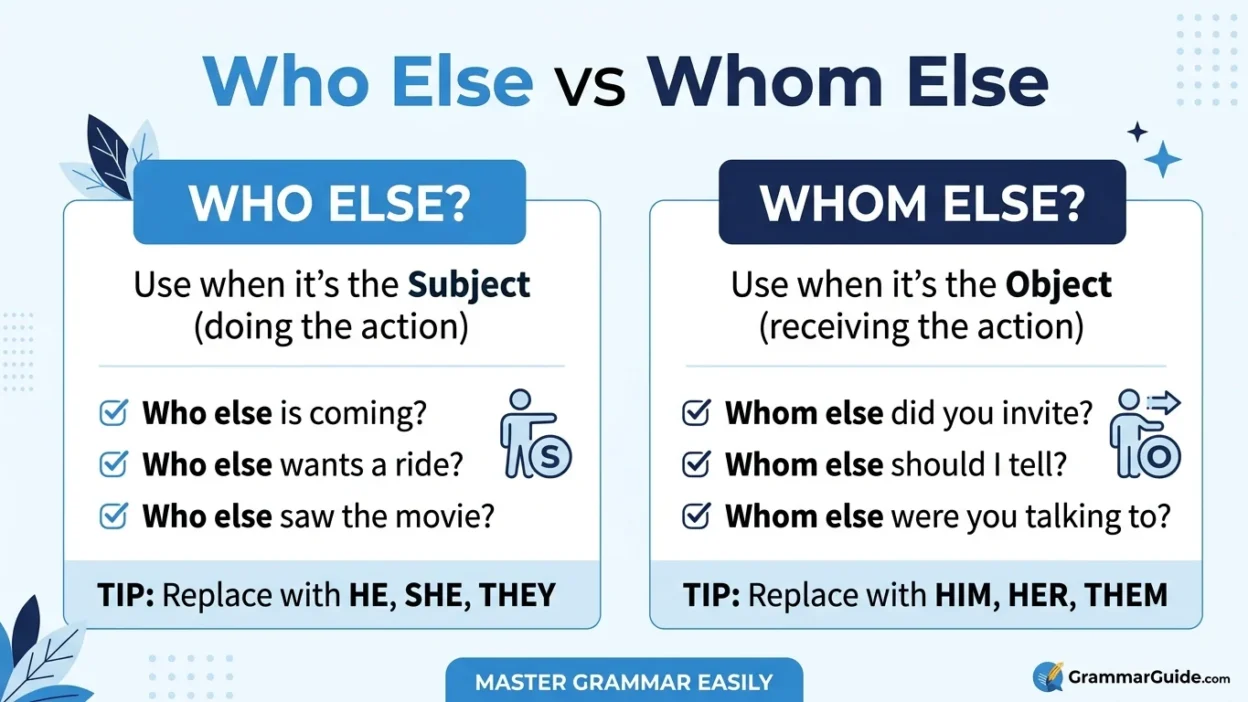
In traditional English grammar, who is used for the subject, while whom is used for the object. This means we say “Who else is coming?” because the person is doing the action. But traditionally, we say “Whom else did you invite?” because the person is receiving the action.
However, modern English is more flexible. In everyday conversation, who is commonly used instead of whom, even when traditional grammar would recommend whom. This makes “Who else did you invite?” perfectly natural in ordinary English.
Quick Answer: Who Else vs Whom Else
Use “who else” when the person is the subject of the sentence.
Who else is coming?
Use “whom else” when the person is the object, particularly in formal English.
Whom else did you invite?
In modern everyday English, however, who else is often used for both subject and object positions.
What Does “Who Else” Mean?
Who else means what other person or what other people.
The word who refers to a person, while else means another or additional.
For example:
Who else is coming to the party?
This means:
What other person is coming to the party?
You can also use who else to ask about people who have a particular quality, experience, or connection.
Who else knows the answer?
Who else wants to join us?
Who else lives here?
Who else can help me?
Who else is extremely common in both spoken and written English.
What Does “Whom Else” Mean?
Whom else has essentially the same basic meaning, but whom traditionally indicates that the person is the object of a verb or preposition.
For example:
Whom else did you invite?
The underlying structure is:
You invited whom else.
The person represented by whom else receives the action of invite, so traditional grammar uses whom.
Another example is:
Whom else should I contact?
The underlying structure is:
I should contact him.
Because him is an object pronoun, traditional grammar uses whom.
Who Else vs Whom Else: The Main Difference
The traditional distinction is simple:
Who is used as a subject.
Whom is used as an object.
Consider these two sentences:
Who else called you?
Here, who else performed the action of calling. Therefore, it is the subject.
Now consider:
Whom else did you call?
Here, you performed the action, while whom else received it. Therefore, whom else is traditionally the object.
Comparison Table
| Phrase | Traditional Role | Example | Explanation |
|---|---|---|---|
| Who else | Subject | Who else is coming? | The person is doing the action |
| Who else | Modern object usage | Who else did you invite? | Common in everyday English |
| Whom else | Object | Whom else did you invite? | The person receives the action |
| Whom else | Object after preposition | To whom else did you speak? | Formal grammatical usage |
The biggest practical difference is formality. Who else is much more common in everyday English.
When to Use “Who Else”
Use who else when the person is the subject.
For example:
Who else wants coffee?
The person represented by who else is the one who wants coffee.
More examples include:
Who else is coming?
Who else knows about this?
Who else can answer the question?
Who else lives in this building?
Who else wants to participate?
Who else saw the accident?
Who else needs help?
In all these examples, who else is functioning as the subject.
When to Use “Whom Else”
Use whom else when the person is the object if you are following traditional grammar rules.
For example:
Whom else did you invite?
You invited him.
Another example:
Whom else did she call?
She called him.
More examples include:
Whom else did you see?
Whom else should I ask?
Whom else did they interview?
Whom else can we trust?
Whom else did he contact?
These constructions are grammatically traditional, but they can sound formal or even slightly old fashioned in casual conversation.
Is “Who Else Did You Invite?” Correct?
Yes.
This is one of the most important things to understand about who else vs whom else.
Traditional grammar recommends:
Whom else did you invite?
because whom else is the object of invite.
But modern English commonly uses:
Who else did you invite?
This version is extremely natural and widely used.
Therefore, you should not assume that who else is always grammatically wrong when it appears as an object.
Formal English
Whom else did you invite?
Everyday English
Who else did you invite?
Both sentences are understandable and widely used, but the first follows the traditional who/whom distinction more strictly.
Is “Whom Else Is Coming?” Correct?
No, not according to traditional grammar.
The correct sentence is:
Who else is coming?
Why?
Because who else is the subject of is coming.
You can think of the sentence as:
He is coming.
Not:
Him is coming.
Since he is the correct subject pronoun, who is correct.
Therefore:
Who else is coming? ✓
Whom else is coming? ✗
This is a useful example because it shows that whom should not simply be used whenever you want to sound formal.
Who Else Should I Contact vs Whom Else Should I Contact?
Both forms are found in English.
Traditional grammar prefers:
Whom else should I contact?
because whom else is the object of contact.
However, most people would naturally say:
Who else should I contact?
in ordinary conversation.
If you are writing a formal letter, academic document, or carefully edited text, whom else may be appropriate.
For everyday communication, who else generally sounds more natural.
Who Else vs Whom Else After a Preposition
The traditional rule is especially clear when the pronoun comes directly after a preposition.
For example:
To whom else should I send the email?
With whom else did you speak?
For whom else was this intended?
About whom else were they talking?
In formal English, whom is traditionally preferred after a preposition.
But everyday English often avoids this structure:
Who else should I send the email to?
Who else did you speak with?
Who else was this intended for?
Who else were they talking about?
These versions are more conversational and natural for many speakers.
Examples of “Who Else”
Here are some common examples:
- Who else is attending the meeting?
- Who else wants some cake?
- Who else knows the answer?
- Who else can help us?
- Who else lives nearby?
- Who else saw what happened?
- Who else wants to go shopping?
- Who else is interested in the job?
- Who else could solve this problem?
- Who else would like some tea?
These are all natural examples of who else.
Examples of “Whom Else”
Here are examples using traditional object grammar:
- Whom else did you invite?
- Whom else did she contact?
- Whom else should I ask?
- Whom else did they interview?
- Whom else did you see?
- Whom else should we inform?
- Whom else did he recommend?
- Whom else were you expecting?
- Whom else can we trust?
- To whom else should I speak?
These examples are grammatical, but many sound more formal than their versions with who.
Who Else or Whom Else in Questions
Questions are where this distinction appears most frequently.
Compare:
Who else called?
The person called. Therefore, who is the subject.
Now:
Whom else did you call?
You called the person. Therefore, whom is traditionally the object.
This gives you a useful pattern:
Who else + verb…?
versus
Whom else + subject + verb…?
For example:
Who else knows?
Whom else did you ask?
Who else came?
Whom else did you see?
A Simple Trick to Remember Who and Whom
The easiest traditional grammar trick is the he/him test.
Use who if you could replace it with he.
Use whom if you could replace it with him.
For example:
Who else is coming?
Try:
He is coming.
That works, so who is correct.
Now:
Whom else did you invite?
Try:
You invited him.
That works, so whom is traditionally correct.
Remember This
Who = he
Whom = him
This simple trick can help you determine the traditional grammatical choice.
Common Mistakes
Mistake 1: Using “Whom” as the Subject
Incorrect:
Whom else is coming?
Correct:
Who else is coming?
The person is the subject, so who is required.
Mistake 2: Assuming “Who Else” Is Always Wrong
Some grammar learners believe that who else did you invite? is incorrect.
That is too strict for modern English.
Although traditional grammar prefers whom else, the use of who in object positions is extremely common.
Who else did you invite?
is perfectly natural in everyday English.
Mistake 3: Using “Whom” Everywhere to Sound Formal
Using whom does not automatically make a sentence better.
For example:
Whom else wants to come?
is incorrect because whom is being used as the subject.
The correct sentence is:
Who else wants to come?
Grammar comes before formality.
Is “Who Else” More Common Than “Whom Else”?
Yes.
Who else is much more common in modern English, particularly in conversation, texting, informal writing, and everyday questions.
Whom else still appears in formal writing and in situations where writers deliberately follow the traditional distinction between subject and object.
As a result, learners should understand both forms but should not feel that they need to use whom every time an object is involved.
American vs British English
The basic rules are the same in American and British English.
Both varieties traditionally distinguish between who and whom, but whom has become less common in ordinary speech in both forms of English.
For example, both American and British speakers commonly say:
Who else did you invite?
rather than:
Whom else did you invite?
The second version is still possible, especially in formal contexts.
Who Else vs Whom Else: Which Is More Natural?
If your goal is natural everyday English, choose who else in most situations.
For example:
Who else is coming?
Who else did you invite?
Who else should I call?
Who else did you see?
These sound natural and conversational.
If your goal is formal or traditional English, use whom else when it is grammatically the object.
For example:
Whom else did you invite?
Whom else should I contact?
To whom else should I speak?
Similar Expressions
Several expressions are closely related to who else and whom else.
Who Else
Means another person or people.
Who else knows?
Anyone Else
Means any other person.
Does anyone else know?
Someone Else
Means another person.
Someone else took my seat.
Somebody Else
Has essentially the same meaning as someone else.
Somebody else can help you.
What Else
Used to ask about another thing rather than a person.
What else do you need?
Understanding these expressions can make questions and conversations more natural.
Final Verdict
Who else and whom else can both be correct, but they have different traditional grammatical roles.
Use who else when the person is the subject:
Who else is coming?
Use whom else when the person is the object in traditional grammar:
Whom else did you invite?
However, modern English frequently uses who instead of whom, particularly in everyday speech.
Therefore, “Who else did you invite?” is natural and widely accepted, even though traditional grammar would prefer “Whom else did you invite?”
The safest practical rule is:
Use “who else” for natural everyday English. Use “whom else” when you want to follow the traditional object rule, especially in formal writing.
Frequently Asked Questions
Is “who else” correct?
Yes. Who else is completely correct when it functions as the subject. It is also commonly used as an object in modern English.
Is “whom else” grammatically correct?
Yes. Whom else is traditionally correct when the person is the object of a verb or preposition.
Which is correct: “who else did you invite” or “whom else did you invite”?
Both are used. Whom else did you invite? follows traditional grammar, while Who else did you invite? is much more common in everyday English.
Should I say “who else is coming” or “whom else is coming”?
Say “Who else is coming?” because who else is the subject of the verb phrase is coming.
Is “who else should I contact” correct?
Yes. Who else should I contact? is natural and widely used. Traditional formal grammar may prefer “Whom else should I contact?”
Is “whom else” too formal?
It can sound formal, especially in ordinary conversation. It is still useful in formal writing when the pronoun is clearly an object.
How do I know whether to use who or whom?
Use the traditional he/him test. If he fits, use who. If him fits, use whom.
For example:
He is coming → Who is coming?
You invited him → Whom did you invite?
Conclusion
The difference between who else and whom else is based on the traditional distinction between subjects and objects.
Who else is used for a subject:
Who else wants to come?
Whom else is traditionally used for an object:
Whom else did you invite?
But modern English has largely reduced the use of whom, especially in everyday conversation. That is why “Who else did you invite?” sounds completely natural to most English speakers.
If you are speaking casually, who else will usually be the better choice. If you are writing formally and want to follow traditional grammar, whom else can be appropriate when it functions as an object.
Remember This
Who else = subject
Who else is coming?
Whom else = traditional object
Whom else did you invite?
Modern English often uses “who” instead of “whom.”
Who else did you invite? ✓ Natural
Whom else did you invite? ✓ Formal and traditional
Easy memory trick:
Who = he
Whom = him

Joseph Richard is the administrator and a dedicated author at DrameyHut, overseeing the platform’s operations and content quality. Alongside his administrative role, he writes insightful articles on dream meanings, helping readers understand their subconscious mind. His work supports the mission of providing clear, meaningful, and engaging dream interpretations.