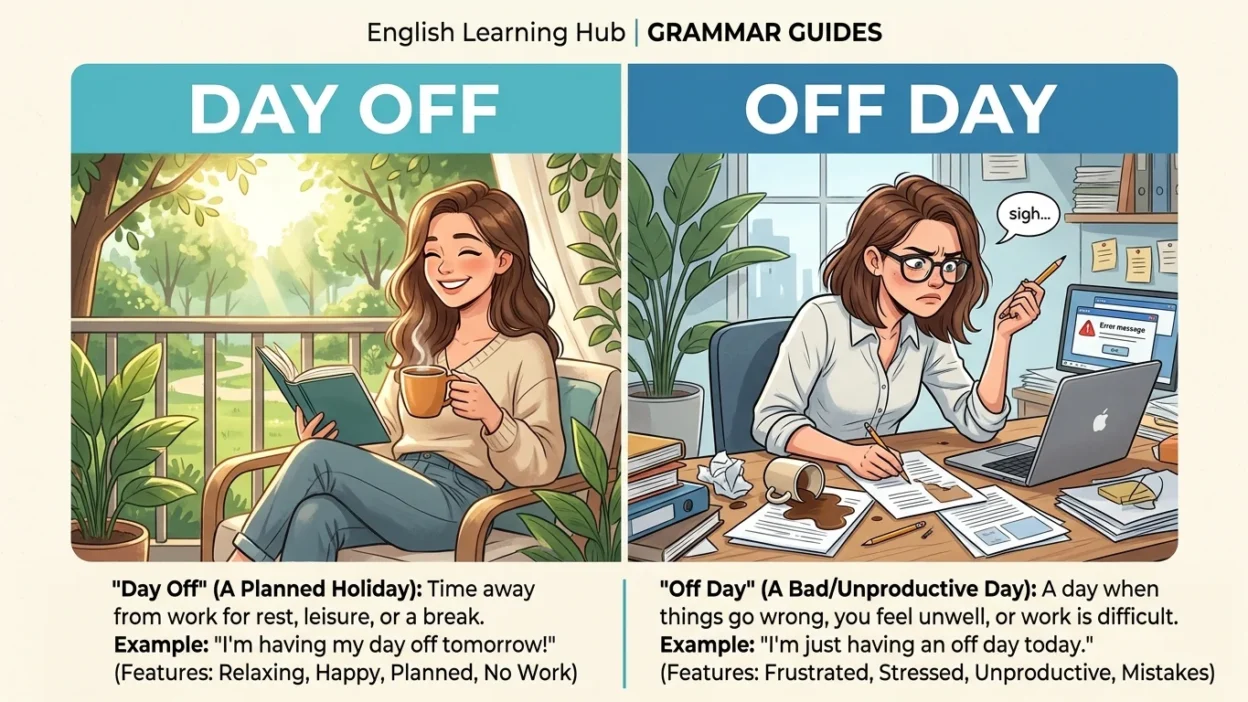
“Day off” and “off day” look almost identical, but they have different meanings in English. This small change in word order can completely change what you are trying to say.
A day off is a day when you do not have to work or attend your usual duties. An off day, on the other hand, usually describes a day when you are not performing well, things are going badly, or you feel less energetic than usual. In some contexts, “off day” can also mean a day when something is not operating or happening as usual.
Understanding the difference is important because these expressions are not interchangeable. In this guide, we will explain day off vs off day, their meanings, grammar, examples, common mistakes, similar expressions, and an easy memory trick to help you remember the difference.
Quick Answer: Day Off vs Off Day
Day off means a day when you are free from work, school, or your usual responsibilities.
Off day usually means a day when you are performing poorly, feeling unusual, or having a bad or difficult day.
For example:
I have a day off tomorrow.
This means you do not have to work tomorrow.
I’m having an off day today.
This means you are not feeling or performing as well as usual.
Easy rule:
Day off = no work.
Off day = not your best day.
Why People Confuse “Day Off” and “Off Day”
The confusion comes from the fact that both expressions contain the same two words.
However, English often changes meaning when words are rearranged.
Compare:
I have a day off.
This refers to time away from work or another regular obligation.
Now compare:
I’m having an off day.
This describes a day that is going poorly or when someone is not at their normal level.
The position of off changes its role and meaning.
Day Off Meaning
A day off is a day when you do not have to work or perform your normal duties.
It is usually a scheduled break from work.
For example:
I have a day off tomorrow.
This means:
I do not have to work tomorrow.
You can also have a day off from school, although day off is especially common when talking about work.
Examples:
Friday is my day off.
She took a day off work.
We have a day off for the holiday.
I’m planning to relax on my day off.
The plural form is days off.
I have two days off next week.
Off Day Meaning
An off day usually describes a day when someone is not performing, feeling, or behaving as well as they normally do.
For example:
I’m having an off day today.
This means that today does not feel like a normal or particularly good day for you.
You might be tired, distracted, frustrated, unmotivated, or simply not performing at your usual level.
For example:
The player was having an off day.
This means the player was performing below their usual standard.
Similarly:
I’m sorry about the mistake. I’m having an off day.
This suggests that the speaker is making more mistakes than usual.
Day Off vs Off Day: Comparison Table
| Expression | Meaning | Example |
|---|---|---|
| Day off | A day away from work or regular duties | I have a day off tomorrow. |
| Off day | A day when you are performing or feeling below normal | I’m having an off day. |
| Days off | More than one free day | I have three days off next week. |
| Off days | Multiple days of poor performance or unusual feelings | Even professional athletes have off days. |
The key difference is simple:
A day off is a break.
An off day is a bad or unusual day.
When to Use “Day Off”
Use day off when you are talking about a scheduled or unscheduled break from work, school, or another regular responsibility.
Talking about work
I have a day off tomorrow.
Monday is my day off.
She took a day off work.
Talking about holidays
We have a day off for the national holiday.
The employees get a day off during the festival.
Talking about relaxation
I’m going to sleep late on my day off.
I usually spend my day off with my family.
Talking about requesting leave
Can I take a day off next Friday?
I need to ask my manager for a day off.
In all these examples, day off refers to time away from normal duties.
Examples of “Day Off”
Here are some natural examples:
- I have a day off tomorrow.
- Friday is my day off.
- She took a day off work.
- I’m going to relax on my day off.
- Can I take a day off next week?
- We have a day off for the holiday.
- He spent his day off watching movies.
- I usually go shopping on my day off.
- My next day off is Monday.
- She has two days off this week.
- I’m looking forward to my day off.
- They gave us an extra day off after the busy season.
When to Use “Off Day”
Use off day when someone is not performing, feeling, or functioning normally.
It is especially common when discussing:
- Sports performance
- Work performance
- Mood
- Energy
- Productivity
- General behavior
For example:
The pitcher had an off day.
This means the pitcher did not perform as well as usual.
You can also use it personally:
I’m having an off day.
This means you are not feeling or functioning at your normal level.
Examples of “Off Day”
- I’m having an off day today.
- The team had an off day yesterday.
- She was unusually quiet because she was having an off day.
- Even the best athletes have an off day sometimes.
- I made several mistakes because I was having an off day.
- The restaurant had an off day, and the service was slower than usual.
- He seems distracted today. Maybe he’s having an off day.
- The singer had an off day during the performance.
- Everyone has an off day from time to time.
- Don’t worry about the mistake. We all have off days.
“Have a Day Off” vs “Have an Off Day”
These two phrases are especially easy to confuse.
Have a day off
I have a day off tomorrow.
This means you are not working tomorrow.
Have an off day
I had an off day yesterday.
This means yesterday was not a good or normal day for you.
Consider this example:
I have a day off today, so I’m staying home.
You are free from work.
But:
I’m having an off day today, so I’m not getting much done.
You may actually be working, but your performance is below normal.
This is one of the clearest ways to understand the difference.
Can “Off Day” Mean a Day Without Work?
Usually, no.
If you want to say that you do not have to work, the natural expression is:
I have a day off.
Do not normally say:
I have an off day.
to mean that you are not scheduled to work.
Instead, say:
I have a day off tomorrow.
However, in some contexts, particularly certain varieties of English or specific workplace contexts, off day may occasionally be used to describe a nonworking day. But day off is the clearest and safest expression when you mean a break from work.
“Day Off” in Questions
You can use day off naturally in questions.
When is your day off?
Do you have a day off tomorrow?
What are you doing on your day off?
Can I take a day off next Friday?
How many days off do you get each month?
These questions are about someone’s free time or schedule.
“Off Day” in Questions
You can also use off day in questions, especially when asking about someone’s performance or mood.
Are you having an off day?
Was that an off day for you?
Why are you having an off day?
Do you ever have off days at work?
These questions usually concern performance, mood, or general well-being rather than someone’s work schedule.
Common Mistakes
Mistake 1: Using “off day” to mean a holiday
Incorrect if you mean that you are not working:
Tomorrow is my off day.
Better:
Tomorrow is my day off.
Mistake 2: Using “day off” to describe poor performance
Incorrect:
The player had a day off during the match.
This normally means the player was taking a break rather than performing badly.
Better:
The player had an off day during the match.
Mistake 3: Confusing “a day off” with “an off day”
Remember the articles:
a day off
but:
an off day
This is because off begins with a vowel sound when it appears first in the second expression.
Mistake 4: Thinking word order does not matter
The expressions have different meanings precisely because the word order changes.
Day off = free from duties.
Off day = below your normal standard.
Day Off vs Day Off From Work
Day off is already commonly understood to mean time away from work, especially in everyday conversation.
For example:
I have a day off tomorrow.
You do not necessarily need to say:
I have a day off from work tomorrow.
Both are correct, but the shorter version is more natural when the context is clear.
You can use day off from work when you want to emphasize the source of the break.
I took a day off from work to attend the appointment.
Day Off vs Holiday
A day off is any day when you are free from your usual work or responsibilities.
A holiday can refer to an official day when businesses, schools, or workplaces are closed, or to a vacation depending on the variety of English.
For example:
Monday is a public holiday, so I have a day off.
Here, the holiday is the reason you have a day off.
However, you can also have a day off that is not a public holiday:
I took a day off work on Thursday.
Off Day vs Bad Day
Off day and bad day are similar, but they are not always identical.
A bad day usually means that unpleasant or difficult things happened.
I had a bad day at work.
An off day often means that you personally were not feeling or performing normally.
I had an off day at work.
The second sentence suggests that your own performance or mood was unusual.
You can have an off day without anything particularly bad happening.
American vs British English
Day off is widely used in both American and British English.
For example:
I have a day off tomorrow.
is natural in both varieties.
Off day is also used in both varieties, particularly when talking about performance or feeling below normal.
For example:
The player was having an off day.
However, workplace terminology can vary somewhat by region and profession. If you want the clearest general expression for a nonworking day, day off is the safest choice.
Similar Expressions
If you mean day off, you can also use:
- Day away from work
- Free day
- Rest day
- Leave day
- Day of leave
However, these expressions are not always exact substitutes.
If you mean off day, alternatives include:
- Bad day
- Rough day
- Difficult day
- Unproductive day
- Poor performance day
- Day when you’re not yourself
Again, the best synonym depends on the context.
Memory Trick
Here is a simple way to remember the difference:
Day OFF
Think:
Your work is OFF.
You are not working.
I have a day off.
OFF day
Think:
Your performance is OFF.
You are not feeling or performing normally.
I’m having an off day.
So remember:
Day off = break from work.
Off day = not your best day.
Which Is Correct: “Day Off” or “Off Day”?
Both are correct expressions, but they are used in different situations.
Use day off when you mean:
A day when you do not have to work.
Use off day when you mean:
A day when you are not performing or feeling as well as usual.
For example:
I have a day off tomorrow.
means you are free tomorrow.
I’m having an off day today.
means today is not going particularly well for you.
Final Verdict
“Day off” and “off day” are both correct, but they do not mean the same thing.
A day off is a break from work, school, or regular responsibilities. It is about your schedule.
An off day is a day when you are feeling, performing, or functioning below your normal level. It is about your condition, mood, or performance.
The easiest rule is:
Day off = no work.
Off day = not your best day.
If you remember that simple distinction, you will know which expression to use in almost every situation.
FAQs
What is the difference between “day off” and “off day”?
A day off is a day when you do not have to work or perform your normal duties. An off day is a day when you are not feeling or performing as well as usual.
Is it correct to say “I have an off day”?
It can be correct when you mean that you are having a day when your mood or performance is below normal. If you mean you are not scheduled to work, say “I have a day off.”
Is “day off” one word?
No. Day off is written as two words.
Is “off day” one word?
No. Off day is also written as two words.
Can “off day” mean a day without work?
Sometimes the expression may be used that way in particular contexts, but day off is the clearest and most widely understood expression for a nonworking day.
What does “I’m having an off day” mean?
It means you are not feeling, performing, or functioning as well as you normally do. You may be tired, distracted, unproductive, or simply not yourself.
What is the plural of “day off”?
The plural is days off.
For example:
I have three days off next week.
What is the plural of “off day”?
The plural is off days.
For example:
Everyone has off days sometimes.
Conclusion
The difference between day off and off day is simple once you focus on the word order. A day off is a free day away from work or regular responsibilities, while an off day is a day when you are not performing or feeling at your usual level.
When talking about your work schedule, use day off. When talking about poor performance, unusual mood, low energy, or a day that simply is not going well, use off day.
Remember This
Day off = a break from work.
I have a day off tomorrow.
Off day = a day when you are not at your best.
I’m having an off day today.
Think:
Day OFF → work is off.
OFF day → you are not at your best.

Daniel Charles is a dedicated author and dream interpretation enthusiast at DrameyHut. He specializes in analyzing dream symbols and meanings, offering clear and insightful content for readers. His work aims to help individuals understand their subconscious thoughts, gain clarity, and explore the deeper messages hidden within their dreams.