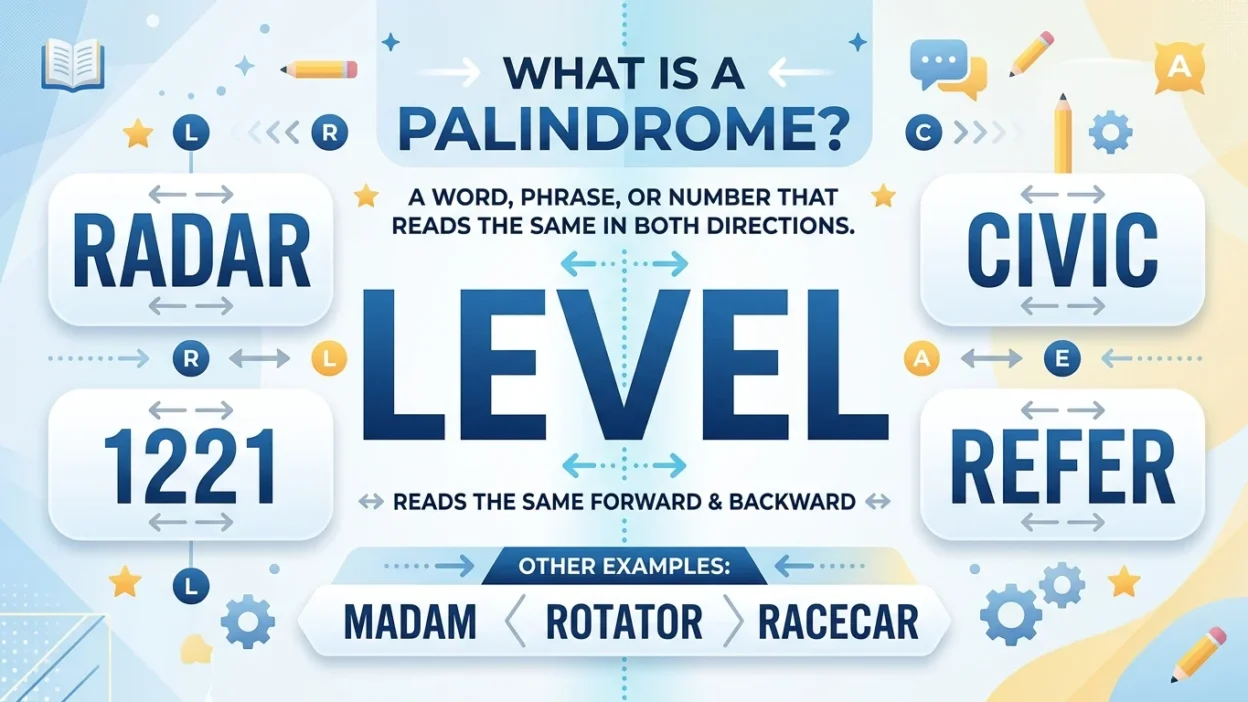
A palindrome is a word, phrase, number, or sequence that reads the same forward and backward, usually when spaces, punctuation, and capitalization are ignored. For example, “level,” “radar,” and “madam” are palindromes because they remain the same when their letters are reversed.
Palindromes can appear in everyday English, mathematics, dates, names, and wordplay. They are interesting because the order of the characters creates a form of symmetry. Once you understand the basic rule, recognizing a palindrome becomes simple: read the word or sequence from left to right, then from right to left. If the meaningful sequence is identical in both directions, it is a palindrome.
Quick Answer
A palindrome is a word, phrase, number, or sequence that reads the same forward and backward. Examples include level, radar, civic, 121, and 1221. In phrases, spaces and punctuation are usually ignored.
What Does Palindrome Mean?
The word palindrome refers to something that has the same sequence when read in reverse order.
For example:
LEVEL
Forward: L E V E L
Backward: L E V E L
Because both directions are identical, level is a palindrome.
The term can apply to much more than individual words. Numbers, phrases, sentences, and even certain biological sequences can be palindromic.
Where Does the Word Palindrome Come From?
The word palindrome comes from Greek roots associated with the idea of running or moving back again.
It was formed from Greek elements meaning roughly “again” and “to run.” The idea fits the concept because the sequence can be read back in the opposite direction and still produce the same result.
Examples of Palindromes
Here are some common one word palindromes:
- level
- radar
- civic
- madam
- refer
- racecar
- rotor
- kayak
- deified
- reviver
- tenet
- noon
For example, racecar reads the same from either direction:
R A C E C A R
Palindrome Phrases
A palindrome can also be a phrase or sentence. In these cases, spaces, punctuation, and capitalization are generally ignored.
For example:
“A man, a plan, a canal, Panama!”
When the spaces and punctuation are removed, the letters form the same sequence in reverse.
Another famous example is:
“Madam, in Eden, I’m Adam.”
These examples are often used as word puzzles because they demonstrate how letters can create symmetrical patterns.
Palindrome Numbers
Numbers can also be palindromes.
Examples include:
121
1331
1441
2002
12321
Take 1331:
Forward: 1 3 3 1
Backward: 1 3 3 1
Therefore, 1331 is a palindrome number.
A number such as 1234 is not a palindrome because reversing it produces 4321.
How to Identify a Palindrome
You can identify a palindrome using a simple three step process:
- Write down the word, phrase, or number.
- Read it from left to right.
- Read it from right to left.
If the sequence is the same in both directions, it is a palindrome.
For phrases, ignore spaces and punctuation when checking the letters.
Example
Consider “level.”
Forward:
level
Backward:
level
Therefore, level is a palindrome.
Now consider “house.”
Forward:
house
Backward:
esuoh
Because the two sequences are different, house is not a palindrome.
Palindrome vs Regular Word
| Feature | Palindrome | Regular word |
|---|---|---|
| Reads the same backward | Yes | Not necessarily |
| Can be a word | Yes | Yes |
| Can be a number | Yes | No |
| Can be a phrase | Yes | Yes |
| Requires symmetrical sequence | Yes | No |
| Example | level | table |
Not every palindrome has to be a common English word. A sequence can be palindromic even when it has no ordinary dictionary meaning.
Palindrome in Mathematics
In mathematics, a palindromic number is a number that remains unchanged when its digits are reversed.
For example:
1221
Reversed:
1221
Therefore, 1221 is a palindromic number.
By contrast:
1235
Reversed:
5321
So 1235 is not palindromic.
Palindrome numbers are often used in mathematical puzzles, programming exercises, and number theory.
Palindrome in Biology
The word palindrome can also have a specialized meaning in biology.
In genetics, a palindromic DNA sequence is a sequence that has a form of symmetry when read in the appropriate directions on complementary DNA strands.
For example, certain restriction enzymes recognize specific palindromic DNA sequences.
This is a technical use of the same basic idea: the sequence has a reversible symmetry.
Common Mistakes About Palindromes
1. Thinking a palindrome must be a word
A palindrome can be a word, phrase, sentence, number, or sequence.
2. Forgetting to ignore spaces in phrases
In a phrase palindrome, spaces generally do not matter.
For example:
A man, a plan, a canal, Panama!
The spaces and punctuation are ignored when checking the letter sequence.
3. Assuming similar spelling is enough
A palindrome must actually read the same backward.
For example, level is a palindrome, but hello is not.
4. Confusing palindrome with an anagram
An anagram rearranges letters to create another word or phrase.
A palindrome preserves the same sequence when read backward.
These are different concepts.
Palindrome vs Anagram
A palindrome depends on symmetry.
An anagram depends on rearrangement.
For example, listen and silent are anagrams because they contain the same letters in a different order.
Level is a palindrome because reversing its letters produces the same sequence.
Memory Trick
Remember:
Palindrome = same backward.
Think of the word level. It looks the same when you read it from either direction.
Another simple memory trick is:
“Palindrome turns around without changing.”
American vs British English
Palindrome is spelled the same in both American and British English.
The meaning is also the same.
For example:
- “Radar is a palindrome.”
- “The number 1221 is palindromic.”
There is no significant American versus British difference in the use of the word.
Similar Words and Terms
Here are some related terms:
Symmetry: A balanced or matching arrangement.
Anagram: A word or phrase formed by rearranging letters.
Mirror word: An informal term sometimes used for something that appears the same when reversed.
Palindromic: The adjective used to describe something that is a palindrome.
For example:
“121 is a palindromic number.”
Final Verdict
A palindrome is a word, phrase, number, or sequence that reads the same forward and backward.
Common examples include level, radar, civic, madam, racecar, and 121. When checking a phrase, spaces and punctuation are usually ignored.
The easiest way to remember the meaning is:
Palindrome = the same when reversed.
Frequently Asked Questions
What is a palindrome in simple words?
A palindrome is something that reads the same forward and backward. Level, radar, and 121 are simple examples.
Is “racecar” a palindrome?
Yes. Racecar is a palindrome because its letters are the same when read from either direction.
Is “hello” a palindrome?
No. Hello becomes olleh when reversed, so it does not read the same backward.
What is a palindrome number?
A palindrome number is a number that remains unchanged when its digits are reversed, such as 121, 1331, or 1221.
Can a sentence be a palindrome?
Yes. Some sentences are designed so their letters read the same forward and backward when spaces and punctuation are ignored.
What is the opposite of a palindrome?
There is no single standard opposite term. A word or sequence that changes when reversed is simply not a palindrome.
What is the adjective form of palindrome?
The adjective is palindromic. For example, “121 is a palindromic number.”
What is the most famous palindrome?
One of the best known English palindrome phrases is “A man, a plan, a canal, Panama!”
Conclusion
A palindrome is a fascinating example of symmetry in language and numbers. It describes something that remains the same when read backward, whether it is a simple word such as level, a number such as 1221, or a longer phrase.
The key idea is easy to remember: read it forward, read it backward, and compare the sequence. If both directions match, you have a palindrome.
Remember This
Palindrome means “the same forward and backward.”
Examples: level, radar, civic, racecar, 121, 1221.

Christopher Thomas is a passionate writer and dream researcher dedicated to exploring the meanings behind dreams. As an author at DrameyHut, he creates insightful and easy-to-understand interpretations that help readers connect with their subconscious mind. His work focuses on guiding individuals toward self-discovery, clarity, and a deeper understanding of their inner thoughts.