
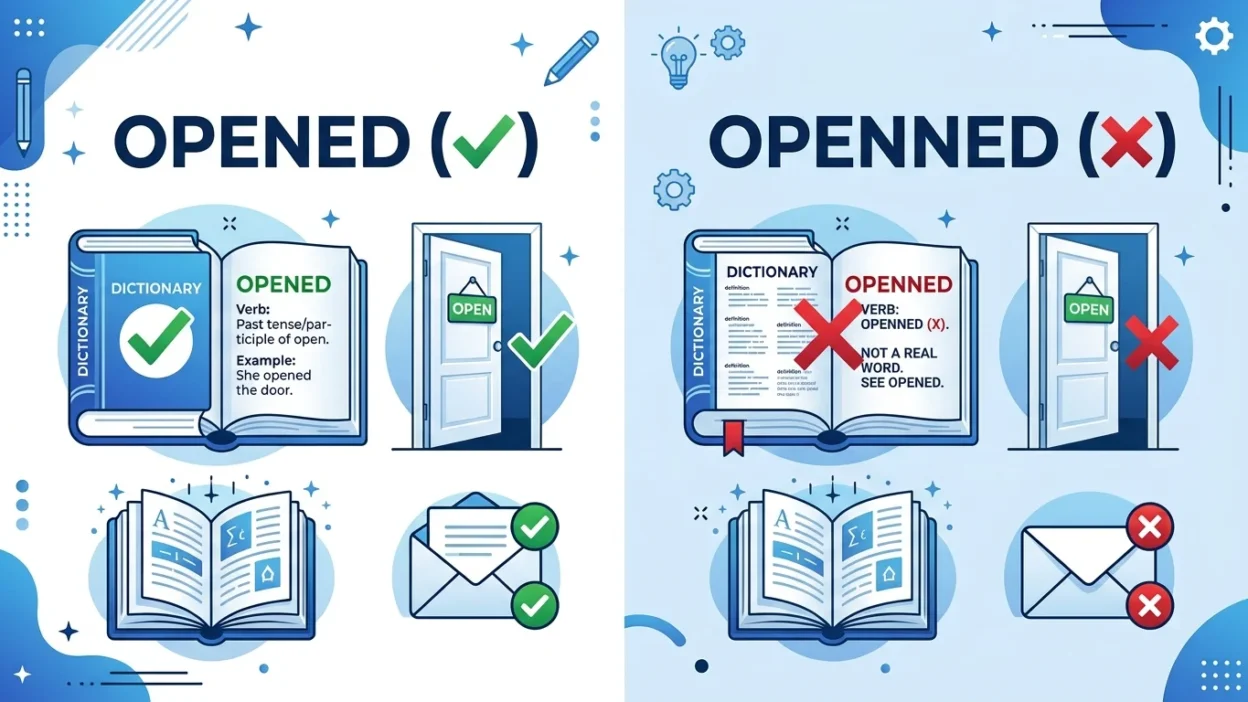
English spelling can sometimes be confusing, especially when adding ed to verbs. One question that often arises is whether the correct past tense of open is opened or openned.
Since some English verbs double their final consonant before adding ed, many learners wonder if open follows the same rule.
The answer is straightforward. Opened is the only correct spelling. Openned is a spelling mistake and is not recognized in standard English. If you’re writing an email, essay, business report, or social media post, using opened ensures your writing is accurate and professional.
This guide explains why opened is correct, why people confuse the spellings, and how to remember the rule.
Quick Answer
Opened is the correct past tense and past participle of open. Openned is an incorrect spelling and should never be used. Whenever you want to describe something that has been opened, always write opened.
Why People Confuse It
Many writers mistakenly spell opened as openned because:
- Some English verbs double the final consonant before adding ed.
- Words like planned, stopped, and preferred follow different spelling rules.
- The pronunciation of opened can make it seem like another n is needed.
- Typing mistakes are common.
The key is knowing when English doubles the final consonant.
First Word: Opened
Opened is the correct past tense and past participle of the verb open.
It means:
- Unlocked
- Uncovered
- Began operating
- Started
- Made accessible
It is used in everyday English, business writing, education, and professional communication.
Example Sentences
- She opened the door.
- The store opened at nine o’clock.
- He opened the package carefully.
- They opened a new restaurant.
- I opened your email this morning.
In every example, opened is the correct spelling.
Second Word: Openned
Openned is not a correct English word.
It is simply a spelling error caused by adding an unnecessary second n.
Incorrect Examples
- She openned the window.
- The museum openned yesterday.
- I openned the document.
Each sentence should use opened instead.
Opened vs Openned Comparison Table
| Feature | Opened | Openned |
| | | |
| Correct Spelling | Yes | No |
| Standard English | Yes | No |
| Dictionary Entry | Yes | No |
| Suitable for Formal Writing | Yes | No |
| Example | He opened the box. | He openned the box. ✘ |
When to Use Each
Use opened whenever referring to:
- Doors
- Windows
- Books
- Businesses
- Files
- Emails
- Conversations
- Opportunities
Never use openned because it is not a valid English spelling.
Examples
Here are several examples showing the correct usage.
- She opened the gift with excitement.
- The bank opened early today.
- I opened the window for fresh air.
- They opened a new office downtown.
- He opened the meeting with a welcome speech.
- The flowers opened in the morning sunlight.
- We opened the website successfully.
- She opened the book to the first page.
- The company opened another branch.
- He opened the email immediately.
- The museum opened to visitors last week.
- I opened the app on my phone.
Common Mistakes
Incorrect:
- I openned the package.
Correct:
- I opened the package.
Incorrect:
- The shop openned yesterday.
Correct:
- The shop opened yesterday.
Incorrect:
- She openned the door slowly.
Correct:
- She opened the door slowly.
Always remove the extra n.
Memory Trick
A simple trick makes this spelling easy to remember.
The verb is open.
Just add ed.
Open + ed = Opened
There is no need to double the n because open does not follow the consonant doubling rule.
American vs British English
Both American English and British English use the same spelling.
The correct form is:
Opened
There are no regional spelling differences.
Openned is incorrect everywhere.
Similar Words
These commonly confused words can also improve your spelling skills.
- Planned and Planed
- Targeted and Targetted
- Reinforce and Reenforce
- Message and Messege
- Performed and Preformed
- Faring and Fairing
- Affect and Effect
- Principal and Principle
- Lose and Loose
- Stationary and Stationery
Learning these word pairs will make your English writing more accurate.
Final Verdict
The answer is simple.
Opened is the correct spelling.
Openned is always incorrect.
Whenever you write about opening something, whether it is a door, business, book, website, or opportunity, always use opened.
Frequently Asked Questions
Is opened or openned correct?
Opened is the correct spelling. Openned is incorrect.
Why isn’t open spelled with two n’s in the past tense?
Because open does not meet the English rule for doubling the final consonant before adding ed.
Is openned a real English word?
No. It is a common spelling mistake and is not recognized in standard English.
Is opened correct in both American and British English?
Yes. Both varieties use opened.
How do you spell opened correctly?
Simply add ed to open.
Open + ed = Opened
Why do people write openned?
Many learners assume all verbs ending with a consonant double the final letter before adding ed, but that rule does not apply to open.
Can spell check detect openned?
Yes. Most spell checkers identify openned as an incorrect spelling and suggest opened.
Remember This
Opened is always correct.
Openned is always incorrect.
Just remember:
Open + ed = Opened
Conclusion
Understanding the difference between opened vs openned is easy once you know the spelling rule. Opened is the only correct past tense and past participle of open, while openned is simply a spelling mistake.
If you’re writing for school, work, or everyday communication, using opened ensures your writing is grammatically correct and professional.
Whenever you’re unsure, remember that open simply takes ed without doubling the final n. This simple rule will help you avoid a common spelling mistake and improve the accuracy of your English writing.

Christopher Thomas is a passionate writer and dream researcher dedicated to exploring the meanings behind dreams. As an author at DrameyHut, he creates insightful and easy-to-understand interpretations that help readers connect with their subconscious mind. His work focuses on guiding individuals toward self-discovery, clarity, and a deeper understanding of their inner thoughts.