
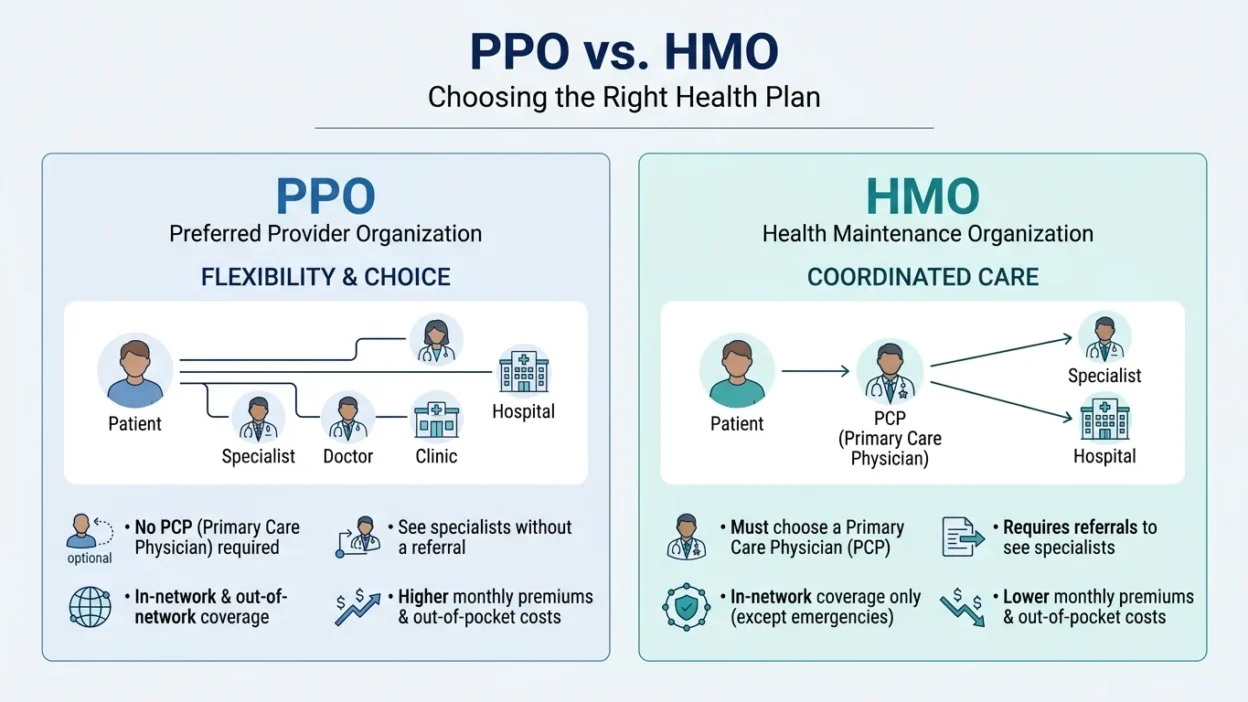
Choosing between a PPO and an HMO health insurance plan can feel confusing, especially when both options offer ways to manage healthcare costs. The main difference comes down to flexibility, provider choice, and how you access medical care. A PPO generally lets you visit a wider range of doctors without a referral, while an HMO usually requires you to use a specific provider network and coordinate care through a primary care physician.
Understanding PPO vs HMO can help you choose a plan that fits your budget, preferred doctors, and healthcare needs. Although an HMO often has lower premiums, a PPO may offer greater freedom to see specialists and receive out of network care. Neither option is automatically better for everyone. The right choice depends on how often you need medical services, whether your doctors are in network, and how much flexibility matters to you.
Quick Answer
A PPO, or Preferred Provider Organization, generally offers more freedom to choose doctors and usually does not require referrals to see specialists. An HMO, or Health Maintenance Organization, typically costs less in premiums but requires you to use its network and often get referrals for specialist care. A PPO may suit people who value flexibility, while an HMO may work well for those seeking lower costs.
Why People Confuse PPO and HMO
PPO and HMO plans are both types of health insurance that help pay for covered medical services. They can both include doctor visits, hospital care, preventive services, and prescription drug coverage, depending on the policy.
The confusion arises because the plan names do not tell you everything about your actual costs or coverage. A low premium does not necessarily mean a plan will be cheaper overall, and a PPO does not guarantee that every doctor or treatment is covered.
Before choosing, compare the plan’s provider network, deductible, copayments, coinsurance, prescription coverage, and annual out of pocket maximum.
What Is a PPO?
A PPO stands for Preferred Provider Organization. It is a health insurance plan that contracts with a network of healthcare providers but generally gives members the option to receive covered care outside that network.
PPO plans typically offer the following features:
- More provider flexibility: You can generally choose from in network doctors without selecting a primary care physician.
- Specialist access: Referrals are usually not required to visit a specialist.
- Out of network options: Covered out of network care may be available, although it generally costs more.
- Potentially higher costs: Monthly premiums and deductibles may be higher than those of comparable HMO plans.
A PPO may be a good fit if you travel frequently, want to keep a particular doctor, or prefer more control over which specialists you see.
However, always check the plan documents. Out of network care may involve higher deductibles, greater coinsurance, or charges that the plan does not cover.
What Is an HMO?
An HMO stands for Health Maintenance Organization. It generally provides healthcare through a defined network of doctors, hospitals, and other medical professionals.
HMO plans commonly include these features:
- Lower premiums: Many HMO plans have lower monthly premiums than comparable PPO plans.
- A primary care physician: You may need to choose a doctor who coordinates your routine care.
- Specialist referrals: Referrals are often required before seeing specialists.
- Limited out of network coverage: Non emergency care outside the network is generally not covered, except in specific circumstances defined by the plan.
An HMO may be a suitable option if your preferred doctors are in network, you are comfortable coordinating care through a primary care physician, and you want to manage your monthly insurance costs.
Emergency care is generally treated differently from routine out of network care. Review your policy for the specific rules that apply.
PPO vs HMO Comparison Table
| Feature | PPO | HMO |
|---|---|---|
| Full form | Preferred Provider Organization | Health Maintenance Organization |
| Monthly premiums | Often higher | Often lower |
| Provider network | Usually offers more flexibility | Usually more restricted |
| Primary care physician | Often optional | Commonly required |
| Specialist referrals | Usually not required | Often required |
| Out of network care | Often covered at a higher cost | Generally not covered except for defined circumstances |
| Deductibles | May be higher | May be lower or absent for some services |
| Best for | People who value provider choice | People who prefer coordinated care and lower premiums |
These are general patterns, not guarantees. Actual benefits and costs vary by insurer, policy, and location.
When to Choose a PPO
A PPO may be the better option if flexibility is a priority.
Consider a PPO if:
- You want to see specialists without getting referrals.
- Your preferred doctor is outside the HMO networks available to you.
- You travel often and want more options for receiving covered care.
- You are willing to pay higher premiums for greater provider choice.
- You want the option of receiving certain covered services outside the network.
For example, imagine you already see a specialist and want to continue treatment without changing doctors. A PPO may make that easier, provided your specialist participates in the plan or the plan offers suitable out of network benefits.
When to Choose an HMO
An HMO may be the better option if keeping healthcare costs manageable is your main priority and you are comfortable with a defined provider network.
Consider an HMO if:
- You want a lower monthly premium.
- Your preferred doctors and hospitals are in network.
- You are comfortable selecting a primary care physician.
- You do not mind getting referrals when required.
- You prefer having one doctor coordinate your care.
For example, if you mainly need preventive checkups and occasional treatment from local doctors who are all in the HMO network, you may find an HMO convenient and cost effective.
PPO vs HMO: Which Is Cheaper?
An HMO often has lower monthly premiums, but the cheapest plan depends on your total healthcare expenses.
Consider these costs when comparing plans:
- Premium: The amount you pay each month for coverage.
- Deductible: The amount you pay for certain covered services before the insurer begins paying according to the plan.
- Copayments: Fixed amounts you pay for covered services.
- Coinsurance: Your share of the cost of a covered service, expressed as a percentage.
- Out of pocket maximum: The annual limit on covered in network cost sharing for essential health benefits under qualifying US marketplace plans. Premiums and some other expenses do not count toward this limit.
A PPO with a higher premium could still make sense if it provides access to doctors you need. An HMO with a lower premium could be more economical if your care stays within the network.
Compare estimated yearly costs rather than looking at the premium alone.
Common Mistakes When Comparing PPO and HMO Plans
Assuming PPO means every doctor is covered: PPO plans still have provider networks, and out of network care can be expensive.
Assuming HMO means no specialist access: HMO members can generally see specialists when they follow the plan’s referral and network requirements.
Choosing based only on monthly premiums: Deductibles, copayments, prescription costs, and expected medical needs also matter.
Ignoring prescription coverage: Two plans may cover different medications or charge different amounts for the same prescription.
Forgetting to check current providers: A doctor who accepts one insurer may not participate in every plan offered by that insurer.
Memory Trick
Remember the letters this way:
PPO means more provider options. HMO means more organized, network based care.
This is a simple guide, not a complete description of every plan. Always read the actual benefits and coverage rules before enrolling.
American vs British English
PPO and HMO are terms used mainly in the United States health insurance system. They are not standard names for equivalent health insurance plans in the United Kingdom.
In the UK, people more commonly discuss NHS care, private medical insurance, and provider networks. The systems differ, so PPO and HMO rules should not be directly applied to British healthcare without checking the relevant policy.
Similar Health Insurance Terms
- EPO: An Exclusive Provider Organization usually covers care within its network, with exceptions such as emergencies. Referrals may not be required.
- POS: A Point of Service plan combines features of HMO and PPO plans. It may require a primary care physician and referrals while offering some out of network benefits.
- HDHP: A High Deductible Health Plan has a higher deductible and may be eligible to pair with a Health Savings Account under applicable US rules. HDHP describes cost sharing rather than the same kind of provider network distinction as PPO and HMO.
Final Verdict
The key difference between PPO and HMO health insurance is flexibility versus a more restricted provider network. A PPO usually provides more freedom to choose doctors and see specialists without referrals, but it may come with higher premiums and out of network costs. An HMO often offers lower premiums and coordinated care, but generally requires you to stay within its network and follow its referral rules.
Choose a PPO if provider flexibility is important enough to justify the cost. Consider an HMO if your doctors are in network and you prefer lower premiums. The best plan is the one that covers the care you need at a total cost you can comfortably afford.
Frequently Asked Questions
Is PPO better than HMO?
Not for everyone. A PPO generally offers more provider flexibility, while an HMO often has lower premiums. Your doctors, budget, and expected healthcare needs determine which is better for you.
Is HMO cheaper than PPO?
HMOs often have lower monthly premiums, but total costs depend on deductibles, copayments, coinsurance, prescription coverage, and your use of healthcare services.
Can you see a specialist with an HMO?
Yes. You can generally see specialists within the plan’s network, but you may need a referral from your primary care physician.
Can you go out of network with a PPO?
Often, yes, for covered services. However, out of network care usually costs more, and some expenses may not be covered. Check the policy before receiving care.
Do PPO plans require a primary care physician?
Usually not. Many PPO plans let members choose doctors directly, although individual policies can have different requirements.
Which plan is better for families?
Either can work. An HMO may suit a family whose preferred doctors are all in network and who want lower premiums. A PPO may be preferable if family members need different specialists or greater provider flexibility.
What is the main difference between PPO and HMO?
The main difference is how you access care. PPO plans generally offer more provider choice and out of network benefits, while HMO plans usually focus on in network care and coordinated treatment.
Remember This
A PPO generally offers more flexibility, while an HMO generally offers a more restricted network and may cost less in premiums. Compare the actual policy details, not just the plan name.
Conclusion
Understanding PPO vs HMO makes it easier to compare health insurance plans based on provider choice, referrals, premiums, and out of pocket costs. PPO coverage may be worth the extra expense if you want greater flexibility. HMO coverage may be a practical option if you are comfortable with a network based system and want to manage your premiums.
Before enrolling, confirm that your doctors, hospitals, and prescriptions are covered, then compare the total expected cost for the year. That approach will help you choose a plan that suits both your healthcare needs and your budget.

Nancy Lisa is a passionate writer and contributor at DrameyHut, focused on uncovering the deeper meanings behind dreams. She creates engaging and insightful content that helps readers interpret their dreams and understand their subconscious thoughts. Her work inspires self-reflection, clarity, and a stronger connection to inner emotions.