Have you ever wondered If to write principal or principle? These two words sound exactly alike, but they have different meanings and uses. Choosing the wrong one can change the meaning of your sentence, especially in school, business, finance, and everyday writing. The good news is that once you understand the difference between principal vs principle, you can easily remember which word to use.
The simplest way to distinguish them is to remember that principal usually means a person in charge, something most important, or an original amount of money, while principle means a rule, belief, or fundamental truth. For example, a school principal manages a school, but a person’s principles guide their behavior.
Although the spelling difference is only one letter, the words serve different purposes. This guide explains their meanings, grammar, common mistakes, and practical examples to help you use both words confidently.
Quick Answer
Principal refers to a person in charge, something of primary importance, or the original amount of a loan or investment. Principle refers to a fundamental rule, belief, law, or standard of behavior. Remember that the principal is your school leader, while your principles are the beliefs that guide your decisions.
Why People Confuse Principal and Principle
Principal and principle are homophones, which means they sound alike but have different spellings and meanings.
Because their pronunciation is identical in standard English, you cannot tell which word someone means simply by hearing it. You must use the context of the sentence.
For example:
- The principal welcomed the students.
- The teacher explained the principle of gravity.
The first sentence refers to a person, while the second refers to a scientific concept. Recognizing the meaning you intend to express is the easiest way to choose the correct spelling.
What Does Principal Mean?
Principal can function as a noun or an adjective. Its meaning depends on how it is used in a sentence.
Principal as a noun
As a noun, principal can refer to a person who manages a school, the original amount of money borrowed or invested, or the leading person or party involved in something.
Examples:
- The principal announced the new school rules.
- I paid part of the principal on my home loan.
- The principal in the agreement signed the document.
Principal as an adjective
As an adjective, principal means main, chief, or most important.
Examples:
- Our principal concern is student safety.
- The principal reason for the delay was bad weather.
- Her principal responsibility is managing the department.
In all these examples, principal identifies a leading person, amount, role, or concern.
What Does Principle Mean?
Principle is a noun that refers to a fundamental belief, rule, standard, or truth. It is commonly used when discussing ethics, science, logic, and personal values.
Examples:
- Honesty is an important principle in leadership.
- The machine operates according to a simple scientific principle.
- She refused to compromise her principles.
- The principle of fairness should guide every decision.
A principle can guide how someone behaves, explain how something works, or describe a rule that applies in a particular situation.
Unlike principal, principle does not refer to a school leader or the original amount of a loan.
Principal vs Principle Comparison Table
| Feature | Principal | Principle |
|---|---|---|
| Part of speech | Noun or adjective | Noun |
| Main meaning | Leader, main, or original amount | Rule, belief, or fundamental truth |
| School example | The principal spoke to the class. | Respect is an important principle. |
| Finance example | The principal balance decreased. | The investment follows a sound principle. |
| Common phrase | Principal reason | Moral principle |
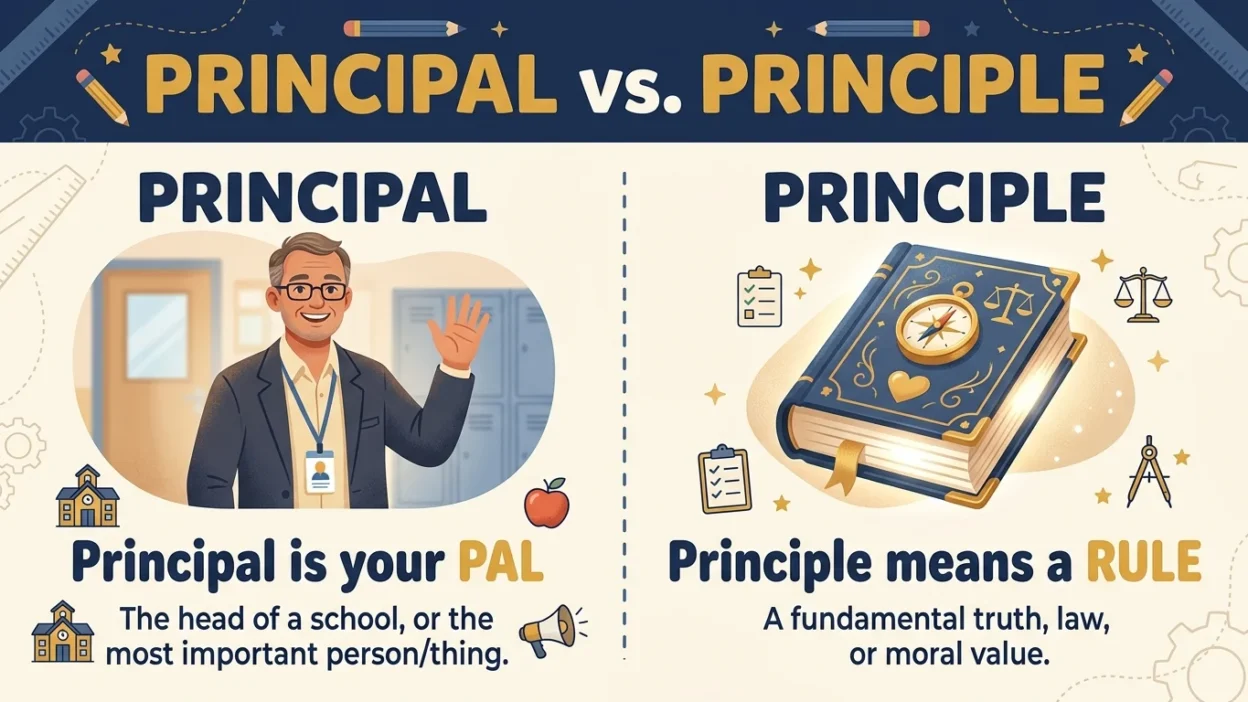
| Memory clue | The principal is your pal | A principle is a rule |
When to Use Principal or Principle
Choosing between these words becomes easier when you identify the meaning of your sentence.
Use principal when referring to a school leader
Use principal when you mean the person responsible for managing a school.
Correct: The principal met with the parents.
Incorrect: The principle met with the parents.
Use principal when something is most important
Use principal as an adjective when describing the main reason, concern, objective, or factor.
Correct: Safety is our principal concern.
Incorrect: Safety is our principle concern.
Use principal when discussing loans
In finance, principal refers to the original amount borrowed or invested, excluding interest.
Correct: She made an extra payment toward the loan principal.
Incorrect: She made an extra payment toward the loan principle.
Use principle when referring to beliefs or values
Use principle when discussing ethical standards, personal beliefs, or rules that guide behavior.
Correct: He follows the principle of honesty.
Incorrect: He follows the principal of honesty.
Use principle when referring to scientific rules
Use principle when discussing a fundamental law, concept, or explanation.
Correct: The experiment demonstrates a basic scientific principle.
Incorrect: The experiment demonstrates a basic scientific principal.
Principal vs Principle: 12 Example Sentences
Here are twelve examples showing how each word works in everyday English.
- The principal greeted every student at the entrance.
- Honesty is a principle I try to follow.
- The principal reason for the cancellation was bad weather.
- The company reduced the principal balance on its loan.
- She refused to lie because it went against her principles.
- Our principal objective is to improve customer service.
- The school principal organized a meeting for parents.
- The scientist explained the principle behind the experiment.
- He borrowed money and began repaying the principal.
- Fairness is a fundamental principle of justice.
- The principal investigator presented the research findings.
- They reached an agreement based on the principle of mutual respect.
Notice that principal appears in references to leaders, importance, and finance. Principle appears in references to beliefs, rules, and fundamental concepts.
Common Mistakes With Principal and Principle
Mistake 1: Writing principle for a school leader
Incorrect: The principle welcomed the new students.
Correct: The principal welcomed the new students.
A school leader is called a principal.
Mistake 2: Using principal for a moral belief
Incorrect: She believes in the principal of equality.
Correct: She believes in the principle of equality.
A belief or standard of behavior is a principle.
Mistake 3: Confusing the main reason with a rule
Incorrect: The principle cause of the problem was poor planning.
Correct: The principal cause of the problem was poor planning.
Here, principal means main or most important.
Mistake 4: Confusing principal with loan interest
Incorrect: Most of the payment went toward the principle.
Correct: Most of the payment went toward the principal.
In financial contexts, principal is the amount borrowed or invested. Interest is the cost of borrowing or the return earned on money.
Memory Trick: Principal vs Principle
The easiest memory trick is:
The principal is your pal.
A school principal is a person, and the word principal contains the word pal.
For principle, remember this phrase:
A principle is a rule.
You can also connect principle with personal values, moral beliefs, and scientific rules.
These simple associations can help you remember the correct spelling without repeatedly checking a dictionary.
American vs British English
There is no meaningful spelling difference between principal and principle in American and British English. Both varieties use the same spellings and basic meanings.
Examples in both varieties:
- The school principal addressed the students.
- Honesty is an important principle.
- The principal amount on the loan has decreased.
The difference is semantic, not regional. You should select the word based on what you mean rather than where your audience lives.
Similar Words to Know
Understanding a few related terms can make the distinction even clearer.
Principle vs rule: A rule is a specific instruction or requirement, while a principle is often a broader belief or fundamental idea.
Principal vs primary: Both can mean main or most important. However, principal also works as a noun for a school leader or a financial amount.
Principal vs principle vs principled: Principal identifies a leader, a main thing, or a financial amount. Principle means a rule or belief. Principled describes someone who acts according to strong moral beliefs.
For example, a principal may make a decision based on a principle, and that decision may be described as principled.
Final Verdict
The difference between principal and principle is straightforward once you focus on meaning. Use principal for a school leader, something most important, or the original amount of a loan or investment. Use principle for a belief, rule, standard, or fundamental truth.
Remember the phrase “the principal is your pal” to help you identify the person, and connect principle with rules and values. With this simple distinction, you can confidently use both words in school assignments, professional emails, financial discussions, and everyday writing.
Frequently Asked Questions
Is it principal or principle?
Both are correct words, but they have different meanings. Principal refers to a leader, something most important, or a financial amount. Principle refers to a rule, belief, or fundamental truth.
Is a school principal spelled principal or principle?
The correct spelling is principal. A principal is the person who leads or manages a school.
Is it principal amount or principle amount?
The correct phrase is principal amount. It refers to the original amount of money borrowed or invested, before interest is added or earned.
What is the difference between principal and principle in a sentence?
Principal can identify a leader or describe something as the main or most important. Principle identifies a rule, belief, or fundamental concept.
Is honesty a principal or a principle?
Honesty is a principle because it is a moral value or standard that guides behavior.
Are principal and principle homophones?
Yes. They are homophones because they sound alike but have different spellings and meanings.
How can I remember principal vs principle?
Remember “the principal is your pal” for a school leader. Think of a principle as a rule or belief that guides your decisions.
Remember This
Principal means a leader, main, or the original amount of money. Principle means a rule, belief, or fundamental truth. The principal is your pal, and a principle is a rule.
Conclusion
Although principal and principle sound alike, they are not interchangeable. Principal is used for school leaders, primary concerns, and financial amounts, while principle refers to beliefs, rules, and fundamental truths. Paying attention to context will help you choose the right word every time.
When in doubt, ask yourself whether you are referring to a person or something important, or whether you mean a belief or rule. That quick check will help you avoid one of English’s most common spelling mistakes.

Daniel Charles is a dedicated author and dream interpretation enthusiast at DrameyHut. He specializes in analyzing dream symbols and meanings, offering clear and insightful content for readers. His work aims to help individuals understand their subconscious thoughts, gain clarity, and explore the deeper messages hidden within their dreams.