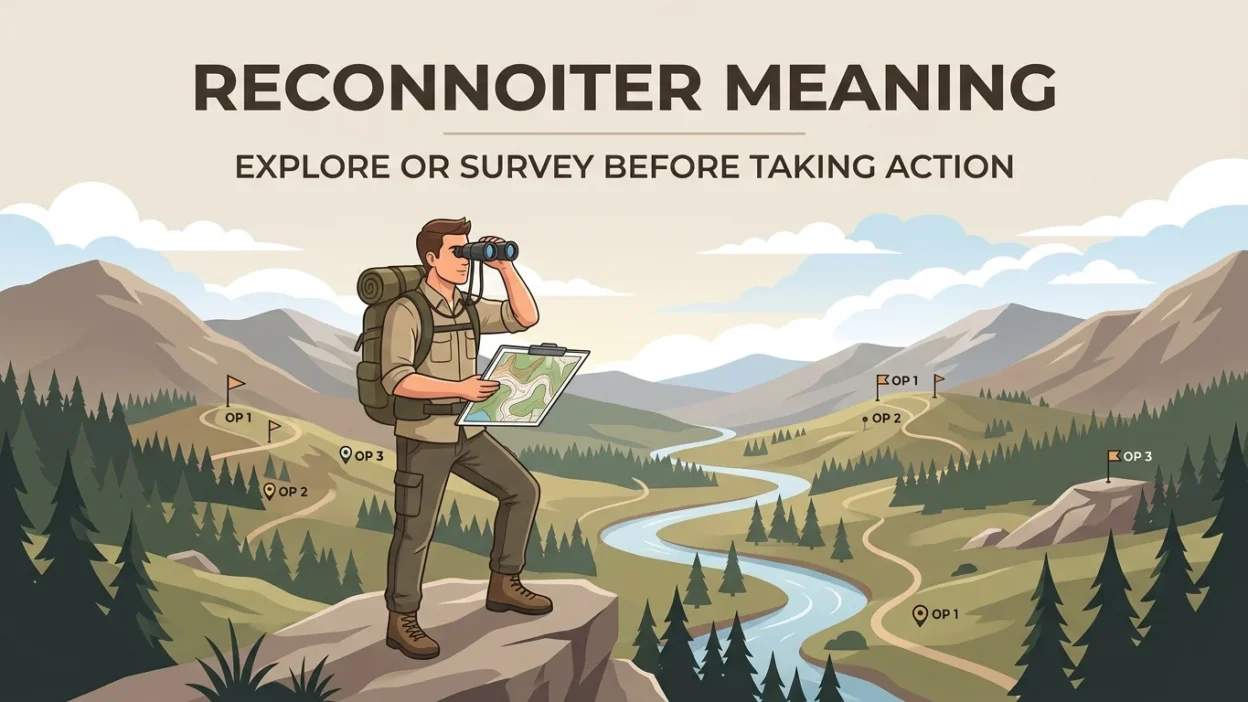
The word reconnoiter is a relatively formal English verb that means to inspect, explore, or survey an area, especially to gather information before taking action. It is often used in military contexts, but it can also be used more broadly when someone examines a place carefully to understand what is there.
For example, if soldiers reconnoiter an area, they investigate the location to learn about the terrain, roads, buildings, possible dangers, or enemy positions. In everyday or figurative English, someone might reconnoiter a new neighborhood before deciding where to live.
Reconnoiter is useful when the idea is not simply looking around, but carefully gathering information for a particular purpose.
Quick Answer: Reconnoiter Meaning
Reconnoiter means to explore or inspect a place carefully to gather information, especially before making a decision or taking action.
Example:
“The soldiers were sent to reconnoiter the area.”
This means they were sent to examine the area and gather useful information.
What Does “Reconnoiter” Mean?
Reconnoiter means to survey, examine, or investigate a place or area, usually to obtain information.
The word is particularly associated with military operations.
For example:
“The scouts reconnoitered the valley before the troops moved forward.”
The scouts examined the valley to understand the terrain and identify possible risks.
However, the word does not have to be used exclusively in military situations.
For example:
“We spent the afternoon reconnoitering the neighborhood before choosing a hotel.”
Here, reconnoitering means carefully exploring the neighborhood.
Reconnoiter Meaning in Simple English
In simple English:
Reconnoiter = look around carefully to gather information.
Imagine that you are visiting an unfamiliar place before deciding what to do next.
You might:
- Examine the roads
- Check the surroundings
- Look for possible problems
- Study the terrain
- Identify useful locations
- Gather information
That process can be described as reconnoitering.
Reconnoiter Pronunciation
Reconnoiter is pronounced approximately like:
rek-uh-NOY-ter
The stress is usually placed on the “noy” syllable.
The word can look intimidating because of its spelling, but its pronunciation becomes easier once you break it into syllables.
Reconnoiter as a Verb
Reconnoiter is primarily used as a verb.
Examples:
“The team reconnoitered the site before beginning the operation.”
“The explorers reconnoitered the coastline.”
“We need to reconnoiter the area before choosing a route.”
The verb can appear in several forms:
- Reconnoiter
- Reconnoiters
- Reconnoitered
- Reconnoitering
For example:
Present: The scouts reconnoiter the area.
Past: The scouts reconnoitered the area.
Continuous: The scouts are reconnoitering the area.
Reconnoiter Examples in Sentences
Here are some natural examples:
- The soldiers were ordered to reconnoiter the area before the operation.
- The scouts reconnoitered the mountain pass.
- The team spent several hours reconnoitering the site.
- We should reconnoiter the route before beginning the hike.
- The explorers reconnoitered the island before establishing camp.
- The pilot flew over the region to reconnoiter the terrain.
- The researchers reconnoitered the location before starting their study.
- The group reconnoitered the neighborhood before renting a house.
- The commander sent a small unit to reconnoiter the road ahead.
- They reconnoitered the area to identify possible obstacles.
Reconnoiter in a Military Context
The word reconnoiter is strongly associated with military reconnaissance.
In military contexts, reconnoitering involves gathering information about an area before an operation.
A reconnaissance team might examine:
- Terrain
- Roads
- Bridges
- Buildings
- Enemy positions
- Potential obstacles
- Defensive positions
- Possible routes
For example:
“The unit was sent to reconnoiter the enemy’s position.”
This means the unit was sent to gather information about the enemy’s location and surroundings.
The purpose is generally to learn before acting.
Reconnoiter in Everyday English
Although the word has a military background, it can be used in ordinary situations.
For example:
“Let’s reconnoiter the area before we decide where to eat.”
This means:
“Let’s explore the area and see what is available before deciding.”
Another example:
“We reconnoitered the city before planning our sightseeing route.”
This means the people explored the city to gather information before making their plans.
However, reconnoiter is relatively formal. In everyday conversation, people are more likely to say:
explore
look around
check out
survey
scout
Reconnoiter vs Explore
These words are similar, but reconnoiter has a more specific purpose.
Explore means to travel around or investigate a place to learn about it.
Reconnoiter means to inspect or survey a place, particularly to gather information that will help with a future action or decision.
Compare:
“We explored the forest.”
This simply means we traveled through it and investigated it.
“We reconnoitered the forest before setting up camp.”
This suggests that we examined the forest specifically to gather information before deciding what to do.
A simple rule:
Explore = investigate a place
Reconnoiter = investigate a place for useful information before acting
Reconnoiter vs Reconnaissance
Reconnoiter and reconnaissance are closely related.
Reconnoiter is a verb.
Reconnaissance is a noun.
For example:
“The soldiers reconnoitered the area.”
Here, reconnoitered is the verb.
“The soldiers conducted reconnaissance of the area.”
Here, reconnaissance is the noun describing the activity.
Think of it this way:
Reconnoiter = to investigate
Reconnaissance = the investigation
Reconnoiter vs Scout
Scout can be both a noun and a verb, and it is often a simpler alternative to reconnoiter.
For example:
“The scouts reconnoitered the area.”
could be expressed more simply as:
“The scouts scouted the area.”
Both communicate the idea of examining a location, but reconnoiter tends to sound more formal and specialized.
Common Mistakes with Reconnoiter
Mistake 1: Thinking It Means Simply “Look”
Reconnoiter involves more than casually looking at something.
It generally suggests careful examination for a purpose.
For example:
“The team reconnoitered the location before beginning the operation.”
The team was gathering information, not merely looking around.
Mistake 2: Using It in Every Situation
Although grammatically correct, reconnoiter can sound overly formal in casual conversation.
Instead of:
“I reconnoitered the supermarket.”
Most people would naturally say:
“I checked out the supermarket.”
or:
“I looked around the supermarket.”
Use reconnoiter when the context involves deliberate investigation, surveying, or preparation.
Mistake 3: Confusing Reconnoiter with Reconnaissance
Remember:
Reconnoiter = verb
Reconnaissance = noun
Correct:
“They reconnoitered the area.”
Correct:
“They conducted reconnaissance.”
Is Reconnoiter a Formal Word?
Yes. Reconnoiter is generally considered a formal or specialized word.
It is especially common in:
- Military writing
- Historical writing
- Journalism
- Adventure literature
- Technical writing
- Formal descriptions of exploration
In casual English, simpler alternatives such as explore, survey, scout, or look around are usually more natural.
Synonyms for Reconnoiter
Depending on the context, synonyms include:
- Explore
- Survey
- Scout
- Inspect
- Examine
- Investigate
- Observe
- Survey the area
- Check out
- Look around
Not every synonym has exactly the same meaning.
For example, explore can simply mean discovering a place, while reconnoiter usually implies gathering information for a specific purpose.
Origin of Reconnoiter
Reconnoiter comes from French reconnaître, meaning to recognize or know again.
The word became associated with military examination of territory and eventually developed its modern English meaning of surveying or examining an area to gather information.
The related English noun reconnaissance comes from the same linguistic family.
American vs British English
Reconnoiter is commonly used in American English.
British English traditionally uses the spelling:
reconnoitre
So you may encounter both:
American English: reconnoiter
British English: reconnoitre
They have the same meaning and essentially the same pronunciation.
The noun reconnaissance is spelled the same in both varieties.
Reconnoiter vs Reconnoitre
These are not different words in meaning. They are different regional spellings.
| Word | Variety | Meaning |
|---|---|---|
| Reconnoiter | American English | To survey or investigate an area |
| Reconnoitre | British English | To survey or investigate an area |
| Reconnaissance | Both | The act of gathering information by surveying an area |
If you are writing for an American audience, reconnoiter is the standard spelling.
If you are following British English conventions, reconnoitre is preferred.
Memory Trick for Reconnoiter
A simple way to remember reconnoiter is:
Reconnoiter = reconnaissance + action
If you are reconnoitering, you are doing reconnaissance.
Think:
Reconnoiter = investigate before you act.
This makes the word easier to remember and helps distinguish it from the simpler verb look.
Final Verdict
Reconnoiter means to carefully examine, explore, or survey an area in order to gather information, especially before taking action.
It is most strongly associated with military reconnaissance, but it can also be used for exploration, planning, and careful investigation in other contexts.
The easiest way to remember it is:
Reconnoiter = investigate an area before acting.
American English uses reconnoiter, while British English commonly uses reconnoitre.
FAQs About Reconnoiter
What does reconnoiter mean in simple words?
Reconnoiter means to explore or inspect an area carefully to gather information.
What is an example of reconnoiter?
“The soldiers reconnoitered the area before moving forward.”
This means they examined the area to gather information before proceeding.
Is reconnoiter a military word?
It is strongly associated with military use, especially when soldiers or scouts survey an area before an operation. However, it can also be used in general exploration and planning.
What is the difference between reconnoiter and reconnaissance?
Reconnoiter is a verb meaning to survey or investigate an area. Reconnaissance is the noun for the activity of gathering information through such investigation.
Is reconnoiter American or British?
Reconnoiter is the common American spelling. British English commonly uses reconnoitre.
What are synonyms for reconnoiter?
Common synonyms include explore, scout, survey, inspect, examine, investigate, and observe.
Is reconnoiter a formal word?
Yes. It is relatively formal and is especially common in military, historical, technical, and literary contexts.
Conclusion
The word reconnoiter means to carefully explore, inspect, or survey an area in order to gather information. It is especially common in military contexts, where a person or team may reconnoiter a location before an operation.
The word can also be used outside the military. Someone might reconnoiter a neighborhood before choosing a place to stay or reconnoiter a hiking route before starting a trip.
Remember the basic idea:
Reconnoiter = investigate an area before taking action.
If you want a simpler everyday alternative, use explore, scout, survey, inspect, or look around, depending on the context.
Remember This
Reconnoiter = carefully examine an area to gather information.
American spelling: reconnoiter
British spelling: reconnoitre
Related noun: reconnaissance
Think:
Reconnoiter before you act.

Christopher Thomas is a passionate writer and dream researcher dedicated to exploring the meanings behind dreams. As an author at DrameyHut, he creates insightful and easy-to-understand interpretations that help readers connect with their subconscious mind. His work focuses on guiding individuals toward self-discovery, clarity, and a deeper understanding of their inner thoughts.