Both “Sorry for bothering you” and “Sorry to bother you” are correct English expressions. They are very similar, but they are normally used in slightly different situations.
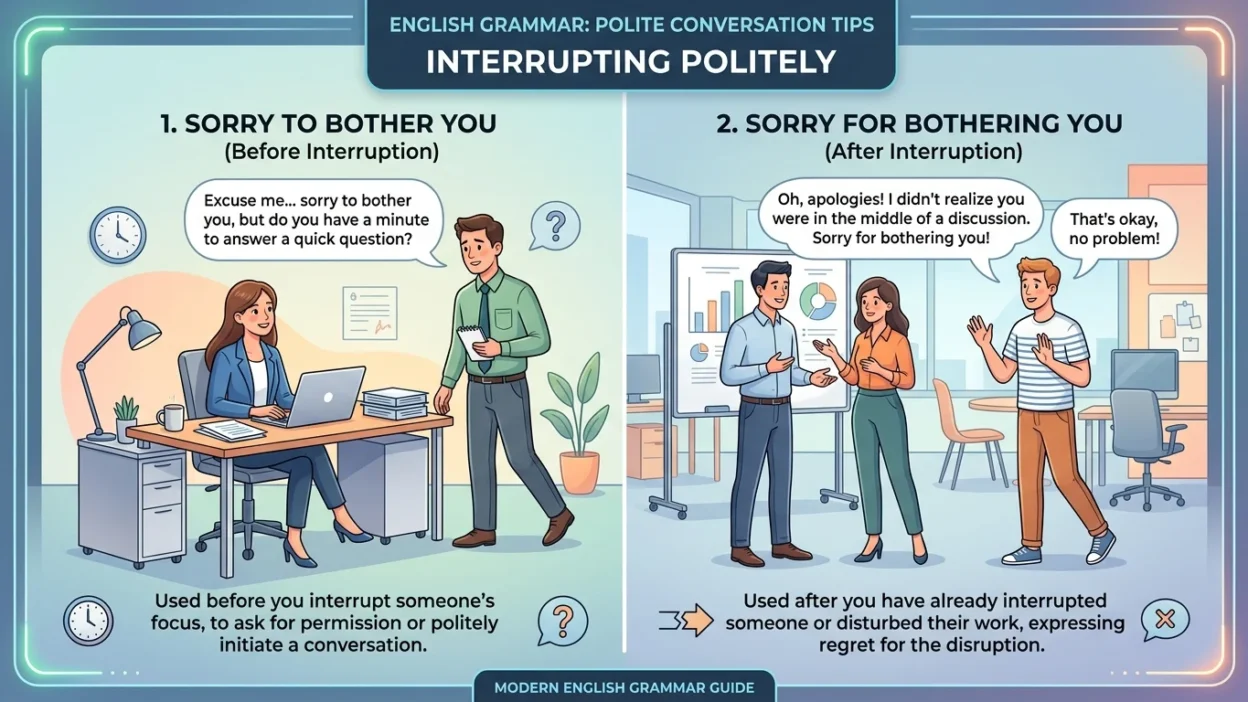
The main difference is timing. “Sorry to bother you” is commonly used when you are about to interrupt or ask someone for something. “Sorry for bothering you” is more often used when you recognize that you have already disturbed or inconvenienced someone.
Quick Answer
“Sorry to bother you” is usually used before or while interrupting someone.
“Sorry for bothering you” is usually used when apologizing for an interruption that has already happened or for repeatedly causing inconvenience.
Both are grammatically correct.
Sorry to Bother You: Meaning and Usage
“Sorry to bother you” is a polite way to apologize before interrupting someone, asking a question, or requesting their attention.
For example:
Sorry to bother you, but could you help me with this?
Here, the speaker is about to ask for help.
It is especially common when you do not want to make someone feel that you are interrupting them unnecessarily.
Examples
- Sorry to bother you, but do you know what time the meeting starts?
- Sorry to bother you, could I ask you a quick question?
- Sorry to bother you while you’re working.
- Sorry to bother you, but I need your signature.
- Sorry to bother you so late at night.
The phrase can also be used when you are already interrupting someone:
Sorry to bother you, but I have an important question.
In this case, the apology happens at the moment of the interruption.
Sorry for Bothering You: Meaning and Usage
“Sorry for bothering you” usually means that you are apologizing because you have already bothered, interrupted, or inconvenienced someone.
The structure is:
sorry for + gerund
So we say:
Sorry for bothering you.
The word “bothering” is a gerund here, functioning after the preposition “for.”
Examples
- Sorry for bothering you earlier.
- I’m sorry for bothering you while you were busy.
- Sorry for bothering you with all these questions.
- I’m sorry for bothering you again.
- Sorry for bothering you so late.
The expression often sounds more reflective because the speaker is apologizing for something that has already happened.
Main Difference
The easiest way to remember the difference is:
| Expression | Typical timing | Meaning |
|---|---|---|
| Sorry to bother you | Before or during an interruption | I apologize for interrupting you |
| Sorry for bothering you | After an interruption or inconvenience | I apologize because I bothered you |
| Sorry to bother you again | Before another request or interruption | I apologize for interrupting you again |
| Sorry for bothering you again | After repeated interruptions | I apologize for having bothered you repeatedly |
“Sorry to Bother You” vs “Sorry for Bothering You” Examples
Consider these situations.
Before asking a question
Sorry to bother you, but could you help me?
This is very natural because the speaker is introducing the interruption.
After asking several questions
I’m sorry for bothering you with so many questions.
This focuses on the fact that the speaker has already asked many questions.
Before interrupting someone at work
Sorry to bother you, but do you have a minute?
This is extremely natural in professional conversation.
After interrupting someone
Sorry for bothering you earlier. I know you were busy.
Here, the interruption has already happened.
Is “Sorry for Bothering You” Grammatically Correct?
Yes. “Sorry for bothering you” is completely grammatical.
After the preposition “for,” English normally uses a noun or gerund.
For example:
- Sorry for calling so late.
- Sorry for interrupting you.
- Sorry for asking so many questions.
- Sorry for bothering you.
We generally do not say:
Sorry for to bother you. ❌
Instead, use:
Sorry to bother you. ✅
or
Sorry for bothering you. ✅
These use two different grammatical structures.
Why Do We Say “Sorry to Bother You”?
The structure “sorry to + verb” is commonly used when expressing regret about an action that is happening or is about to happen.
Examples include:
- Sorry to interrupt.
- Sorry to disturb you.
- Sorry to disappoint you.
- Sorry to keep you waiting.
- Sorry to bother you.
This is why “Sorry to bother you” is especially natural when you are about to make a request.
Why Do We Say “Sorry for Bothering You”?
The structure “sorry for + gerund” focuses more directly on the action that caused the inconvenience.
Examples include:
- Sorry for interrupting.
- Sorry for disturbing you.
- Sorry for calling so late.
- Sorry for bothering you.
- Sorry for keeping you waiting.
It can therefore emphasize the action itself.
Which One Is More Common?
Both expressions are common, but “Sorry to bother you” is especially common when beginning a request.
For example:
Sorry to bother you, but could you tell me where the station is?
This sounds natural because the speaker is politely acknowledging the interruption before asking for help.
“Sorry for bothering you” is also natural, particularly when the speaker is apologizing afterward.
Sorry for bothering you earlier. I didn’t realize you were in a meeting.
Common Mistakes
1. Sorry for to bother you ❌
Do not combine for with the infinitive to bother.
Correct:
Sorry for bothering you. ✅
Or:
Sorry to bother you. ✅
2. Sorry to bothering you ❌
After to in this structure, use the base form of the verb.
Correct:
Sorry to bother you. ✅
Not:
Sorry to bothering you. ❌
3. Sorry for bother you ❌
After the preposition for, use the gerund.
Correct:
Sorry for bothering you. ✅
4. Thinking one expression is wrong
Neither expression is wrong.
The choice depends mainly on the situation and the emphasis you want to give.
A Simple Memory Trick
Remember:
to + verb
for + -ing
So:
Sorry to bother you.
Sorry for bothering you.
For timing, remember:
“To bother” = before or during.
“For bothering” = after the bothering.
This is not an absolute grammatical rule because context can overlap, but it is a very useful guideline.
In Professional English
Both expressions can be polite in professional communication.
For example:
Sorry to bother you, but could you please review this document?
This is appropriate when you are making a request.
Afterward, you could say:
Sorry for bothering you while you were busy.
However, in very formal business writing, you may sometimes avoid apologizing unnecessarily and use a more direct but polite expression:
I hope I’m not interrupting. Could I ask you a quick question?
or:
When you have a moment, could you please take a look at this?
American vs British English
There is no important American versus British English difference between these expressions.
Both “Sorry to bother you” and “Sorry for bothering you” are used in American and British English.
The difference is primarily about grammar, timing, and context, not regional spelling.
Similar Expressions
You can also use:
- Sorry to interrupt.
- Sorry to disturb you.
- Sorry for interrupting.
- Sorry for disturbing you.
- Excuse me for bothering you.
- I apologize for bothering you.
- I hope I’m not disturbing you.
- I hope I’m not interrupting.
The most natural choice depends on the situation and how formal you want to sound.
Final Verdict
“Sorry to bother you” and “Sorry for bothering you” are both correct.
Use “Sorry to bother you” when you are about to interrupt someone or make a request.
Use “Sorry for bothering you” when you are apologizing for an interruption or inconvenience that has already occurred.
The easiest rule:
Before an interruption:
Sorry to bother you.
After an interruption:
Sorry for bothering you.
FAQs
Is “Sorry to bother you” correct?
Yes. “Sorry to bother you” is a natural and polite English expression, especially before asking someone a question or making a request.
Is “Sorry for bothering you” correct?
Yes. “Sorry for bothering you” is also grammatically correct and is commonly used when apologizing for having disturbed or inconvenienced someone.
Is “Sorry to bother you” more polite than “Sorry for bothering you”?
Neither is inherently more polite. “Sorry to bother you” is often more natural before an interruption, while “Sorry for bothering you” often refers to an interruption that has already happened.
Should I say “Sorry to bother you” before asking a question?
Yes. This is one of the most common uses of the expression.
For example:
Sorry to bother you, but could I ask you something?
Is “Sorry for to bother you” correct?
No. Use “Sorry to bother you” or “Sorry for bothering you.”
What is the difference between “sorry to” and “sorry for”?
Sorry to + verb is commonly used to express regret about an action you are about to take or are taking. Sorry for + gerund/noun focuses on the action or situation you are apologizing for.
Conclusion
The difference between “Sorry to bother you” and “Sorry for bothering you” is small but useful.
When you are about to interrupt someone or ask for their attention, “Sorry to bother you” is usually the best choice.
When you are apologizing for having already disturbed someone, “Sorry for bothering you” is often more appropriate.
Both are correct, natural, and polite expressions in everyday English.
Remember This
Sorry to bother you = before or during an interruption.
Sorry for bothering you = apologizing for an interruption or inconvenience.
And remember the grammar:
to + base verb → to bother
for + gerund → for bothering

Christopher Thomas is a passionate writer and dream researcher dedicated to exploring the meanings behind dreams. As an author at DrameyHut, he creates insightful and easy-to-understand interpretations that help readers connect with their subconscious mind. His work focuses on guiding individuals toward self-discovery, clarity, and a deeper understanding of their inner thoughts.