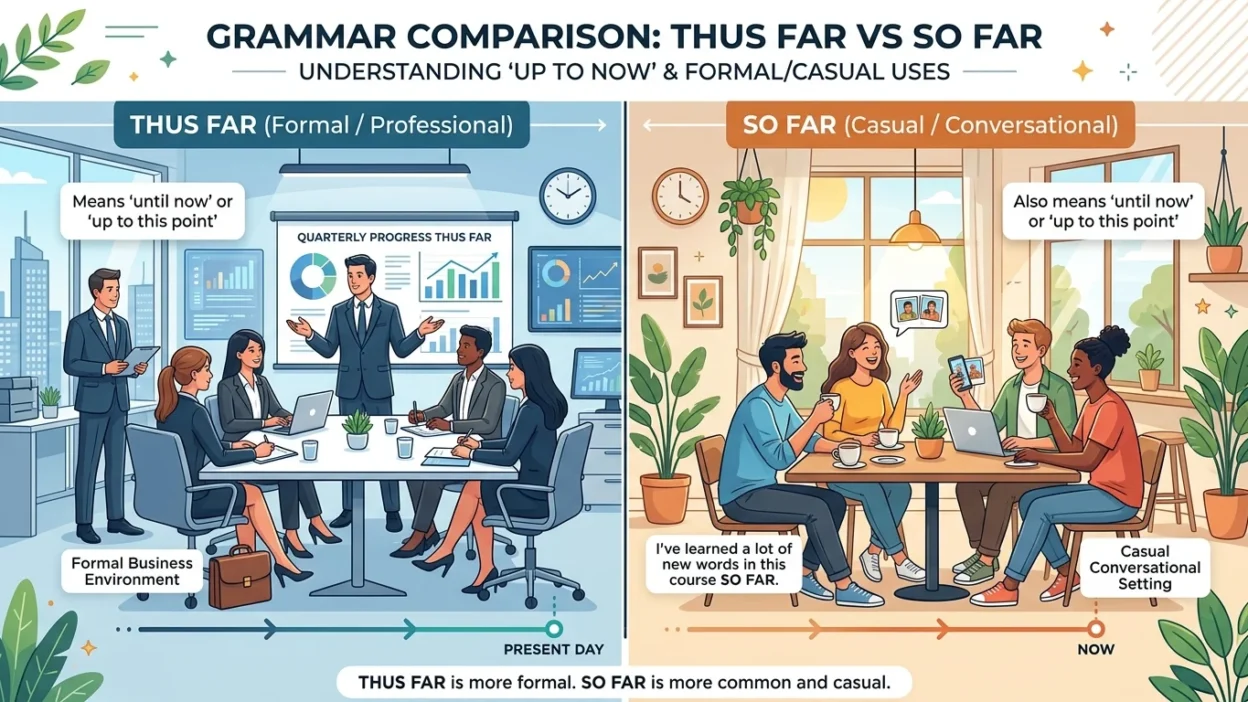
“Thus far” and “so far” are both correct expressions that mean “up to this point” or “until now.” In many sentences, they can be used interchangeably without changing the basic meaning.
The main difference is tone and style. “So far” is much more common in everyday English and sounds natural and conversational. “Thus far” is more formal and is more likely to appear in academic writing, reports, journalism, formal speeches, and professional contexts.
Understanding the difference can help you choose the expression that fits your situation. If you are talking casually about your experience, “so far” is usually the better choice. If you are writing a formal report or emphasizing the results achieved up to a particular point, “thus far” may sound more appropriate.
Quick Answer
Thus far and so far both mean “up to now” or “until this point.” The difference is mainly in register. So far is common and conversational, while thus far is more formal and sometimes more literary. In most contexts, either expression can be grammatically correct.
Why People Confuse It
People often confuse “thus far” and “so far” because they frequently communicate exactly the same idea.
For example:
We have received ten applications so far.
and
We have received ten applications thus far.
Both mean that ten applications have been received up to the present point.
The difference is not usually meaning. It is primarily style, tone, and frequency of use.
The word “thus” itself is relatively formal and can mean “in this way,” “therefore,” or “to this extent.” In the expression “thus far,” however, it means approximately “up to this point.”
Thus Far
Thus far means up to this point, until now, or so far.
It is grammatically correct and tends to sound more formal than “so far.”
Examples
- Thus far, the project has been successful.
- We have found no evidence of misconduct thus far.
- Thus far, the results have been encouraging.
- The company has hired fifty employees thus far.
- Thus far, nobody has volunteered.
- She has performed exceptionally well thus far.
- The investigation has revealed several important facts thus far.
The expression is particularly suitable for formal or analytical writing.
Thus Far in Academic Writing
You may see “thus far” in research papers, academic discussions, and formal reports.
For example:
Research conducted thus far suggests that the treatment may be effective.
This sounds formal and objective.
In everyday conversation, most people would probably say:
Research so far suggests that the treatment may be effective.
Both versions are correct.
So Far
So far also means up to this point, until now, or up to the present time.
It is much more common in everyday English.
Examples
- So far, everything is going well.
- I’ve read three chapters so far.
- So far, I like the new job.
- We haven’t received an answer so far.
- How is your new car working so far?
- So far, nobody has complained.
- The movie is great so far.
Because it is natural and widely used, “so far” is generally the safest choice in ordinary conversation.
Comparison Table
| Expression | Meaning | Tone | Common Use |
|---|---|---|---|
| So far | Up to now | Neutral and conversational | Everyday speech and writing |
| Thus far | Up to now | Formal | Academic, professional, literary, and formal writing |
| Until now | Up to the present | Neutral | General English |
| To date | Up to the present date | Formal | Reports, business, statistics |
| As yet | Up to this time | Formal | Often used with negatives |
Thus Far vs So Far: Key Difference
The most important distinction is register.
So far
So far is neutral and natural.
So far, the trip has been amazing.
This sounds completely normal in conversation.
Thus far
Thus far sounds more formal.
Thus far, the project has met all of its objectives.
This would fit naturally in a business report or formal presentation.
You could replace thus far with so far:
So far, the project has met all of its objectives.
The meaning remains essentially the same, but the tone becomes less formal.
When to Use Each
Use “so far” in everyday conversation
Choose so far when speaking with friends, coworkers, family members, or acquaintances.
How’s your new job going so far?
So far, it’s going really well.
This sounds natural and relaxed.
Use “thus far” in formal writing
Thus far can work well in academic, professional, legal, or analytical contexts.
The evidence collected thus far supports the original hypothesis.
It gives the sentence a more formal tone.
Use “so far” for a casual tone
If you are writing an email or message that does not require a formal style, so far is usually preferable.
We’ve completed five tasks so far.
Use “thus far” for emphasis or formality
If you want to emphasize the progress or evidence available up to this point, “thus far” can be effective.
The evidence presented thus far strongly supports the argument.
Examples: Thus Far vs So Far
Here are examples showing how the two expressions can often be exchanged.
Example 1
So far, the plan has worked.
Thus far, the plan has worked.
Both mean the plan has worked up to this point.
Example 2
We have received 100 responses so far.
We have received 100 responses thus far.
The second sentence sounds more formal.
Example 3
So far, I haven’t seen anything unusual.
Thus far, I haven’t seen anything unusual.
Both are grammatical, but the second sounds more formal.
Example 4
The experiment has produced promising results so far.
The experiment has produced promising results thus far.
Both are correct.
Example 5
How are you enjoying the course so far?
“Thus far” is possible grammatically, but “so far” sounds much more natural in this conversational question.
Common Mistakes
1. Thinking “thus far” is incorrect
It is not incorrect.
Thus far is a standard English expression meaning up to now.
2. Thinking “so far” is too informal for all writing
“So far” is not incorrect or unprofessional.
It can be perfectly appropriate in professional and academic writing when the tone is not excessively formal.
3. Using “thus far” in every situation
Although correct, thus far can sound unnecessarily formal in casual conversation.
For example:
How has your vacation been thus far?
This is grammatically fine, but:
How has your vacation been so far?
sounds more natural in ordinary conversation.
4. Confusing “thus far” with “therefore”
“Thus” can mean “therefore” in other contexts, but “thus far” has a different meaning.
Thus, we decided to leave.
Here, “thus” means approximately therefore.
Thus far, everything has been successful.
Here, “thus far” means up to this point.
Is “Thus Far” More Formal Than “So Far”?
Yes.
This is the clearest practical difference.
So far is neutral and very common.
Thus far is more formal and less common in casual speech.
Think of the difference like this:
so far → everyday English
thus far → formal English
However, “thus far” is not exclusively formal. You can encounter it in ordinary writing and speech, especially when someone deliberately wants a more polished or formal tone.
Thus Far vs Until Now
“Until now” can also mean up to the present point, but there can be a slight difference in emphasis.
I’ve enjoyed the course so far.
This simply describes your experience up to now.
Until now, I had never considered that possibility.
Here, “until now” emphasizes a change or contrast between the past and the present.
Thus, so far and thus far are especially common for describing progress or an ongoing situation.
Thus Far vs To Date
To date is another formal alternative.
The company has raised $2 million so far.
The company has raised $2 million thus far.
The company has raised $2 million to date.
All three can mean that the amount has been reached up to the present time.
However, to date is particularly common in business, financial, statistical, and official writing.
American vs British English
There is no significant American versus British English difference here.
So far and thus far are used in both American and British English.
The main distinction is register, not geography.
American and British speakers generally understand both expressions without difficulty.
Similar Expressions
Depending on the context, you can use:
- Up to now
- Until now
- Up to this point
- To date
- So far
- Thus far
- As of now
- As yet
These expressions are not always perfect substitutes because their grammar and emphasis can differ.
For example:
So far, we’ve had no problems.
is very natural.
To date, we’ve had no problems.
sounds more formal.
Until now, we’ve had no problems.
can suggest that the situation has changed or is about to change.
Memory Trick
Remember:
SO FAR = simple and everyday.
THUS FAR = formal and polished.
If you’re speaking casually and are unsure which one to choose, “so far” is usually the safest option.
If you’re writing a formal report and want a more elevated expression, “thus far” can be a good choice.
Final Verdict
Thus far and so far are both correct and generally mean “up to now” or “until this point.”
The biggest difference is their tone.
So far is more common, natural, and conversational.
Thus far is more formal and is often used in academic, professional, analytical, or literary contexts.
For everyday English, choose so far. For formal writing, thus far may be a better stylistic choice.
FAQs
Is “thus far” the same as “so far”?
Yes. In most contexts, both expressions mean “up to now” or “until this point.” The main difference is that “thus far” is more formal.
Is “so far” grammatically correct?
Yes. “So far” is a completely standard English expression and is extremely common in everyday speech and writing.
Is “thus far” formal?
Yes. “Thus far” generally has a more formal or literary tone than “so far.”
Can I use “thus far” in everyday conversation?
Yes, but it may sound more formal than necessary. In casual conversation, “so far” usually sounds more natural.
Which is better: “thus far” or “so far”?
Neither is universally better. “So far” is usually better for everyday English, while “thus far” can be better for formal or academic writing.
Can “thus far” and “so far” be used interchangeably?
Often, yes. For example, “The results have been positive so far” and “The results have been positive thus far” have essentially the same meaning.
What is a formal alternative to “so far”?
Thus far and to date are both common formal alternatives to “so far.”
Does “thus far” mean “therefore”?
Not in the expression “thus far.” Here, it means “up to this point.” The word “thus” can mean “therefore” in other contexts.
Conclusion
The expressions “thus far” and “so far” are both correct ways to talk about something that has happened or continued up to the present point.
The easiest distinction is one of style. “So far” is the everyday choice and sounds natural in conversations, emails, and general writing. “Thus far” carries a more formal tone and works especially well in academic, professional, analytical, and formal contexts.
When in doubt, use “so far.” It is natural, clear, and widely accepted. Choose “thus far” when the context calls for a more formal or polished style.
Remember This
So far = up to now, everyday and natural.
Thus far = up to now, but more formal.
Example:
So far, everything is going well.
Thus far, everything is going well.
Both are correct. The second simply sounds more formal.

Christopher Thomas is a passionate writer and dream researcher dedicated to exploring the meanings behind dreams. As an author at DrameyHut, he creates insightful and easy-to-understand interpretations that help readers connect with their subconscious mind. His work focuses on guiding individuals toward self-discovery, clarity, and a deeper understanding of their inner thoughts.