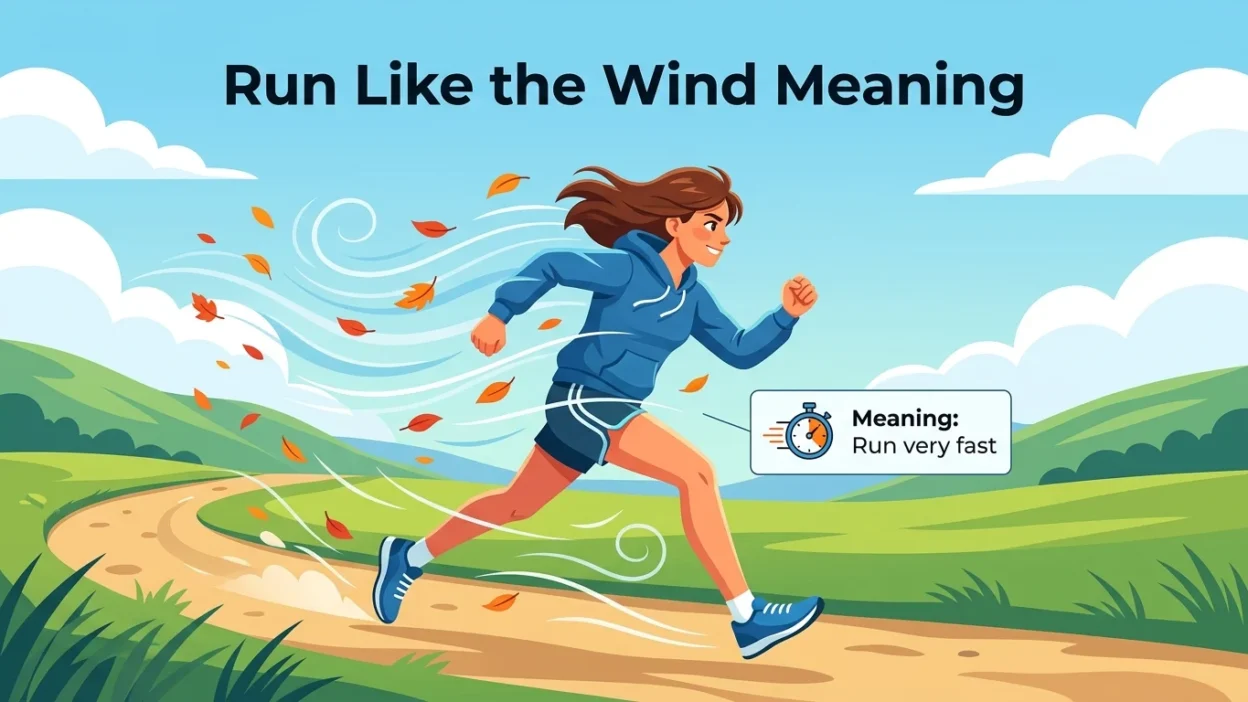
The phrase “run like the wind” is a colorful English expression that means to run very fast. When someone tells you to “run like the wind,” they are encouraging you to run as quickly as possible. The phrase compares a person’s speed to the wind, which can move rapidly and freely.
For example, if someone says, “Run like the wind!”, they are not suggesting that you literally run like the wind. It is a figurative expression used to emphasize great speed. It can be used seriously, humorously, or dramatically depending on the situation.
You may hear this phrase in everyday conversations, stories, movies, sports situations, and conversations with children. Understanding this idiom is useful because its meaning cannot be understood completely by taking the words literally.
Quick Answer
“Run like the wind” means to run very fast or as quickly as possible. It is an informal, vivid expression that compares a person’s speed to the speed of the wind. For example, “Run like the wind!” means “Run as fast as you can!”
Why People Confuse It
The phrase can confuse English learners because wind does not literally run.
Run like the wind!
If you interpret every word literally, the sentence does not make much sense.
The phrase uses a simile, comparing the speed of running with the speed of moving wind.
The intended meaning is:
Run very quickly.
For example:
The dog escaped from the yard, so we ran like the wind after it.
This means:
We ran extremely fast after the dog.
The expression is about speed, not about literally behaving like wind.
What Does “Run Like the Wind” Mean?
“Run like the wind” means to run extremely fast.
It can mean:
- Run very quickly
- Run as fast as possible
- Hurry away quickly
- Move at great speed
The phrase can be used as a command:
Run like the wind!
It can also describe something that already happened:
She ran like the wind when she heard the alarm.
Or it can describe someone’s ability:
That athlete can run like the wind.
In every case, the central idea is great speed.
Is “Run Like the Wind” an Idiom?
Yes. “Run like the wind” is an idiomatic expression and simile.
It contains the comparison word “like”, which makes it a simile.
The phrase compares running speed with the movement of wind.
Similar English expressions include:
- Run like lightning
- Fast as lightning
- Like a rocket
- At lightning speed
- Run for your life
“Run like the wind” is especially vivid because wind is associated with speed, freedom, and movement.
Examples of “Run Like the Wind”
Here are some natural examples:
- Run like the wind! The bus is about to leave.
- When the dog started chasing him, he ran like the wind.
- She ran like the wind to catch the train.
- If you want to win the race, you have to run like the wind.
- The children ran like the wind across the field.
- He ran like the wind when he realized he was late.
- Run like the wind and get help!
- The athlete ran like the wind toward the finish line.
- We ran like the wind when the rain started.
- He can run like the wind when he really wants to.
- The horse ran like the wind across the open field.
- She grabbed her bag and ran like the wind.
“Run Like the Wind” in a Sentence
The expression can appear in different sentence structures.
As a command
Run like the wind!
This means:
Run as fast as you can!
In the past tense
He ran like the wind.
This means:
He ran extremely fast.
With “can”
She can run like the wind.
This means:
She can run very quickly.
With “was”
He was running like the wind.
This emphasizes that he was running extremely fast at that time.
“Run Like the Wind” vs “Run Fast”
These expressions have the same basic meaning, but their style is different.
| Expression | Meaning | Tone |
|---|---|---|
| Run like the wind | Run very fast | Vivid, informal |
| Run fast | Run quickly | Neutral |
| Run quickly | Move quickly on foot | Neutral |
| Run as fast as you can | Run at maximum speed | Direct |
| Sprint | Run at very high speed | More specific |
| Hurry | Move quickly | General |
“Run like the wind” is more colorful than simply saying “run fast.”
For example:
Run fast!
is straightforward.
Run like the wind!
sounds more dramatic, energetic, or playful.
When to Use “Run Like the Wind”
To encourage someone to run quickly
Run like the wind! We’re going to miss the train.
To describe someone running very fast
He ran like the wind toward the finish line.
In a humorous situation
I saw my old teacher at the supermarket and ran like the wind in the opposite direction.
In storytelling
Hearing the noise behind her, she ran like the wind.
With children
Come on, run like the wind!
The phrase is especially natural in casual speech and storytelling.
Literal vs Figurative Meaning
The phrase is normally figurative.
Literal interpretation
The wind moves quickly.
Figurative expression
She ran like the wind.
The second sentence does not mean that she became wind. It means that she moved very quickly.
This is an example of figurative language because one thing is compared with another to create a vivid mental image.
The Meaning of “Like the Wind”
The important part of the phrase is the comparison:
like the wind
Wind can move quickly and strongly, so comparing a runner to the wind emphasizes speed.
For example:
He ran like the wind.
creates a stronger image than:
He ran quickly.
The first sentence makes the reader imagine someone moving with the speed and force of the wind.
Common Mistakes
Mistake 1: Taking the expression literally
“Run like the wind” does not mean that a person should imitate the physical behavior of wind.
It means:
Run very fast.
Mistake 2: Thinking “run” must always mean escape
The expression can describe any fast running.
She ran like the wind to win the race.
There is no need for danger or escape.
Mistake 3: Assuming it is only used as a command
It can be used in many ways.
He ran like the wind.
She can run like the wind.
They were running like the wind.
Mistake 4: Using it in highly formal writing
The phrase is informal and figurative.
In a scientific or formal report, you would normally write:
The athlete ran at a very high speed.
rather than:
The athlete ran like the wind.
Is “Run Like the Wind” Positive or Negative?
The expression itself is generally neutral or positive, but its context can change the tone.
For example:
Run like the wind and win the race!
This is encouraging and positive.
But:
When he saw the angry dog, he ran like the wind.
Here, it describes a quick escape from danger.
It can also be humorous:
I saw the bill and ran like the wind.
The speaker is joking about wanting to escape from an expensive bill.
Run Like the Wind vs Run for Your Life
These expressions are related but not identical.
Run like the wind focuses primarily on speed.
Run like the wind!
means:
Run very fast.
Run for your life focuses on danger or urgency.
Run for your life!
means:
Run as fast as possible because you may be in danger.
Someone can run like the wind without being in danger.
Run Like the Wind vs Run Like Lightning
Both expressions describe very fast movement.
He ran like the wind.
He ran like lightning.
Both suggest that he ran extremely quickly.
However, “run like the wind” is a well-established and common expression, while “run like lightning” is a more general comparison.
American vs British English
“Run like the wind” is understood in both American and British English.
There is no significant difference in meaning between the two varieties.
The expression is informal and can appear in everyday conversation, children’s stories, sports contexts, and humorous situations.
For example:
Run like the wind!
is natural in both American and British English.
Memory Trick
Think about the speed of the wind.
Wind moves quickly → run like the wind → run very fast.
A simple memory sentence is:
Run like the wind = Run as fast as possible.
You can remember it as:
Wind = fast
Run like the wind = run fast
Similar Expressions
Several expressions can communicate a similar idea.
Run as fast as you can
Run as fast as you can!
This is direct and literal.
Run for your life
Run for your life!
This suggests danger or extreme urgency.
Sprint
He sprinted toward the finish line.
“Sprint” means to run at very high speed for a relatively short distance.
At full speed
The horse ran at full speed.
This emphasizes maximum speed.
Like lightning
She moved like lightning.
This means extremely quickly.
At lightning speed
The car disappeared at lightning speed.
This emphasizes very high speed.
Is “Run Like the Wind” a Compliment?
It can be, depending on context.
If you say:
You run like the wind!
you may be praising someone’s speed.
However, if you say:
He ran like the wind away from the scene.
you are simply describing how quickly he ran.
So the expression itself does not necessarily praise someone. Context determines the speaker’s intention.
Final Verdict
“Run like the wind” means to run very fast or as quickly as possible. It is a vivid, informal expression that compares a person’s running speed to the speed of the wind.
You can use it as an encouragement:
Run like the wind!
or as a description:
She ran like the wind.
The phrase is usually figurative rather than literal and can be used in sports, storytelling, casual conversation, humorous situations, and everyday English.
The easiest rule to remember is:
Run like the wind = Run very fast.
FAQs
What does “run like the wind” mean?
“Run like the wind” means to run very fast or as quickly as possible. It is an informal figurative expression.
Is “run like the wind” an idiom?
Yes. It is an idiomatic expression and simile that compares someone’s running speed with the speed of the wind.
What does “run like the wind” mean in simple words?
It simply means “run very fast.”
Is “run like the wind” a compliment?
It can be, especially when praising someone’s speed, but it can also simply describe fast running. The context determines the tone.
Can I say “he ran like the wind”?
Yes. This is a natural use of the expression.
He ran like the wind to catch the bus.
It means he ran very quickly.
Is “run like the wind” formal?
No. It is an informal and colorful expression. It is better suited to conversation, storytelling, and casual writing than highly formal or academic writing.
What is another way to say “run like the wind”?
You can say “run very fast,” “run as fast as you can,” “sprint,” “run at full speed,” or, when danger is involved, “run for your life.”
What is the opposite of “run like the wind”?
Possible opposites include “walk slowly,” “move slowly,” “take your time,” or “go at a leisurely pace.” The best choice depends on the context.
Conclusion
The phrase “run like the wind” is a colorful way to say “run very fast.” It uses the wind as a comparison because wind can move quickly and powerfully. The expression creates a vivid image of someone moving at great speed.
You can use “run like the wind” as a command, a description, or a humorous expression. It is common in casual English and is understood in both American and British English.
Remember This
Run like the wind = Run very fast.
When someone says:
“Run like the wind!”
they are telling you:
“Run as fast as you can!”
The phrase is figurative, informal, and often energetic or humorous, so use it when you want your English to sound more vivid.

Christopher Thomas is a passionate writer and dream researcher dedicated to exploring the meanings behind dreams. As an author at DrameyHut, he creates insightful and easy-to-understand interpretations that help readers connect with their subconscious mind. His work focuses on guiding individuals toward self-discovery, clarity, and a deeper understanding of their inner thoughts.