
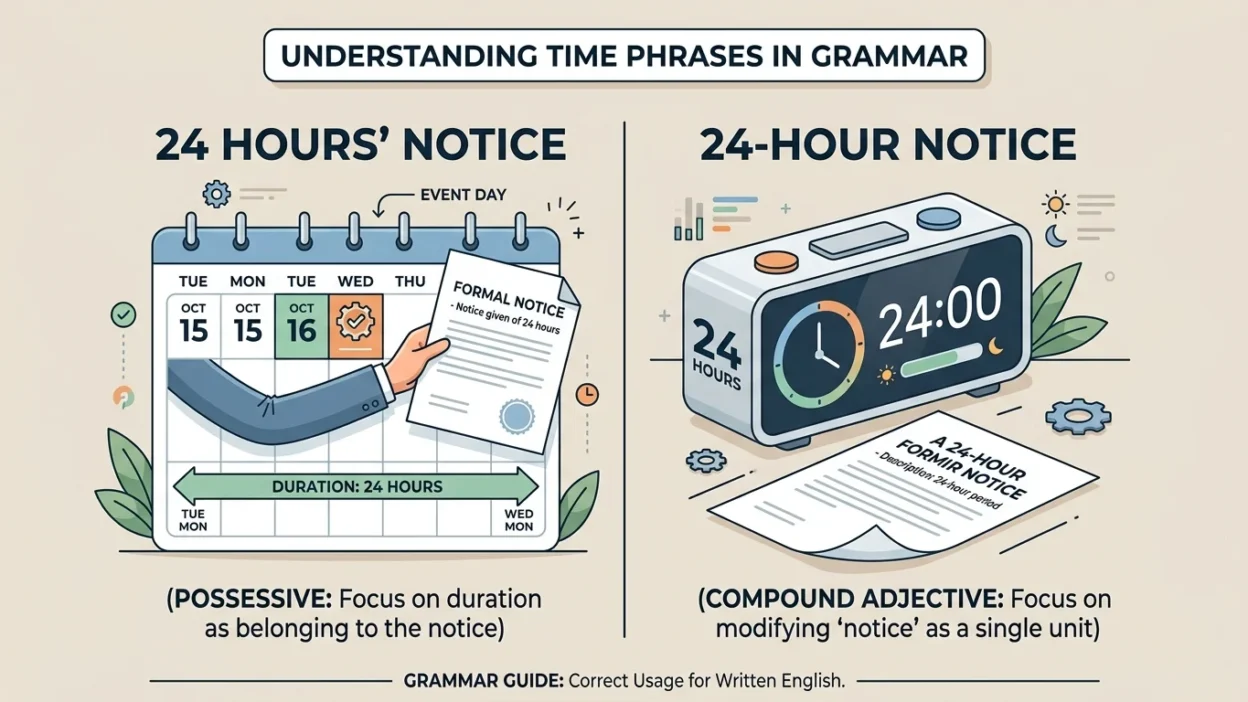
“24 hours notice” is a common phrase used when someone needs to give advance warning before an event, appointment, cancellation, visit, or change. You may see it in sentences such as “Please give us 24 hours notice” or “We require 24 hours’ notice.” But what is the correct grammatical form?
The most standard form is “24 hours’ notice” when you mean notice given 24 hours in advance. The apostrophe after hours shows possession: the notice is associated with a period of 24 hours.
You may also see “24 hour notice” when the phrase is used as a compound adjective, as in “We require 24 hour notice.” Understanding this small difference can help you write the phrase correctly in emails, policies, signs, and professional communication.
Quick Answer
The standard form is “24 hours’ notice” when “24 hours” refers to the amount of advance time.
Example:
“Please provide 24 hours’ notice before canceling your appointment.”
Use “24 hour notice” when the entire phrase works as an adjective before a noun.
Example:
“We require 24 hour notice.”
Why People Confuse It
People often leave out the apostrophe because “24 hours notice” looks natural in everyday writing. However, hours’ notice is a possessive construction.
There is also a second form, 24 hour notice, which creates confusion because it does not use an apostrophe.
The key is to look at how the phrase functions in the sentence.
24 Hours’ Notice
“24 hours’ notice” means notice given at least 24 hours before something happens.
The apostrophe comes after hours because hours is plural.
Examples:
- We need 24 hours’ notice before cancellation.
- Please give us 24 hours’ notice if you cannot attend.
- The landlord must provide 24 hours’ notice before entering.
- You need to give 24 hours’ notice to change your appointment.
- The company requires 24 hours’ notice for refunds.
The phrase can be understood as “notice of 24 hours.”
24-Hour Notice
“24-hour notice” is a compound adjective. It describes the type of notice being required or given.
Because it functions as a compound modifier before a noun, hour remains singular.
Examples:
- We require 24-hour notice.
- This service requires 24-hour notice before cancellation.
- The hotel provides 24-hour notice of scheduled maintenance.
- Customers must provide 24-hour notice for changes.
- The policy requires 24-hour notice for appointment cancellations.
Think of it as:
24-hour + noun
For example:
24-hour notice
24-hour period
24-hour service
Comparison Table
| Form | Correct? | Use | Example |
|---|---|---|---|
| 24 hours’ notice | Yes | Advance notice measured in 24 hours | Please give 24 hours’ notice. |
| 24-hour notice | Yes | Compound adjective before a noun | We require 24-hour notice. |
| 24 hours notice | Usually no | Missing possessive apostrophe | Please give 24 hours notice. |
| 24 hours’ notices | No | Incorrect pluralization | Please give 24 hours’ notices. |
| 24-hours’ notice | No | Incorrect hyphenation | Please give 24-hours’ notice. |
When to Use Each
Use 24 hours’ notice when you are treating 24 hours as the amount of advance notice.
Example:
Please give me 24 hours’ notice before changing the appointment.
Use 24-hour notice when the phrase comes directly before a noun as a compound modifier.
Example:
We require 24-hour notice before changing an appointment.
Both forms can be correct. The difference is grammatical structure, not meaning.
10+ Examples of 24 Hours’ Notice
- Please give us 24 hours’ notice before canceling your booking.
- Customers must provide 24 hours’ notice for appointment changes.
- We need at least 24 hours’ notice to prepare the room.
- The tenant received 24 hours’ notice before the inspection.
- Please provide 24 hours’ notice if you cannot attend.
- The restaurant requires 24 hours’ notice for large reservations.
- You must give 24 hours’ notice before requesting a refund.
- The company asks employees to provide 24 hours’ notice for schedule changes.
- I would appreciate 24 hours’ notice before the meeting is moved.
- The service requires 24 hours’ notice for cancellations.
- Please give me 24 hours’ notice if your plans change.
- We were not given 24 hours’ notice about the cancellation.
10+ Examples of 24-Hour Notice
- We require 24-hour notice for cancellations.
- The policy requires 24-hour notice before an appointment is changed.
- Customers must provide 24-hour notice for special requests.
- The hotel gives guests 24-hour notice before maintenance work.
- A 24-hour notice period is required for cancellations.
- The company has a 24-hour notice policy.
- Please check the 24-hour notice requirement before booking.
- The landlord provided a 24-hour notice before the inspection.
- The service operates under a 24-hour notice policy.
- The agreement includes a 24-hour notice requirement.
A useful point: in some sentences, 24 hours’ notice sounds more natural than a 24-hour notice. The latter is possible when “notice” is being treated as a specific document or formal notice, but it is not always the most natural choice.
Common Mistakes
1. Writing “24 hours notice”
In careful standard writing, write:
Please give 24 hours’ notice.
Not:
Please give 24 hours notice.
2. Writing “24-hours notice”
Do not normally hyphenate the plural phrase this way.
Incorrect:
24-hours notice
Correct:
24 hours’ notice
3. Writing “24-hours’ notice”
The hyphen and apostrophe should not both be used in this construction.
Correct:
24 hours’ notice
4. Writing “24 hour notice”
When it is used as a compound adjective, include the hyphen:
24-hour notice
5. Making “hour” plural in a compound adjective
When a number and measurement work together as a compound modifier, the measurement usually stays singular.
Correct:
a 24-hour notice period
Not:
a 24-hours notice period
Memory Trick
Use this simple rule:
Before a noun → 24-hour
As a time amount → 24 hours’
So:
24-hour notice period
24 hours’ notice
Remember: compound adjective = singular “hour.” Possessive time expression = plural “hours’.”
American vs British English
American and British English generally use the same grammatical distinction between 24 hours’ notice and 24-hour notice.
You may see small style differences in punctuation and formatting, but the underlying rule remains the same.
For example, both varieties can use:
Please give 24 hours’ notice.
And:
We require 24-hour notice.
Similar Expressions
Several expressions have the same general idea:
24 hours in advance
This is very clear and conversational.
Please let me know 24 hours in advance.
One day’s notice
This means approximately one day of advance warning.
We require one day’s notice.
Advance notice
This is a broader expression that does not specify a particular amount of time.
We received advance notice of the changes.
Prior notice
This is common in formal or legal writing.
The company must provide prior notice.
48 hours’ notice
The same possessive rule applies to other periods.
Please give us 48 hours’ notice.
48-hour notice
Use the compound-adjective form before a noun.
The company has a 48-hour notice requirement.
Final Verdict
The correct form depends on how you use the phrase.
Use “24 hours’ notice” when you mean that someone must give notice 24 hours in advance:
Please give us 24 hours’ notice.
Use “24-hour notice” when the phrase acts as a compound adjective:
We have a 24-hour notice policy.
The form “24 hours notice” is generally missing the possessive apostrophe and should be avoided in careful writing.
FAQs
Is “24 hours notice” grammatically correct?
In standard careful English, the preferred form is “24 hours’ notice.” The apostrophe indicates the possessive relationship.
Is it “24 hours’ notice” or “24-hour notice”?
Both can be correct. Use 24 hours’ notice when referring to the amount of advance notice. Use 24-hour notice when it functions as a compound adjective before a noun.
Should “24-hour notice” have a hyphen?
Yes. When “24-hour” modifies a following noun, the hyphen helps show that the words function together as one modifier.
Why is there an apostrophe in “24 hours’ notice”?
The apostrophe marks the possessive construction. 24 hours’ notice can be understood as notice associated with a period of 24 hours.
Is “24 hours notice” or “24 hours’ notice” better?
24 hours’ notice is the standard choice when you mean advance notice of 24 hours.
Is “24-hour notice” correct?
Yes. It is correct when 24-hour functions as a compound adjective.
Can I say “24 hours in advance”?
Yes. “24 hours in advance” is completely correct and is often very clear in everyday communication.
Conclusion
24 hours’ notice and 24 hour notice are both correct, but they have different grammatical structures. Use 24 hours’ notice when you are talking about the amount of advance time required. Use 24 hour notice when the phrase acts as an adjective before a noun.
The most important thing to remember is the difference between a possessive time expression and a compound modifier. Once you recognize that difference, phrases such as 48 hours’ notice, 72 hours’ notice, and 48 hour notice period become much easier to write correctly.
Remember This
24 hours’ notice = notice given 24 hours in advance.
24-hour notice = a compound adjective.
24 hours notice = usually missing the apostrophe.
Easy rule:
Time amount → 24 hours’ notice
Before a noun → 24-hour notice

Christopher Thomas is a passionate writer and dream researcher dedicated to exploring the meanings behind dreams. As an author at DrameyHut, he creates insightful and easy-to-understand interpretations that help readers connect with their subconscious mind. His work focuses on guiding individuals toward self-discovery, clarity, and a deeper understanding of their inner thoughts.