If you have ever written “ofcourse” instead of “of course,” you are not alone. This is a common spelling mistake because the two words are frequently pronounced together and function as a single expression in everyday speech. As a result, many people assume they should also be written as one word.
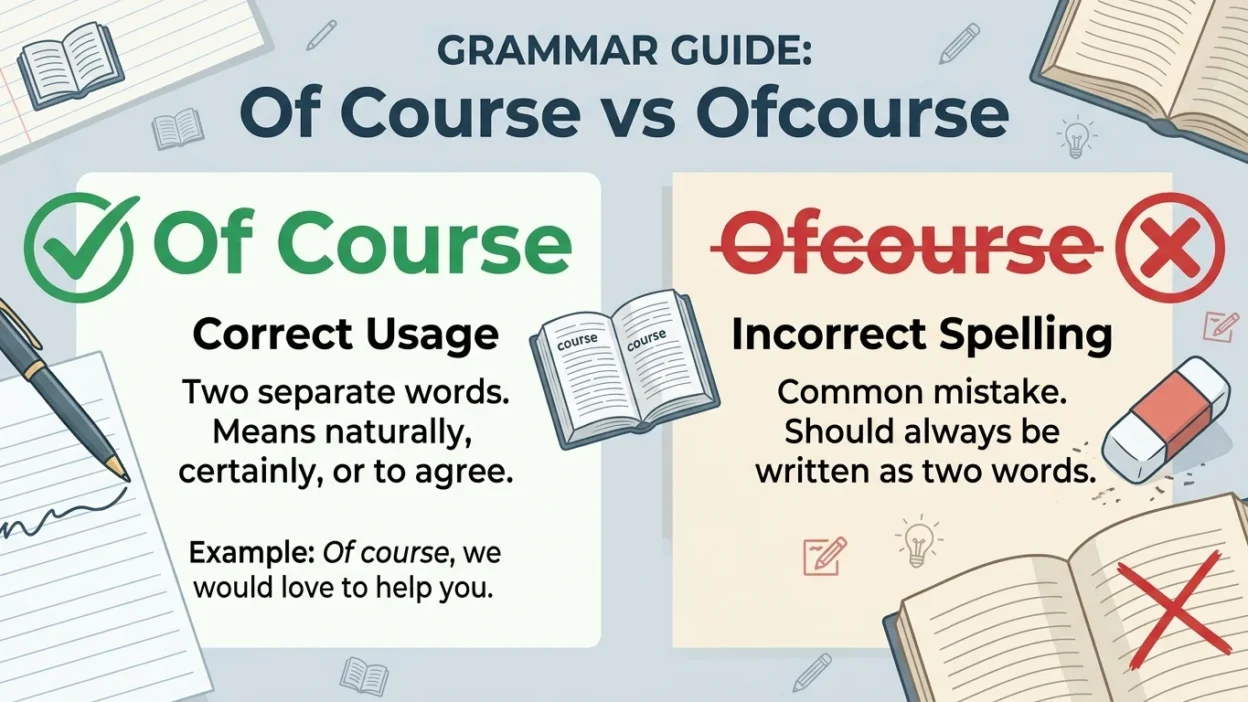
The correct spelling is “of course,” written as two separate words. “Ofcourse” is not the standard spelling in English and should be avoided in formal and informal writing.
The phrase of course is commonly used to mean “certainly,” “naturally,” or “as expected.” It can also introduce information that the speaker considers obvious or already understood. Once you remember that of course consists of two words, this common spelling problem becomes easy to avoid.
Quick Answer
Of course is the correct spelling. It is always written as two words in standard English.
Example:
“Of course, I will help you.”
Ofcourse is an incorrect spelling and should not be used in standard English writing.
Why People Confuse It
People often confuse of course and ofcourse because the phrase is pronounced smoothly as a single unit in normal speech.
Other common phrases can also look like they might be one word, especially when they are frequently used together.
For example:
- of course ✅
- ofcourse ❌
The important point is that of course is an established two-word phrase, not a single compound word.
Of Course
Of course is the correct expression.
It can mean:
- certainly
- naturally
- obviously
- as expected
- without doubt
Examples:
Of course, you can come with us.
She will of course be invited.
Of course I remember you.
The exact meaning depends on context and tone.
Of Course as “Certainly”
One common use is to give an affirmative answer.
“Can I borrow your book?”
“Of course!”
Here, of course means certainly or yes, definitely.
Of Course as “Naturally”
It can also indicate that something is natural or expected.
Of course, everyone wants to succeed.
Here, the speaker presents the statement as something expected or obvious.
Of Course as “Obviously”
Sometimes of course introduces information that the speaker believes should already be understood.
He was tired, of course, after working all night.
In this use, the phrase can have a meaning similar to obviously or as you would expect.
Ofcourse
Ofcourse is not the standard spelling of the phrase.
It is generally considered a misspelling of of course.
Incorrect:
Ofcourse, I will help you.
Correct:
Of course, I will help you.
Incorrect:
Thank you, ofcourse.
Correct:
Thank you, of course.
You may occasionally see ofcourse in usernames, informal online writing, or typing errors, but that does not make it a standard English spelling.
Comparison Table
| Form | Correct? | Meaning | Example |
|---|---|---|---|
| of course | ✅ Yes | Certainly, naturally, obviously | Of course, I agree. |
| ofcourse | ❌ No | Intended to mean “of course” | Ofcourse, I agree. |
| of-course | ❌ Usually no | Not the standard form | Of-course, I agree. |
| Of course | ✅ Yes | Same phrase at the beginning of a sentence | Of course, you can stay. |
When to Use “Of Course”
Use of course whenever you want to express certainty, agreement, naturalness, or something expected.
To give permission
“May I come in?”
“Of course.”
To agree
“Do you want to join us?”
“Of course!”
To emphasize something expected
Of course, she was nervous before the interview.
To add an obvious fact
He was disappointed, of course, after losing the competition.
In polite conversation
“Could you help me with this?”
“Of course.”
10+ Examples of “Of Course”
- Of course, you can use my laptop.
- Of course, I remember your name.
- She will of course be there.
- Of course, we should discuss the problem.
- “Can I ask you something?” “Of course.”
- Of course, he was happy about the good news.
- You can of course contact me anytime.
- Of course, everyone makes mistakes.
- I will of course consider your suggestion.
- Of course, they knew what was happening.
- Thank you for helping me. “Of course!”
- She was nervous, of course, because it was her first presentation.
Common Mistakes
1. Writing “ofcourse”
This is the most common mistake.
❌ Ofcourse, I agree.
✅ Of course, I agree.
Always write the expression as two words.
2. Adding a hyphen
You normally do not write of-course.
❌ Of-course, I agree.
✅ Of course, I agree.
3. Treating it as one word because of pronunciation
In natural speech, of course may sound closely connected. However, pronunciation does not determine whether the words should be combined in writing.
4. Using unnecessary capitalization
In the middle of a sentence, use lowercase:
I will of course help you.
At the beginning of a sentence:
Of course, I will help you.
Punctuation with “Of Course”
When of course appears at the beginning of a sentence, a comma is often appropriate.
Of course, I can help.
When it appears as an interrupting comment, commas can set it off.
She will, of course, attend the meeting.
At the end of a sentence, punctuation depends on the sentence structure.
I can help you, of course.
However, not every use requires commas. The punctuation can depend on how closely of course is integrated into the sentence.
Memory Trick
Remember:
Of course = two words
Think of the phrase as:
of + course
Do not combine them.
A simple memory sentence is:
Of course, “of course” is two words!
If you see ofcourse, mentally separate it into of course.
American vs British English
Of course is standard in both American and British English.
There is no meaningful spelling difference between the two varieties.
Americans and British speakers alike write:
Of course, I can help you.
The incorrect form ofcourse should be avoided in both varieties.
Similar Expressions
Certainly
Certainly means definitely or without doubt.
Certainly, I can help you.
Definitely
Definitely expresses strong certainty.
I will definitely attend.
Naturally
Naturally can mean that something is expected or unsurprising.
Naturally, she was concerned.
Obviously
Obviously indicates that something seems clear or easy to understand.
Obviously, we need more time.
Sure
Sure is common in informal conversation.
“Can I come along?”
“Sure!”
Of course not
The phrase can also be used in negative responses.
Of course not! I would never do that.
Of Course vs Certainly
These words can sometimes be used similarly, but their tone can differ.
Of course often sounds more conversational and can express willingness or agreement.
“Can you help me?”
“Of course.”
Certainly can sound slightly more formal.
“Can you help me?”
“Certainly.”
Both are correct, but of course is extremely common in everyday English.
Final Verdict
The correct form is of course, always written as two words.
Of course can mean certainly, naturally, obviously, or as expected, depending on the context. It is common in everyday conversation, professional communication, and formal writing.
Ofcourse is a misspelling and should be avoided.
So, if you are unsure, remember this simple rule:
Of course = correct
Ofcourse = incorrect
FAQs
Is “ofcourse” one word?
No. Ofcourse is not the standard English spelling. The correct form is of course, written as two words.
Is “of course” correct grammar?
Yes. Of course is a standard English expression used to indicate certainty, agreement, naturalness, or something expected.
Should “of course” be hyphenated?
No. The standard expression is of course, without a hyphen.
Is “of course” formal or informal?
It can be used in both formal and informal English. Its tone depends on the context.
Can “of course” mean “yes”?
Yes. In conversation, of course can be used as an enthusiastic or polite way of saying yes or certainly.
Do you put a comma after “of course”?
Often, yes, especially when of course appears at the beginning of a sentence as an introductory expression.
Of course, I understand.
However, punctuation depends on the phrase’s position and role in the sentence.
Is “of course” the same in American and British English?
Yes. Of course is standard in both American and British English.
Conclusion
The difference between of course and ofcourse is simple: of course is the correct standard spelling, while ofcourse is a misspelling. Even though the phrase is commonly pronounced as a connected expression, it remains two separate words in writing.
Use of course when you want to express certainty, agreement, naturalness, or something that should be expected. It works naturally in casual conversations, emails, professional writing, and many other situations.
Remember This
Of course = correct ✅
Ofcourse = incorrect ❌
The phrase is always written as two words in standard English.
Easy rule: If you mean “certainly,” write “of course.”

Nancy Lisa is a passionate writer and contributor at DrameyHut, focused on uncovering the deeper meanings behind dreams. She creates engaging and insightful content that helps readers interpret their dreams and understand their subconscious thoughts. Her work inspires self-reflection, clarity, and a stronger connection to inner emotions.