Spatter and splatter are closely related words, and both describe liquid or small particles being scattered in different directions. Because their meanings overlap so much, it is easy to wonder whether they are simply two spellings of the same word.
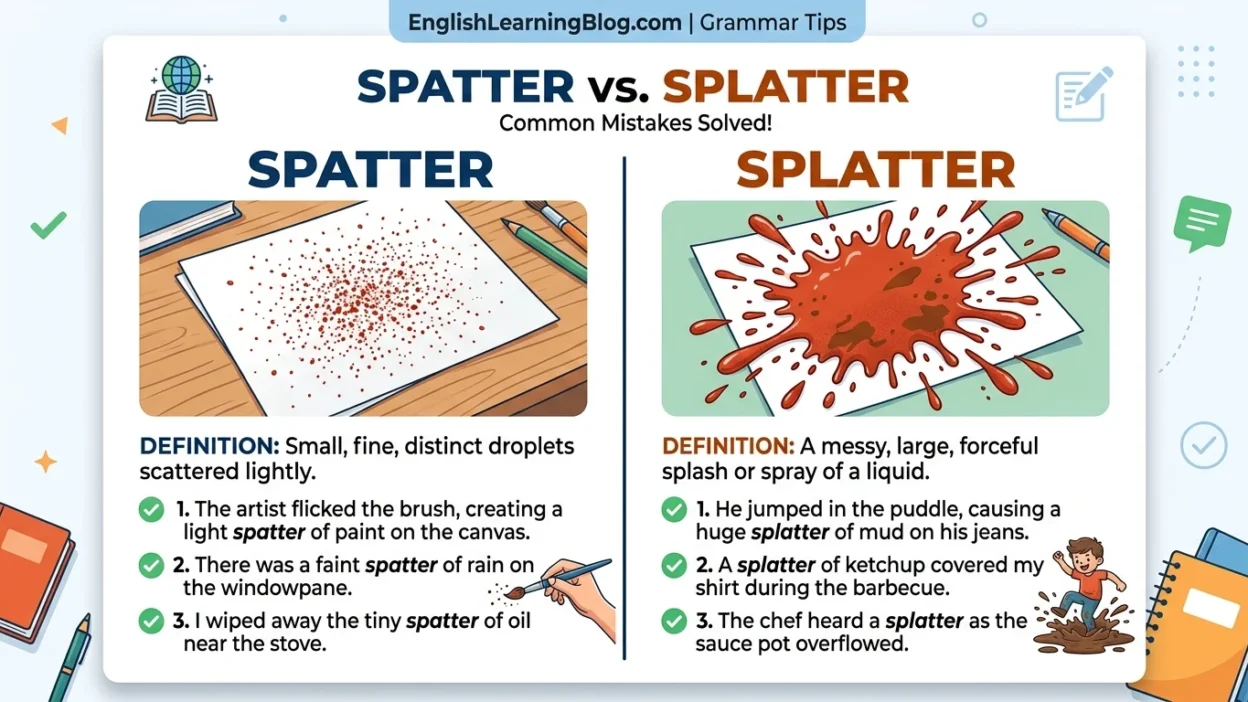
They are not exactly the same, though. Spatter usually suggests small drops scattered over a surface, while splatter often suggests a more noticeable, messy, or forceful scattering of liquid or material. The difference is often one of degree and context rather than a strict grammatical rule.
Quick Answer
Spatter usually means small drops or particles scattered over something, often in a relatively light or scattered pattern. Splatter suggests a messier or more forceful scattering. Both can be verbs and nouns, and their meanings overlap considerably.
Why People Confuse It
Both words can describe liquid being scattered:
- Water spattered onto the floor.
- Water splattered onto the floor.
Both sentences are possible.
The main difference is the impression created.
Spatter often emphasizes individual small drops.
Splatter often emphasizes a messy, irregular, or forceful spread.
Spatter
Spatter means to scatter small drops or particles over a surface or through the air.
It can refer to:
- Water
- Mud
- Paint
- Oil
- Blood
- Food
- Other liquids or small particles
Examples
- Rain spattered against the window.
- Mud spattered his shoes.
- Paint spattered across the wall.
- Water spattered onto the floor.
- The puddle spattered when the car drove through it.
As a noun:
- There were spatters of mud on his jacket.
- The wall was covered with paint spatter.
Splatter
Splatter means to scatter liquid or small pieces of material, usually in a messy, irregular, or somewhat forceful way.
Examples
- The car splattered mud onto the pedestrians.
- Grease splattered onto the stove.
- Paint splattered across the canvas.
- The water splattered everywhere.
- The children splattered each other with water.
As a noun:
- There was paint splatter all over the floor.
- The kitchen counter was covered in splatter.
Comparison Table
| Feature | Spatter | Splatter |
|---|---|---|
| Basic meaning | Scatter small drops or particles | Scatter liquid or material messily |
| Typical impression | Small scattered drops | Messier or more forceful spread |
| Can be a noun | Yes | Yes |
| Can be a verb | Yes | Yes |
| Used for paint | Yes | Yes |
| Used for water | Yes | Yes |
| Used for mud | Yes | Yes |
| Meaning overlap | High | High |
When to Use Each
Use spatter when you want to emphasize small drops scattered around.
Raindrops spattered the windshield.
Use splatter when you want to emphasize messiness, irregularity, or force.
Mud splattered all over the car.
In many everyday situations, either word can work.
Examples
- Rain spattered against the window.
- Mud spattered his trousers.
- Paint spattered across the wall.
- Water spattered onto the pavement.
- Oil spattered from the pan.
- Mud splattered across the windshield.
- Grease splattered onto the kitchen floor.
- Paint splattered all over the artist’s clothes.
- The children splattered water everywhere.
- The car splattered mud onto the sidewalk.
- There were small spatters of paint on the table.
- The floor was covered in paint splatter.
Common Mistakes
Assuming “spatter” is always more correct
It isn’t.
Spatter and splatter are both standard English words.
Assuming they have completely different meanings
Their meanings overlap significantly.
You can often describe the same event with either word, although one may sound more natural depending on the context.
Thinking “splatter” only refers to blood
Splatter can describe many substances.
For example:
- Paint splatter
- Mud splatter
- Water splatter
- Grease splatter
Memory Trick
Think of the extra l in splatter as suggesting “lots of mess.”
Spatter = small scattered drops
Splatter = messy or forceful scattering
This is only a memory aid, not a strict grammar rule.
American vs British English
Both spatter and splatter are used in American and British English.
There is no major regional difference in their basic meanings. Splatter is especially familiar in expressions such as splatter paint and splatter film, while spatter is common in technical and descriptive contexts.
Similar Words
You may also encounter:
- Splash
- Sprinkle
- Spray
- Scatter
- Spill
- Drip
- Sprinkle
- Spritz
- Droplet
- Spray
These words describe related actions but emphasize different patterns or amounts of liquid.
Final Verdict
Spatter and splatter are both correct. The difference is mainly about the image or degree of messiness they convey.
Spatter generally suggests small drops scattered over a surface, while splatter often suggests a messier, more forceful, or irregular spread.
When the context does not require a precise distinction, either word may be appropriate.
Remember This
Spatter = small scattered drops
Splatter = messier or more forceful scattering
For example:
Rain spattered against the window. ✅
Mud splattered all over the car. ✅
FAQs
What is the difference between spatter and splatter?
Spatter usually refers to small drops scattered over a surface, while splatter often suggests a messier or more forceful scattering. Their meanings overlap considerably.
Is spatter or splatter correct?
Both are correct English words. The appropriate choice depends on the context and the effect you want to describe.
Is blood spatter or blood splatter correct?
Blood spatter is a well established technical term, especially in forensic contexts. Blood splatter is also understandable and used in general English.
Is it paint spatter or paint splatter?
Both are possible. Paint splatter often emphasizes the messy effect, while paint spatter can emphasize individual droplets or scattered marks.
Can spatter and splatter be verbs?
Yes. Both can function as verbs.
Water spattered the window.
Mud splattered the car.
Are spatter and splatter synonyms?
They are near synonyms, but splatter often carries a stronger sense of messiness or force.
Is splatter always more forceful than spatter?
Not necessarily. The distinction is flexible, and native speakers sometimes use the words interchangeably.
Conclusion
The difference between spatter and splatter is subtle. Spatter generally brings to mind small, scattered drops, while splatter tends to suggest a messier or more dramatic spread of liquid or material.
Both words are useful, and neither is inherently more correct. If you’re describing a small pattern of droplets, spatter may be the better choice. If you’re emphasizing a messy or forceful result, splatter often sounds more natural.

Nancy Lisa is a passionate writer and contributor at DrameyHut, focused on uncovering the deeper meanings behind dreams. She creates engaging and insightful content that helps readers interpret their dreams and understand their subconscious thoughts. Her work inspires self-reflection, clarity, and a stronger connection to inner emotions.