“Whole day” and “all day” are very similar expressions, so it is easy to wonder if they mean exactly the same thing. In many sentences, they can describe something that continues throughout an entire day, but their grammar and emphasis are slightly different.
The main difference is that all day is usually more natural when describing an activity or situation that continues throughout the day. The whole day emphasizes the entire day as one complete period. In everyday English, all day is often the more natural choice.
Quick Answer
All day means throughout the entire day and is usually the more natural expression. The whole day also means the entire day but places more emphasis on the day as a complete period. Whole day without the is usually used in specific structures such as a whole day.
Why People Confuse It
Both expressions contain the idea of an entire day.
Compare:
I waited all day.
I waited the whole day.
Both can mean that you waited throughout the entire day.
However, all day is generally more natural and common in everyday English.
All Day
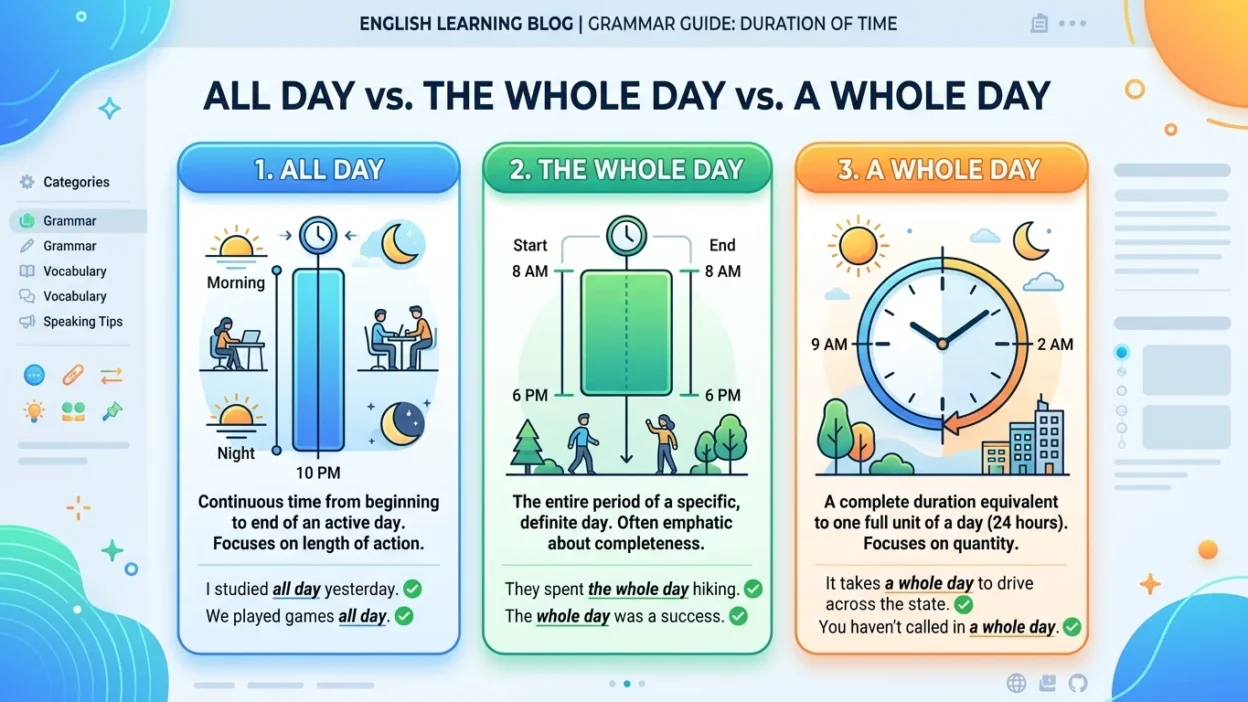
All day means throughout the entire day.
It is commonly used to describe an action or situation that continues for a long period during the day.
Examples
- I worked all day.
- She studied all day.
- It rained all day.
- He was tired all day.
- We waited all day for the bus.
- They talked all day.
You can use all day without an article.
I stayed home all day. ✅
The Whole Day
The whole day emphasizes the entire day as one complete period.
Examples
- I spent the whole day at home.
- She stayed there the whole day.
- We spent the whole day together.
- He worked for the whole day.
- They were traveling for the whole day.
The phrase often sounds slightly more emphatic than all day.
Compare:
I studied all day.
This simply says that studying continued throughout the day.
I spent the whole day studying.
This emphasizes that the entire day was devoted to studying.
A Whole Day
Do not confuse a whole day with the whole day.
A whole day means one complete day.
- It took a whole day to finish the project.
- She spent a whole day cleaning the house.
- We waited for a whole day.
- The journey lasted a whole day.
Here, a whole day often emphasizes the length of time.
Comparison Table
| Expression | Meaning | Example |
|---|---|---|
| All day | Throughout the entire day | I worked all day. |
| The whole day | The entire specific day | I spent the whole day at home. |
| A whole day | One complete day | It took a whole day. |
| All of the day | The entire day | Less natural in everyday English |
| The entire day | The complete day | I stayed there the entire day. |
When to Use Each
Use all day when talking about an activity or situation continuing throughout the day.
She was working all day.
Use the whole day when emphasizing that the entire specific day was involved.
She spent the whole day working.
Use a whole day when emphasizing the amount of time.
The project took a whole day.
Examples
- I worked all day.
- She studied all day.
- It rained all day.
- We waited all day.
- He was busy all day.
- I spent the whole day at home.
- She spent the whole day reading.
- We were together the whole day.
- It took a whole day to complete the task.
- The journey lasted a whole day.
- They talked all day.
- He spent the whole day watching movies.
Common Mistakes
Saying “whole day” by itself
In many situations, you need an article or determiner.
❌ I worked whole day.
✅ I worked all day.
✅ I worked the whole day.
✅ I worked for a whole day.
Using “all the day”
All the day is grammatically possible in certain literary or older contexts, but it is not the normal expression in modern everyday English.
❌ I worked all the day.
✅ I worked all day.
Confusing “a whole day” and “the whole day”
A whole day means one complete day as a period of time.
The whole day usually refers to a particular day.
It took a whole day to repair the car.
I spent the whole day repairing the car.
Memory Trick
Remember:
All day = throughout the day
The whole day = the entire specific day
A whole day = one complete day
For everyday conversation, all day is often the easiest and most natural choice.
American vs British English
There is no major difference between American and British English here.
Both varieties commonly use:
all day
the whole day
a whole day
However, all day is generally the most natural choice when describing something that happens continuously throughout a day.
Similar Expressions
You may also see:
- All morning
- All afternoon
- All evening
- All night
- The whole morning
- The whole afternoon
- The entire day
- Throughout the day
- For the entire day
- A full day
Examples:
I worked all morning.
She slept all night.
We spent the entire day together.
Final Verdict
All day and the whole day can often have the same basic meaning, but they have slightly different emphasis.
Use all day for something happening throughout the day:
I worked all day. ✅
Use the whole day when emphasizing the complete day:
I spent the whole day working. ✅
Use a whole day when referring to one complete day as a duration:
It took a whole day. ✅
Remember This
All day = throughout the day ✅
The whole day = the entire day ✅
A whole day = one complete day ✅
Avoid:
I worked whole day. ❌
Prefer:
I worked all day. ✅
FAQs
Is it “whole day” or “all day”?
Usually, all day is the natural choice when you mean throughout the entire day. Use the whole day or a whole day when appropriate.
Is “I worked whole day” correct?
No. In standard English, say I worked all day, I worked the whole day, or I worked for a whole day.
Is “all day” grammatically correct?
Yes. All day is a standard expression meaning throughout the entire day.
What is the difference between “all day” and “the whole day”?
The meaning can overlap. All day emphasizes duration throughout the day, while the whole day emphasizes the day as a complete period.
What does “a whole day” mean?
A whole day means one complete day and often emphasizes the length of time.
Which is more natural, “all day” or “the whole day”?
All day is generally more natural in everyday English when describing an ongoing activity.
Can I say “all of the day”?
Yes, but it is less natural in ordinary conversation. All day or the whole day is usually better.
Conclusion
The difference between whole day and all day is mainly about grammar and emphasis. All day is the most natural expression when you mean something happened continuously throughout the day.
The whole day emphasizes the entire day, while a whole day emphasizes one complete day as a period of time.
If you’re unsure, remember the simplest pattern: I worked all day, I spent the whole day working, and it took a whole day. These three structures cover most everyday situations.

Daniel Charles is a dedicated author and dream interpretation enthusiast at DrameyHut. He specializes in analyzing dream symbols and meanings, offering clear and insightful content for readers. His work aims to help individuals understand their subconscious thoughts, gain clarity, and explore the deeper messages hidden within their dreams.