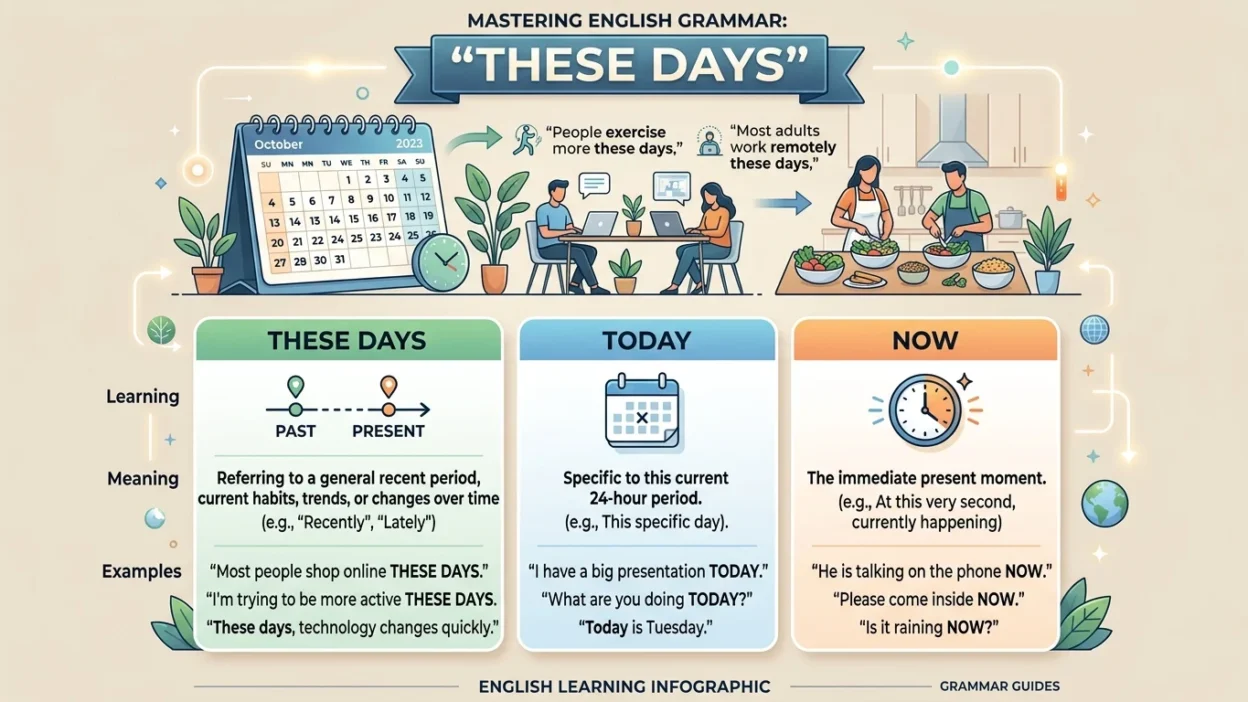
“These days” is a common English expression used to talk about the present period of time, especially when describing something that is happening now or has become common recently. It is often used when comparing the present with the past.
For example, if you say, “These days, I work from home,” you mean that working from home is part of your current routine. The expression does not refer to specific individual days. Instead, it refers generally to the current period. “These days” is usually used with the simple present tense, although other tenses can appear depending on the meaning.
It is natural in everyday conversation, informal writing, and many professional contexts. Understanding how to use “these days” correctly can help you describe current habits, trends, lifestyles, and situations naturally.
Quick Answer
“These days” means “nowadays” or “at the present time.” It usually describes a current habit, situation, or trend and is commonly used with the simple present tense. For example, “These days, I exercise every morning” means that exercising every morning is part of your current routine.
What Does “These Days” Mean?
“These days” refers to the present period of time.
It does not usually mean literally “these particular days.” Instead, it describes what is happening nowadays or recently.
For example:
These days, I drink less coffee.
This means:
Nowadays, I drink less coffee.
The expression is especially useful when there is an implied or explicit contrast with the past.
I used to stay up late, but these days I go to bed early.
Here, “these days” contrasts the speaker’s current habit with an earlier habit.
These Days Grammar
“These days” functions as an adverbial time expression.
It can appear at the beginning, middle, or end of a sentence.
At the Beginning
These days, many people work remotely.
This position is very common.
In the Middle
People these days often communicate online.
This is also natural.
At the End
Many people work remotely these days.
This is perhaps one of the most common patterns in everyday English.
The comma after “these days” is generally used when the expression appears at the beginning as an introductory time phrase.
These Days With the Simple Present
The simple present is the most common tense used with “these days.”
For example:
These days, I work from home.
She exercises regularly these days.
People these days spend a lot of time online.
I don’t watch much television these days.
The simple present works well because “these days” often describes a current habit, condition, or general trend.
These Days With Other Tenses
Although the simple present is especially common, “these days” is not restricted to one tense.
Present Continuous
You can use the present continuous when emphasizing something happening around the present period.
These days, I am working longer hours.
This emphasizes the current temporary situation.
Past Tense
“These days” can sometimes be used when talking about a period in the past, especially when referring to what was happening during that period.
In those days, people wrote letters more often.
However, “in those days” is usually more natural for a clearly past period than “these days.”
Present Perfect
The present perfect can also occur when describing a change that has developed over time.
These days, I have become more interested in photography.
The exact tense depends on what you want to emphasize.
These Days vs Nowadays
These days and nowadays are very similar.
| Expression | Meaning | Style | Example |
|---|---|---|---|
| These days | At the present time | Very common and natural | I exercise more these days. |
| Nowadays | At the present time | Slightly more formal or general | Nowadays, many people shop online. |
| Currently | At the present time | More formal | I am currently working on a new project. |
| At present | Now | Formal | The service is unavailable at present. |
| Now | At this time | Very common | I work from home now. |
“These days” is especially natural when discussing current habits or changes from the past.
These Days vs Now
“These days” and “now” can overlap, but they are not always interchangeable.
Now often refers to the present moment or current situation.
I am busy now.
This can mean that the speaker is busy at this exact time.
These days usually refers to a broader period.
I am very busy these days.
This means the speaker has generally been busy recently or during the current period.
So:
now = this moment or current situation
these days = the current period
These Days vs Today
“Today” usually refers to the current calendar day.
I am working from home today.
This means the person is working from home on this particular day.
“These days” refers to a broader period.
I am working from home these days.
This suggests that working from home is currently part of the person’s routine.
Examples of These Days
- These days, I wake up early.
- I don’t watch much television these days.
- People these days spend a lot of time on their phones.
- She works from home these days.
- These days, online shopping is extremely popular.
- I rarely eat fast food these days.
- He seems much happier these days.
- Many students study online these days.
- I am much more careful with my money these days.
- These days, we communicate mostly through messaging apps.
- My parents travel more these days.
- I don’t see him very often these days.
These Days in Questions
“These days” can also appear naturally in questions.
What are you doing these days?
This can mean:
What have you been doing recently?
Another example:
How are you feeling these days?
This asks about the person’s general condition during the current period.
You can also ask:
Are you working from home these days?
This asks whether working from home is currently part of someone’s routine.
Common Mistakes
1. Using “these days” for one specific day
“These days” normally refers to a period, not one particular day.
If you mean one specific day, use today.
I am working from home today.
If you mean your current routine, use:
I am working from home these days.
2. Confusing “these days” with “those days”
These days refers to the present period.
Those days generally refers to a period in the past or a previously mentioned period.
These days, I exercise every morning.
In those days, I didn’t exercise at all.
3. Using “these days” when “now” is more precise
If you mean this exact moment, “now” is usually better.
I can’t talk now.
Not:
I can’t talk these days.
The second sentence suggests a general period rather than the immediate moment.
4. Assuming “these days” always requires the present tense
The expression commonly occurs with the present tense, but the appropriate tense depends on the meaning of the sentence.
5. Using “in these days”
“In these days” is generally unnatural when you simply mean “nowadays.”
Say:
These days, people communicate online.
Not:
In these days, people communicate online.
However, “in these days” can appear in unusual or specialized contexts where “these days” refers to a particular period.
Memory Trick
Remember:
These days = nowadays = now, in the current period
Think of “these” as pointing to the period you are living through right now.
For example:
I exercise more these days.
means:
I exercise more nowadays.
American vs British English
“These days” is common and natural in both American and British English.
There is no meaningful difference in grammar or meaning between the two varieties.
For example:
American English: I don’t go out much these days.
British English: I don’t go out much these days.
Both sentences are completely natural.
Similar Expressions
Nowadays
Nowadays, many people work remotely.
Very similar to “these days.”
Currently
I am currently working on a new project.
More formal and focused on the present situation.
At present
The service is unavailable at present.
More formal.
Recently
I have been feeling tired recently.
Refers to the period leading up to now rather than simply describing the current period.
Lately
I have been very busy lately.
Often focuses on a recent period.
Now
I work from home now.
Usually more direct and concise.
Final Verdict
“These days” is a correct and very common English expression meaning “nowadays” or “at the present time.”
It is especially useful for describing current habits, lifestyles, situations, and trends. The simple present is the most common tense with the expression, but other tenses can be used when the meaning requires them.
Remember that “these days” normally refers to a period of time, not one particular day. For a specific day, use “today.” For the exact present moment, use “now.”
FAQs
What does “these days” mean?
“These days” means nowadays or during the current period of time.
Is “these days” grammatically correct?
Yes. “These days” is a standard and very common English time expression.
What tense is used after “these days”?
The simple present is especially common, particularly when describing current habits or general situations. Other tenses can also be used depending on the meaning.
What is the difference between “these days” and “nowadays”?
They have essentially the same meaning. “These days” is very common in everyday English, while “nowadays” can sound slightly more formal or general.
What is the difference between “these days” and “today”?
“These days” refers to a broader current period, while “today” refers to the current calendar day.
Can I say “these days” at the end of a sentence?
Yes. This is very common.
I don’t watch much TV these days.
Can “these days” refer to the past?
Usually, “these days” refers to the present. When referring to a past period, “those days” or “in those days” is generally more appropriate.
Do I need a comma after “these days”?
When “these days” begins a sentence as an introductory time expression, a comma is commonly used:
These days, I work from home.
When it appears at the end, no comma is needed:
I work from home these days.
Conclusion
“These days” is one of the most useful expressions for talking about the present period. It can describe current habits, changing lifestyles, general trends, and situations that are different from the past. It is natural in both conversation and writing.
The easiest way to understand it is to think of “these days” as “nowadays.” Use “today” when you mean one particular day and “now” when you mean the immediate present. Once you understand this difference, using “these days” becomes simple and natural.
Remember This
These days = nowadays = during the current period
Use these days for current habits, situations, and trends.
I exercise more these days.
Use today for one particular day.
I am exercising today.
Use now for the present moment.
I am exercising now.

Nancy Lisa is a passionate writer and contributor at DrameyHut, focused on uncovering the deeper meanings behind dreams. She creates engaging and insightful content that helps readers interpret their dreams and understand their subconscious thoughts. Her work inspires self-reflection, clarity, and a stronger connection to inner emotions.