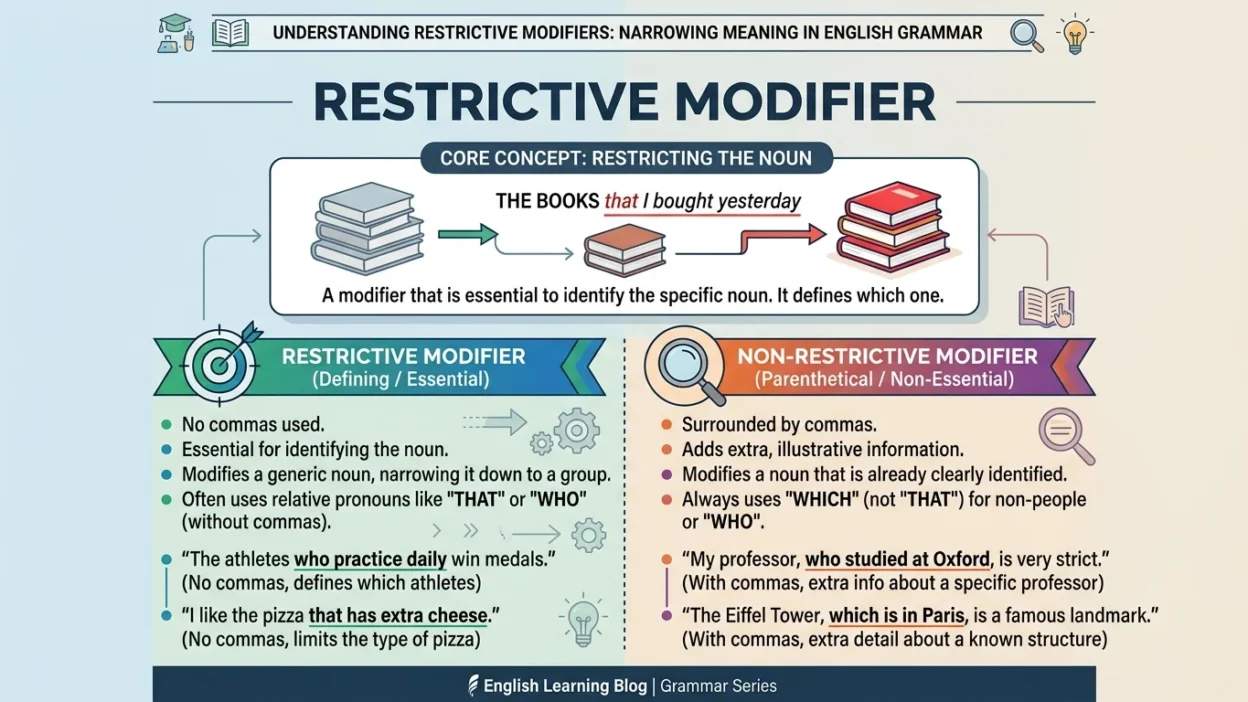
A restrictive modifier is a word, phrase, or clause that provides essential information about a noun. It restricts or narrows the meaning of that noun by telling the reader exactly which person, thing, or group is being discussed.
Because the information is essential to the meaning of the sentence, a restrictive modifier is generally not separated by commas.
Understanding restrictive modifiers is important because they are closely connected to the difference between restrictive and nonrestrictive modifiers.
Compare these two sentences: “The students who studied passed the test” and “The students, who studied, passed the test.” The first sentence identifies which students passed, while the second suggests that all the students studied and passed.
The presence or absence of commas can therefore change the meaning significantly. Once you understand what a restrictive modifier does, punctuation decisions involving relative clauses and modifying phrases become much easier.
Quick Answer
A restrictive modifier gives essential information that identifies or limits the noun it modifies. It is normally written without commas. For example, “The book that you recommended is excellent” uses a restrictive modifier because “that you recommended” identifies which book is meant.
Why People Confuse It
Restrictive modifiers are often confused with nonrestrictive modifiers because both types add information about a noun.
The key difference is whether the information is essential to identifying or limiting the noun.
Consider:
The employees who arrived early received breakfast.
The phrase who arrived early identifies which employees received breakfast. It is restrictive.
Now consider:
The employees, who arrived early, received breakfast.
This version suggests that the employees already being discussed all arrived early. The information is presented as additional rather than identifying information.
That difference is why punctuation matters.
What Is a Restrictive Modifier?
A restrictive modifier is a modifier that restricts, identifies, or narrows the meaning of the noun it modifies.
It answers questions such as:
Which one?
Which people?
Which things?
What kind?
For example:
The car parked outside belongs to Sarah.
The phrase parked outside tells us which car is being discussed.
There may be several cars, so the modifier helps identify the particular one.
Another example:
Students who complete the assignment will receive a certificate.
The modifier who complete the assignment limits the group to those students who complete it.
Restrictive Relative Clauses
One of the most common types of restrictive modifier is a restrictive relative clause.
A relative clause usually begins with words such as:
who
that
which
whose
whom
For example:
The woman who lives next door is a doctor.
The clause who lives next door identifies which woman is meant.
There could be several women, so the information is essential.
Another example:
I need the document that you sent yesterday.
The clause that you sent yesterday identifies which document is needed.
Restrictive Modifiers and Commas
The most important punctuation rule is simple:
Restrictive modifiers generally do not take commas.
For example:
The students who passed the exam celebrated.
Do not write:
The students, who passed the exam, celebrated.
unless you intend the commas to communicate a different meaning.
The commas indicate that the information is additional rather than essential.
Restrictive vs Nonrestrictive Modifiers
This is the most important comparison to understand.
| Type | Purpose | Commas | Example |
|---|---|---|---|
| Restrictive modifier | Identifies or limits the noun | Usually no commas | The students who studied passed. |
| Nonrestrictive modifier | Adds extra information | Usually commas | The students, who studied, passed. |
Restrictive
The books that are on the table belong to me.
The modifier that are on the table identifies which books belong to the speaker.
Nonrestrictive
The books, which are on the table, belong to me.
This suggests that the books have already been identified and that their location is simply additional information.
When to Use a Restrictive Modifier
Use a restrictive modifier when removing the modifier would make the noun too broad, unclear, or different in meaning.
For example:
People who exercise regularly often feel healthier.
The phrase who exercise regularly identifies a particular group of people.
Without it:
People often feel healthier.
The meaning becomes much broader.
Another example:
The restaurant that serves Italian food is across the street.
The modifier identifies which restaurant is being discussed.
Examples of Restrictive Modifiers
- The student who won the competition received a trophy.
- The house that has a red door belongs to my uncle.
- I read the book that you recommended.
- The employees who worked overtime received extra pay.
- She bought the dress that she saw online.
- The dog sleeping on the sofa is mine.
- The people waiting outside need assistance.
- The car parked near the entrance belongs to David.
- The applicant whose résumé impressed us was hired.
- The restaurant where we had dinner has closed.
- Students who arrive late must wait outside.
- The files stored on this computer are confidential.
In each example, the modifier helps identify or narrow the noun.
Common Types of Restrictive Modifiers
Restrictive modifiers can appear in several forms.
Restrictive Adjective
The blue car is mine.
If there are several cars and the adjective identifies the relevant one, “blue” restricts the meaning of “car.”
Restrictive Phrase
The man wearing a black jacket is my brother.
The phrase identifies which man is being discussed.
Restrictive Relative Clause
The woman who called yesterday left a message.
The relative clause identifies which woman.
Restrictive Prepositional Phrase
The books on the shelf are mine.
The phrase identifies which books.
Common Mistakes
1. Adding unnecessary commas
Incorrect for a restrictive meaning:
The students, who completed the assignment, received certificates.
If only the students who completed the assignment received certificates, write:
The students who completed the assignment received certificates.
2. Removing essential information
Consider:
The employees who work remotely attend the online meeting.
Removing the modifier changes the meaning:
The employees attend the online meeting.
The second sentence refers to all the employees, not necessarily only those who work remotely.
3. Confusing restrictive with nonrestrictive information
Ask yourself:
Does this information identify which noun I mean?
If yes, the modifier is probably restrictive.
4. Assuming every relative clause needs commas
Relative clauses do not automatically require commas.
The punctuation depends on whether the clause is restrictive or nonrestrictive.
5. Ignoring the change in meaning caused by commas
Compare:
My brothers who live in Canada are doctors.
This could mean that only the brothers living in Canada are doctors.
My brothers, who live in Canada, are doctors.
This suggests that the brothers being discussed all live in Canada and are doctors.
The commas can therefore change the intended meaning.
Memory Trick
Remember:
Restrictive = restricts
A restrictive modifier restricts the noun to a particular person, thing, or group.
Ask:
Which one?
If the modifier helps answer that question, it is likely restrictive.
For example:
The students who studied passed.
Which students?
The students who studied.
That is restrictive.
American vs British English
The basic concept of restrictive modifiers is the same in American and British English.
Both varieties generally use commas to distinguish nonrestrictive information from restrictive information.
There can be differences in style preferences, especially concerning that and which, but the fundamental distinction remains the same.
For example:
The car that I bought is blue.
is restrictive in both varieties.
Restrictive Modifier vs Restrictive Clause
The terms are related but not identical.
A restrictive modifier is a broad grammatical category. It can be a word, phrase, or clause that restricts the meaning of a noun.
A restrictive clause is specifically a clause that performs this function.
For example:
The man in the blue shirt is my teacher.
“In the blue shirt” is a restrictive phrase.
The man who is wearing a blue shirt is my teacher.
“Who is wearing a blue shirt” is a restrictive clause.
Both restrict the noun “man.”
Similar Grammar Terms
Nonrestrictive Modifier
Adds information that is not essential for identifying the noun and is generally separated by commas.
Restrictive Clause
A clause that limits or identifies the noun it modifies.
Relative Clause
A clause that modifies a noun or noun phrase, often beginning with a relative pronoun or relative adverb.
Essential Modifier
Another way of describing information that is necessary to the intended meaning.
Nonessential Modifier
A modifier that provides additional information without restricting the noun.
Final Verdict
A restrictive modifier provides essential information that identifies or limits the noun it modifies. It can appear as a single word, phrase, or clause.
The most important punctuation rule is that restrictive modifiers are generally not separated by commas.
If the modifier answers “Which one?” or otherwise narrows the noun to a particular group, it is likely restrictive.
FAQs
What is a restrictive modifier?
A restrictive modifier is a word, phrase, or clause that provides essential information about a noun and limits its meaning.
Does a restrictive modifier need commas?
Usually, no. Restrictive modifiers are generally written without commas because their information is essential to the intended meaning.
What is an example of a restrictive modifier?
In “The students who studied passed the exam,” the phrase “who studied” is a restrictive modifier because it identifies which students passed.
What is the difference between restrictive and nonrestrictive modifiers?
A restrictive modifier identifies or limits the noun, while a nonrestrictive modifier simply adds extra information. Restrictive modifiers generally do not use commas, while nonrestrictive modifiers generally do.
Can a restrictive modifier be a phrase?
Yes. For example, “The woman in the red dress is my teacher” contains the restrictive phrase “in the red dress.”
Can a restrictive modifier be one word?
Yes. An adjective can function as a restrictive modifier when it limits or identifies the noun.
Why are commas important with restrictive modifiers?
Commas can signal that information is additional rather than essential. Adding or removing commas can therefore change the meaning of a sentence.
Conclusion
A restrictive modifier is an essential part of a sentence when it helps identify or narrow the noun being discussed. It can be an adjective, phrase, or clause, and it commonly appears in sentences containing relative clauses.
The easiest way to recognize one is to ask whether the modifier answers “Which one?” If removing it makes the noun broader or changes the intended meaning, the modifier is probably restrictive. Remember that restrictive modifiers generally do not require commas.
Remember This
Restrictive modifier = essential information that limits or identifies a noun.
Ask:
“Which one?”
If the modifier answers that question, it is likely restrictive.
Restrictive: The students who studied passed.
Nonrestrictive: The students, who studied, passed.
The commas can change the meaning, so use them carefully.

Nancy Lisa is a passionate writer and contributor at DrameyHut, focused on uncovering the deeper meanings behind dreams. She creates engaging and insightful content that helps readers interpret their dreams and understand their subconscious thoughts. Her work inspires self-reflection, clarity, and a stronger connection to inner emotions.