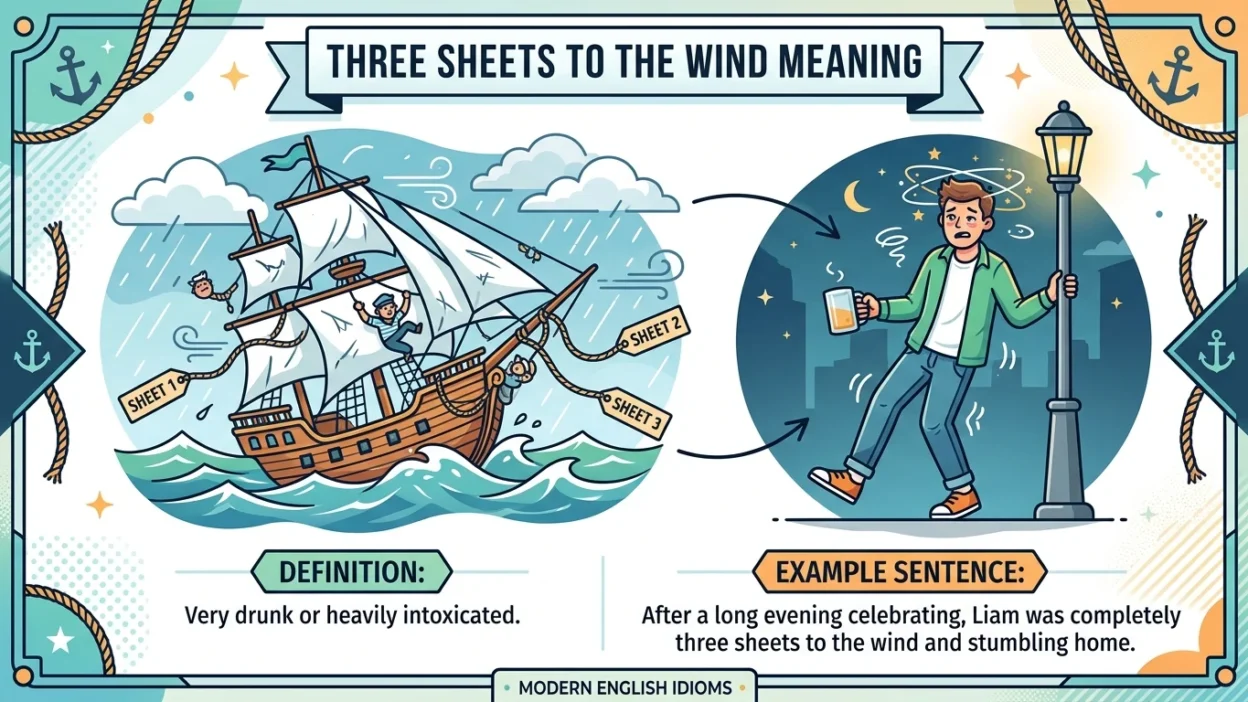
“Three sheets to the wind” is an informal English idiom meaning very drunk or heavily intoxicated. It is usually used humorously or figuratively to describe someone who has had too much alcohol and is behaving unsteadily, confusedly, or foolishly.
The expression has a nautical origin and is one of several English idioms connected to sailing.
Quick Answer
Three sheets to the wind means very drunk or extremely intoxicated.
By midnight, he was three sheets to the wind.
This means:
By midnight, he was very drunk.
The expression is informal and often humorous.
What Does “Three Sheets to the Wind” Mean?
When someone is three sheets to the wind, they are usually extremely drunk.
The phrase can describe someone who:
- Has consumed too much alcohol
- Is staggering or unsteady
- Is speaking unclearly
- Is behaving foolishly
- Has difficulty standing or walking
- Is heavily intoxicated
For example:
After several drinks, he was three sheets to the wind.
This means he was very drunk.
Is “Three Sheets to the Wind” Always About Alcohol?
Traditionally, the idiom refers specifically to drunkenness.
However, people sometimes use it humorously to describe someone who appears extremely confused, exhausted, disoriented, or out of control.
For example:
After working all night, I was three sheets to the wind.
This is a playful, nonliteral use, but the traditional meaning remains very drunk.
What Does “Three Sheets” Mean?
The word sheet in this expression does not refer to a bed sheet.
In nautical terminology, a sheet is a rope or line used to control the position of a sail.
So the phrase has a sailing-related origin.
What Does “To the Wind” Mean?
The traditional explanation connects the expression with sails and ropes.
If a ship’s sheets become loose, the sails can flap or hang loosely in the wind. A ship with multiple loose sheets would be difficult to control.
The image of a ship becoming increasingly unstable is thought to have contributed to the expression’s association with drunkenness.
Where Did “Three Sheets to the Wind” Come From?
The expression has a nautical background, although the exact historical development of the phrase is debated.
Sheet was a nautical term for a rope controlling a sail. A loose sheet could allow a sail to flap around in the wind.
The phrase eventually became associated with a person who was unsteady and difficult to control, much like a poorly controlled ship.
The expression is now firmly established as an idiom meaning very drunk.
How to Use “Three Sheets to the Wind”
The phrase is generally used after a linking verb such as be, get, or end up.
Examples
He was three sheets to the wind.
She got three sheets to the wind at the party.
By the end of the night, they were three sheets to the wind.
He came home three sheets to the wind.
After drinking all evening, she was completely three sheets to the wind.
“Three Sheets to the Wind” in a Sentence
Here are some natural examples:
He was three sheets to the wind by midnight.
They got three sheets to the wind after the celebration.
My uncle came home three sheets to the wind.
She was so three sheets to the wind that she could barely walk.
The sailors were reportedly three sheets to the wind after the long voyage.
Three Sheets to the Wind vs Drunk
Drunk is the straightforward word.
Three sheets to the wind is an idiomatic and humorous way of saying someone is very drunk.
Compare:
He was drunk.
Simple and direct.
He was three sheets to the wind.
More colorful, informal, and humorous.
Three Sheets to the Wind vs Tipsy
These expressions describe different levels of intoxication.
Tipsy usually means slightly drunk.
She was a little tipsy after one glass of wine.
Three sheets to the wind suggests much heavier drunkenness.
By the end of the party, he was three sheets to the wind.
So:
Tipsy → mildly drunk
Drunk → intoxicated
Three sheets to the wind → very drunk
Similar Expressions
English has many informal expressions for being drunk.
Three Sheets to the Wind
He was three sheets to the wind.
Wasted
He got completely wasted.
This is very informal and can suggest extreme intoxication.
Hammered
He was hammered last night.
Very informal.
Plastered
She was plastered by the end of the evening.
Very informal.
Under the Influence
He was driving under the influence.
This is much more formal and is often used in legal contexts.
Is “Three Sheets to the Wind” Formal?
No.
“Three sheets to the wind” is an informal idiom.
It works well in:
- Casual conversations
- Humorous writing
- Fiction
- Informal storytelling
- Movies and television
- Informal articles
It is generally not appropriate for formal or professional writing when a precise term such as intoxicated is more suitable.
Common Mistakes
Saying “three sheet to the wind”
The established expression is:
three sheets to the wind ✅
Because three is plural, sheets should also be plural.
Thinking “sheets” means bed sheets
In the original nautical imagery, sheets refer to ropes or lines used to control sails, not bedding.
Taking the phrase literally
Someone who is three sheets to the wind does not literally have three sheets blowing around them.
It is an idiom meaning:
very drunk
Can You Say “Two Sheets to the Wind”?
You may occasionally hear variations such as “one sheet to the wind” or “two sheets to the wind,” but “three sheets to the wind” is the established idiomatic expression.
The traditional phrase is:
three sheets to the wind
“Three Sheets in the Wind” vs “Three Sheets to the Wind”
The established expression is:
three sheets to the wind ✅
Not:
❌ three sheets in the wind
The preposition to is part of the traditional idiom.
Quick Comparison Table
| Expression | Meaning | Tone |
|---|---|---|
| Three sheets to the wind | Very drunk | Informal, humorous |
| Drunk | Intoxicated | Neutral |
| Tipsy | Slightly drunk | Informal |
| Wasted | Extremely drunk | Very informal |
| Intoxicated | Under the influence of alcohol | Formal |
| Under the influence | Affected by alcohol or drugs | Formal/legal |
Easy Memory Trick
Imagine a sailing ship with several sails becoming loose in a strong wind.
The ship becomes unstable and difficult to control.
Now imagine a person who has had too much to drink. They are also unsteady and difficult to control.
That gives you:
Three sheets to the wind = very drunk
Final Verdict
“Three sheets to the wind” is an informal idiom meaning very drunk or heavily intoxicated.
It comes from nautical terminology, where a sheet is a rope or line used to control a sail. The expression creates the humorous image of a person being as unsteady and difficult to control as a ship with loose sails.
For example:
He was three sheets to the wind by midnight.
This simply means:
He was very drunk by midnight.
Remember that the phrase is informal, so use “intoxicated” or another more neutral term when writing in a formal or professional context.
FAQs
What does “three sheets to the wind” mean?
It means very drunk or heavily intoxicated.
Is “three sheets to the wind” an idiom?
Yes. It is an informal English idiom with a nautical origin.
Why does “three sheets to the wind” mean drunk?
The phrase comes from nautical terminology. Sheets were ropes used to control sails, and loose sheets could make a ship unstable and difficult to control. This imagery became associated with drunken behavior.
Is “three sheets to the wind” formal?
No. It is an informal and often humorous expression.
Can I use “three sheets to the wind” for someone who is slightly drunk?
Usually, no. The phrase generally suggests heavy drunkenness. Tipsy is more appropriate for someone who is only slightly drunk.
Is “three sheets in the wind” correct?
The established idiom is “three sheets to the wind.”
What is another word for “three sheets to the wind”?
Depending on the context, you could use very drunk, heavily intoxicated, wasted, hammered, or plastered. Some of these alternatives are highly informal.
Conclusion
“Three sheets to the wind” is a colorful English idiom that means very drunk or heavily intoxicated. Its nautical background gives it the image of a ship becoming unstable when its sail ropes are loose, which fits the unsteady behavior associated with heavy drunkenness.
Because the expression is informal and often humorous, it is best suited to casual conversation, storytelling, and informal writing. If you need a more neutral or professional term, “intoxicated” is a better choice.

Nancy Lisa is a passionate writer and contributor at DrameyHut, focused on uncovering the deeper meanings behind dreams. She creates engaging and insightful content that helps readers interpret their dreams and understand their subconscious thoughts. Her work inspires self-reflection, clarity, and a stronger connection to inner emotions.