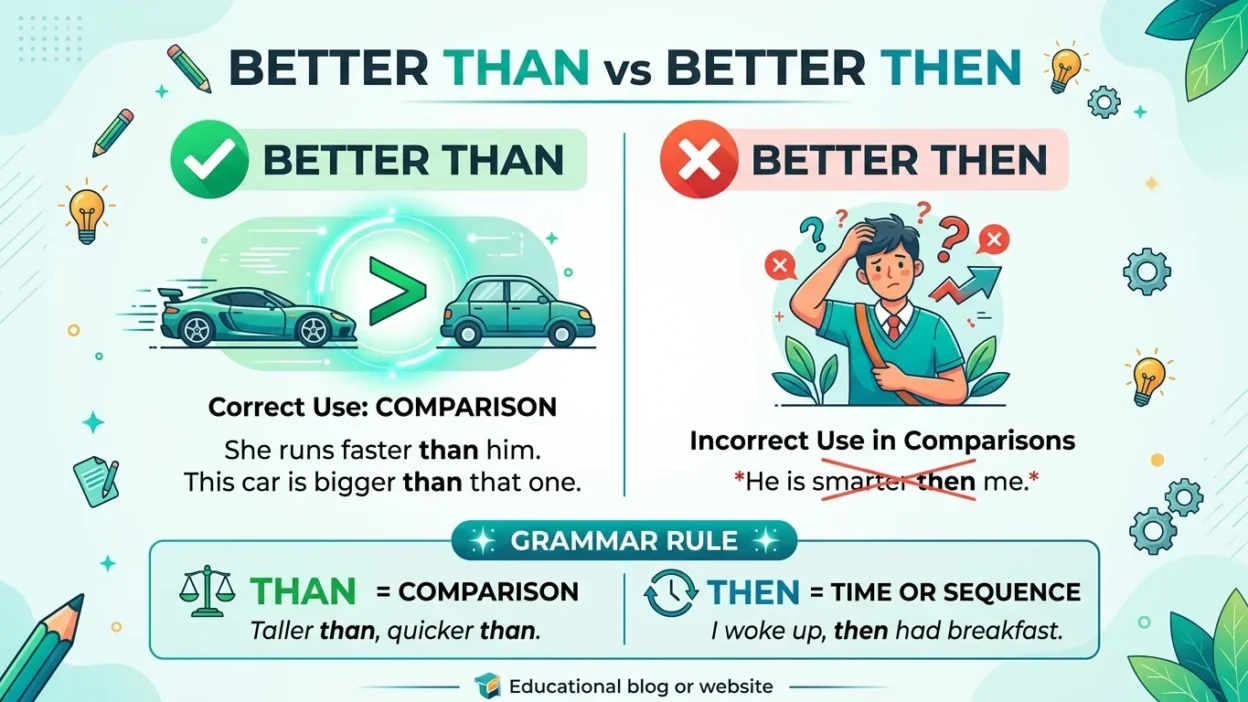
“Better than” and “better then” sound similar when spoken, but only one is correct when you are making a comparison. The correct expression is “better than.”
Than is used for comparisons, while then is mainly used to talk about time, sequence, or what happens next.
Quick Answer
Better than ✅ = correct for comparisons
Better then ❌ = incorrect when you mean “better in comparison with”
For example:
This phone is better than my old one. ✅
Not:
This phone is better then my old one. ❌
What Does “Better Than” Mean?
Better than is used when comparing two or more people, things, actions, or situations.
Better is the comparative form of good or well, and than introduces the thing being compared.
Examples
This book is better than the movie.
She is better than me at tennis.
Today is better than yesterday.
I feel better than I did last week.
He can do it better than I can.
In each example, than introduces the comparison.
What Does “Better Then” Mean?
Better then is usually a spelling mistake when someone intends to write better than.
For example:
❌ This option is better then the other one.
✅ This option is better than the other one.
However, then itself is a correct English word. It simply has a different meaning.
Then is generally related to time, sequence, or consequence, not comparison.
Than vs Then
The easiest way to understand the difference is:
Than = comparison
Then = time or sequence
Than
She is taller than her brother.
This is better than that.
He runs faster than I do.
Then
We went home then.
Finish your work, then call me.
I lived there then.
If you’re ready, then let’s go.
Better Than: Common Uses
Comparing Two Things
This restaurant is better than the other one.
Comparing Abilities
She sings better than I do.
Comparing Experiences
Today feels better than yesterday.
Comparing Choices
Taking the train is better than driving.
Giving an Opinion
I think this option is better than the first one.
Better Than vs Better Then Examples
Correct
This plan is better than the previous one. ✅
Incorrect
This plan is better then the previous one. ❌
Correct
She performed better than expected. ✅
Incorrect
She performed better then expected. ❌
Correct
I feel better than before. ✅
Incorrect
I feel better then before. ❌
When “Then” Can Follow “Better”
Although “better then” is normally incorrect for comparisons, there are sentences where better and then happen to appear next to each other for completely different grammatical reasons.
For example:
If you know a better solution, then tell me.
Here, then is not part of better than. It means something like “in that case.”
Another example:
Things were better then.
Here, then refers to a particular time in the past.
Life was better then than it is now.
Notice that this sentence contains both:
better then = better at that past time
than it is now = comparison
This distinction is important.
Better Then Can Sometimes Be Correct
“Better then” can be grammatically correct when then means “at that time” or is functioning as a sequence/consequence word.
For example:
Things were better then.
Meaning:
Things were better at that time.
Another example:
If you have a better idea, then let me know.
Here, then means “in that case.”
So “better then” is not always grammatically impossible. It is simply not a substitute for “better than” in a comparison.
Comparison Table
| Word | Main Meaning | Example |
|---|---|---|
| Than | Used for comparison | This is better than that. |
| Then | Time or sequence | We were happier then. |
| Better than | Makes a comparison | She is better than me. |
| Better then | Usually a mistake for better than | ❌ He is better then me. |
Common Mistakes
Mistake 1: Using “then” for a comparison
❌ This is better then that.
✅ This is better than that.
Mistake 2: Confusing “than” and “then”
❌ She is taller then me.
✅ She is taller than me.
Mistake 3: Thinking “then” is always wrong after “better”
Not necessarily.
Things were better then.
This is correct because then means “at that time.”
Easy Memory Trick
Remember:
Than = comparison
Then = time
If you are comparing two things, use than:
Better than.
Faster than.
Bigger than.
More expensive than.
If you are talking about what happened next or when something happened, use then:
First we ate, then we left.
Things were different then.
Better Than in Common Expressions
You will often see better than in these phrases:
- Better than ever
- Better than before
- Better than expected
- Better than nothing
- Better than average
- Better than most
- Better than usual
- Better than I thought
- Better than you think
- Better than it looks
Examples
She is doing better than ever.
The results were better than expected.
This is better than nothing.
He performed better than I thought.
“Better Than Ever”
One especially common expression is:
Better than ever
It means something is now better than it has been at any previous time.
The company is doing better than ever.
I feel better than ever.
Not:
❌ I feel better then ever.
“Better Than Before”
Another common expression is:
Better than before
The new version is better than before.
Here, than introduces the comparison with an earlier state.
“Better Then Than Now”
This sentence is useful for understanding the difference:
Things were better then than now.
The first then means “at that time.”
The second than introduces a comparison.
More naturally:
Things were better then than they are now.
So the two words can appear in the same sentence but perform completely different jobs.
Final Verdict
When you are making a comparison, the correct expression is:
better than ✅
For example:
This option is better than the other one.
Then is used mainly for time, sequence, or consequence:
Things were better then.
Finish this, then call me.
So remember:
Than = comparison
Then = time or sequence
If you’re comparing something, always choose “better than,” not “better then.”
FAQs
Is it “better than” or “better then”?
For comparisons, the correct expression is “better than.”
This is better than that. ✅
What is the difference between than and then?
Than is mainly used for comparisons, while then refers to time, sequence, or consequence.
She is better than me.
We ate, then we left.
Is “better then” always wrong?
No. Better then can be correct when then means “at that time.”
Things were better then.
But it is incorrect if you are using then to introduce a comparison.
Why do people confuse “than” and “then”?
They are pronounced similarly, especially in fast speech. Their similar spelling also makes them easy to confuse.
Is “better than before” correct?
Yes.
This version is better than before. ✅
Is “better than ever” correct?
Yes.
She is doing better than ever. ✅
Is “better then ever” correct?
No.
❌ better then ever
✅ better than ever
Conclusion
“Better than” is the correct expression when making a comparison. Than introduces the person, thing, or situation being compared, as in “This option is better than the other one.”
Then has a different function. It is used mainly to refer to time, sequence, or consequence, as in “Things were better then” or “Finish your work, then go home.”
The easiest rule is simple: than = comparison, then = time or sequence. So when you want to compare something, always use “better than.”

Daniel Charles is a dedicated author and dream interpretation enthusiast at DrameyHut. He specializes in analyzing dream symbols and meanings, offering clear and insightful content for readers. His work aims to help individuals understand their subconscious thoughts, gain clarity, and explore the deeper messages hidden within their dreams.