When you repeat something you said earlier, you may wonder whether you should put your own words inside quotation marks. This is often called a self quote or quoting yourself. The answer depends on whether you are reproducing your exact earlier words or simply expressing the same idea again.
If you are deliberately presenting your previous words as a quotation, you can use quotation marks even when you are the person who originally said them.
There is no grammatical rule that says quotation marks can only be used for someone else’s words. However, you should make it clear that you are referring to your earlier statement rather than creating the impression that someone else said it.
For example, if you previously said, “I will finish the project today,” you can later write, I said, “I will finish the project today.” The quotation marks are appropriate because you are reproducing your own exact words.
Quick Answer
Yes, you can quote yourself using quotation marks. If you are repeating your exact earlier words, quotation marks are appropriate, even if you are the original speaker. If you are only restating your idea in different words, quotation marks are generally unnecessary. The key is whether you are presenting the words as an actual quotation.
What Is a Self Quote?
A self quote is when you quote something that you previously said or wrote.
For example:
I said, “I need more time to finish the project.”
If you were the person who originally said “I need more time to finish the project,” you are quoting yourself.
There is nothing grammatically wrong with this.
Quotation marks identify the words as a quotation. They do not require the original speaker to be a different person.
Another Example
Suppose you said yesterday:
“We should postpone the meeting.”
Today, you could say:
As I said yesterday, “We should postpone the meeting.”
The quotation marks show that you are deliberately reproducing your earlier words.
Can You Quote Yourself?
Yes.
There is no general English grammar rule prohibiting someone from quoting their own words.
You might quote yourself when:
- Referring back to something you said earlier
- Repeating a statement from a previous conversation
- Referring to something you wrote
- Giving a speech or presentation
- Explaining your position
- Reproducing a previous statement in an article
- Documenting what you previously said
For example:
I told the team, “We need to finish this by Friday.”
If those were your own words, quotation marks are still correct.
When Should You Use Quotation Marks for Your Own Words?
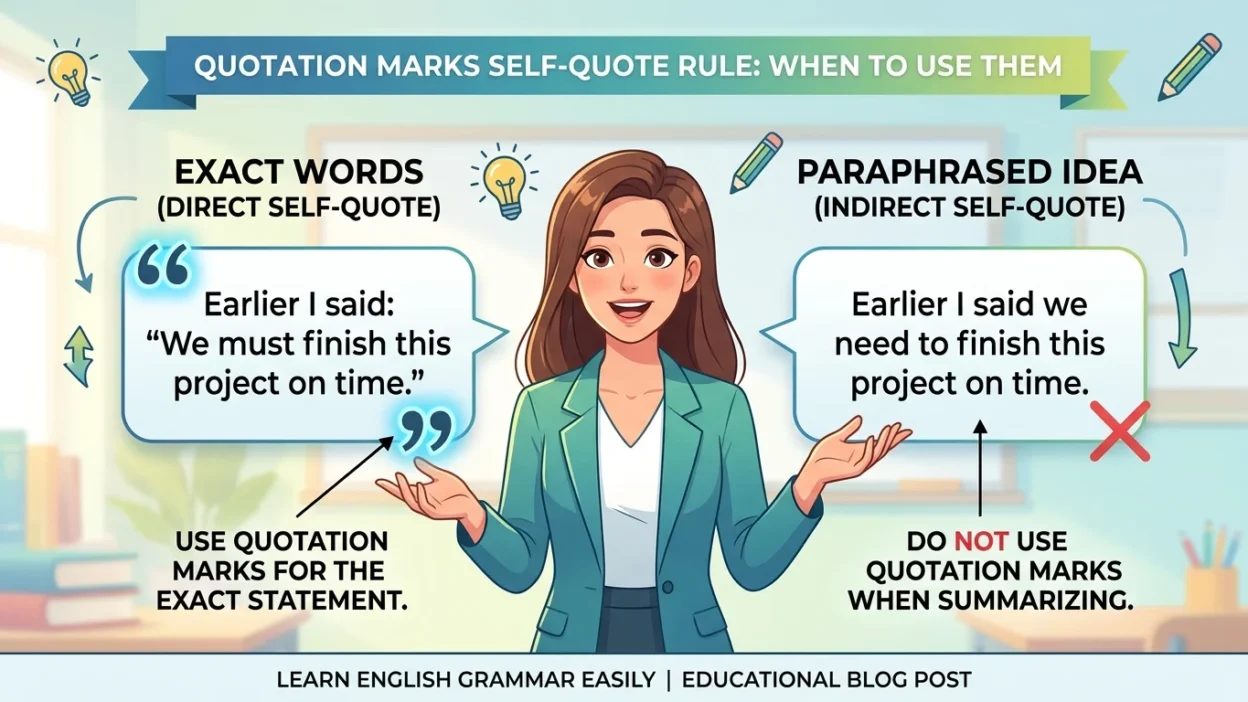
Use quotation marks when you want to present the words as an exact quotation.
Compare these two sentences:
I said that we needed to leave early.
I said, “We need to leave early.”
The first sentence reports the meaning of what you said.
The second presents your actual words.
This distinction is important.
Exact Words
I said, “I don’t agree with the proposal.”
Quotation marks show that these are the exact words being quoted.
Paraphrase
I said that I didn’t agree with the proposal.
There are no quotation marks because the sentence reports the idea rather than reproducing the exact wording.
Quoting Yourself in an Article
You can quote yourself in an article, blog post, essay, or other written work if you are referring to something you previously said or wrote.
For example:
In my previous article, I wrote, “Clear writing should make complex ideas easier to understand.”
Here, quotation marks indicate the exact words from your earlier writing.
If you are referring to your earlier idea without reproducing the exact wording, you can write:
In my previous article, I argued that clear writing should make complex ideas easier to understand.
No quotation marks are necessary because this is a paraphrase.
Quoting Yourself in a Conversation
Self quotation can also occur in ordinary conversation.
For example:
I told you, “I don’t want to go.”
The speaker is referring to their own previous words.
Another example:
As I said earlier, “This isn’t going to work.”
This is completely understandable and grammatically acceptable.
However, in casual conversation, speakers often do not reproduce their exact words. They may simply say:
As I said earlier, this isn’t going to work.
Whether quotation marks are needed depends on the context because spoken language does not literally display punctuation. In writing, quotation marks help signal that the wording is being presented as a quotation.
Quoting Yourself in an Email
You can quote yourself in an email, particularly when referring to something you previously wrote.
For example:
As I mentioned in my previous email, “The revised document will be ready by Friday.”
This can be useful when you want to emphasize exactly what you previously promised or stated.
You can also use a shorter form:
As I said earlier, “We need everyone’s approval before proceeding.”
Self Quote vs Paraphrase
This is one of the most important distinctions.
| Situation | Quotation Marks? | Example |
|---|---|---|
| Exact previous words | Yes | I said, “We need more time.” |
| Paraphrasing your previous words | No | I said that we needed more time. |
| Referring generally to an idea | No | I previously argued that the plan was risky. |
| Reproducing a written statement | Yes | I wrote, “The results are inconclusive.” |
| Referring to a title or special term | Depends on style | See the section title “Results.” |
The basic rule is:
Exact words → quotation marks.
Restated idea → no quotation marks.
Do Quotation Marks Mean Someone Else Said It?
No.
Quotation marks do not mean that someone else must have said the words.
They indicate that the enclosed words are being presented as a quotation.
The speaker can be:
- Another person
- Yourself
- A character
- An organization
- A historical figure
- A source or document
For example:
I said, “I’m ready.”
You are quoting yourself.
Similarly:
Sarah said, “I’m ready.”
You are quoting Sarah.
The grammatical function of the quotation marks is the same.
“I Said” With a Self Quote
A common structure is:
I said, “…”
For example:
I said, “I’ll call you tomorrow.”
If you are reporting your own earlier words, this is perfectly acceptable.
You can also use:
I told him, “I’ll call you tomorrow.”
I wrote, “The results need further investigation.”
I explained, “We don’t have enough evidence yet.”
The important point is that the words inside quotation marks are being presented as the actual words used.
Should You Quote Yourself If You Are Speaking Again?
Not necessarily.
If you are simply making the statement again, you do not need quotation marks.
For example:
I said yesterday that I was tired.
You are not necessarily quoting your exact words.
But:
I said yesterday, “I’m tired.”
clearly presents the earlier wording as a direct quotation.
This distinction is particularly important in formal writing.
Self Quote in Academic Writing
Academic writing requires particular care.
You can quote your own previously published work, but if the earlier work is published or otherwise used as a source, you may need to cite it according to the required citation style.
Quotation marks alone do not replace a citation.
For example:
In my earlier study, I wrote, “The findings require further investigation” (Author, Year, p. X).
The exact citation format depends on the style being used, such as APA, MLA, Chicago, or another system.
If you are quoting your own unpublished notes or an earlier statement in the same document, the situation may be different.
The important principle is that quotation marks show quoted wording, while citations identify the source when a formal citation is required.
Self Quote and Plagiarism
Quoting yourself does not automatically mean there is a plagiarism problem.
However, in academic publishing, reusing your own previously published material without proper acknowledgment can raise issues of self plagiarism or duplicate publication.
If you are reusing substantial wording from your own earlier publication, follow the rules of the relevant institution, publisher, or citation style.
For ordinary personal writing, this is generally not an issue.
Quotation Marks for Emphasis
Another common question is whether you can put your own words in quotation marks simply to emphasize them.
Usually, quotation marks should not be used merely for emphasis.
For example:
This is a “very important” rule.
If “very important” is simply your own emphasis, the quotation marks can make the reader wonder whether you are being sarcastic or whether someone else used those words.
Better alternatives include:
This is a very important rule.
or simply:
This is a very important rule.
Quotation marks have specific functions and should not be treated as general-purpose emphasis marks.
Quotation Marks Around a Word You Just Used
Sometimes writers put quotation marks around a word to signal that they are using it in a special, unusual, ironic, or nonliteral way.
For example:
He was “helping” me by deleting the files.
Here, the quotation marks may suggest that the writer does not really consider the action helpful.
This is different from a self quote.
The quotation marks are not saying that you previously said “helping.” They are signaling a particular attitude toward the word.
Single vs Double Quotation Marks
The choice between single and double quotation marks depends largely on the style and variety of English.
American English generally uses double quotation marks for ordinary direct quotations:
She said, “I’ll be there soon.”
British English often uses single quotation marks as the primary quotation style:
She said, ‘I’ll be there soon.’
However, style guides and individual publications can have their own conventions.
The important thing is to follow one consistent style.
Quotation Marks Inside a Quotation
If you quote yourself and the quotation itself contains another quotation, you may need a second level of quotation marks.
For example:
I said, “John told me, ‘I’ll call tomorrow.’”
The exact style can vary between American and British conventions.
The principle is that different levels of quotation should be clearly distinguished.
Common Mistakes
1. Thinking you cannot quote yourself
This is a common misconception.
You can quote yourself.
I said, “I will finish it today.”
is perfectly grammatical.
2. Using quotation marks around a paraphrase
Incorrect or misleading:
I said, “I needed more time,” when your original words were actually “I couldn’t finish it today.”
If you are not reproducing the actual words, do not present them as a direct quotation.
Better:
I said that I needed more time.
3. Using quotation marks just for emphasis
Quotation marks are not normally needed simply because you want to emphasize a word.
Use bold or italics where appropriate, depending on the writing style.
4. Assuming quotation marks prove a statement is authentic
Quotation marks indicate that wording is being presented as a quotation, but in formal or academic writing, the source may still need to be identified.
5. Mixing quotation styles
Choose a consistent convention for single and double quotation marks and follow the style guide required for your writing.
American vs British English
The basic rule about self quotation is the same in both American and British English.
You can quote your own words in either variety.
The main difference is often the preferred quotation-mark style.
American English commonly uses double quotation marks for primary quotations.
British English often uses single quotation marks, although conventions vary by publication and style guide.
Thus:
American style:
I said, “I’ll be back.”
Common British style:
I said, ‘I’ll be back.’
Both clearly indicate a direct quotation.
Memory Trick
Remember this simple rule:
Exact words = quote them.
Same idea = paraphrase it.
For example:
I said, “We need more time.”
This presents the exact words.
But:
I said that we needed more time.
This presents the idea without claiming to reproduce the exact wording.
And remember:
You can quote yourself because quotation marks identify quoted words, not the identity of the speaker.
Final Verdict
Yes, you can quote yourself, and there is no general grammar rule against doing so.
Use quotation marks when you are deliberately reproducing your own exact earlier words:
I said, “We need to leave now.”
If you are merely summarizing or paraphrasing what you previously said, quotation marks are unnecessary:
I said that we needed to leave.
The most important rule is not who said the words. It is whether you are presenting the words as an exact quotation.
Also, do not use quotation marks simply for emphasis unless you have a specific reason, such as signaling irony, skepticism, or an unusual use of a word.
FAQs
Can I use quotation marks for my own words?
Yes. You can use quotation marks when you are presenting your own previous words as a direct quotation.
Can you quote yourself in an essay?
Yes. If you are referring to your own previous words, you can quote yourself. In academic writing, you may also need a citation if the quotation comes from previously published work.
Is it grammatically correct to say “I said, ‘…’”?
Yes. This is a standard structure for introducing a direct quotation, including a quotation of your own words.
Do quotation marks mean someone else said it?
No. Quotation marks identify words being presented as a quotation. The original speaker can be you.
Should I use quotation marks when paraphrasing myself?
No. If you are expressing the same idea in different words, it is a paraphrase rather than a direct quotation.
Can I put quotation marks around a word for emphasis?
You can in certain contexts, such as irony or a special use, but quotation marks should not normally be used simply as general emphasis.
Is “self quote” one word or two?
Self quote is commonly written as two words when used as a noun or informal term. You may also see self-quote with a hyphen, depending on style.
Can I quote something I said earlier in the same conversation?
Yes. If you are reproducing your earlier words as a direct quotation, quotation marks can be used.
Conclusion
The self quote rule is actually quite simple: you can quote yourself whenever you want to present your own previous words as a direct quotation. English quotation marks do not require the quoted speaker to be another person.
The important distinction is between quoting and paraphrasing. If you reproduce the exact wording, quotation marks are appropriate. If you merely restate the meaning in your own words, quotation marks are generally unnecessary.
So, if you are writing an article, sending an email, preparing a speech, or discussing something you said earlier, remember that quotation marks are about quoted wording, not about if the speaker is someone else.
Remember This
You can quote yourself.
Exact words → quotation marks
I said, “I need more time.”
Paraphrased idea → no quotation marks
I said that I needed more time.
The key question is:
“Am I reproducing the actual words?”
If yes, quotation marks are appropriate. If not, paraphrase without quotation marks.

Daniel Charles is a dedicated author and dream interpretation enthusiast at DrameyHut. He specializes in analyzing dream symbols and meanings, offering clear and insightful content for readers. His work aims to help individuals understand their subconscious thoughts, gain clarity, and explore the deeper messages hidden within their dreams.