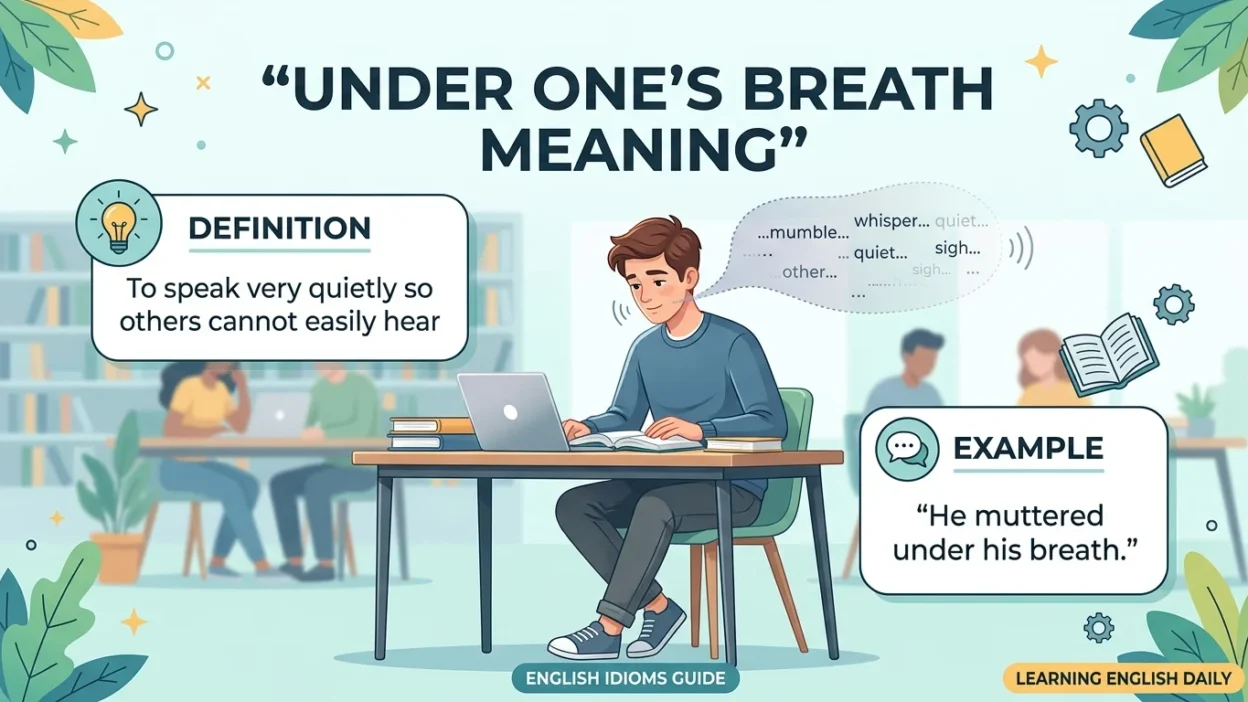
“Under one’s breath” is a common English idiom meaning to say something very quietly so that other people cannot easily hear it. It is often used when someone is muttering, complaining, expressing annoyance, or making a private comment.
For example:
She complained under her breath.
This means she complained quietly, so that others would not clearly hear her.
Quick Answer
Under one’s breath means speaking very quietly or muttering, usually so that other people cannot hear clearly.
He muttered something under his breath.
In simple English:
He said something very quietly.
The phrase is often associated with anger, frustration, embarrassment, disagreement, or private comments, although it can also be used neutrally.
What Does “Under One’s Breath” Mean?
When someone says something under their breath, they speak so softly that the words are difficult for others to hear.
The expression does not literally mean that the words are spoken underneath someone’s physical breath. It is a figurative expression describing quiet speech or muttering.
For example:
“This is ridiculous,” he said under his breath.
He said it quietly, probably because he did not want everyone around him to hear.
Examples of “Under One’s Breath”
Example 1
She muttered under her breath when her boss criticized her.
She spoke quietly because she did not want her boss to hear her comment.
Example 2
“I can’t believe this,” he said under his breath.
He expressed his frustration quietly.
Example 3
He was complaining under his breath throughout the meeting.
He was complaining quietly enough that people could barely hear him.
Example 4
She whispered something under her breath and walked away.
She said something very quietly.
Example 5
“This is going to take forever,” Tom muttered under his breath.
Tom expressed his frustration quietly.
“Mutter Under One’s Breath”
The phrase frequently appears with the verb mutter.
He muttered under his breath.
Mutter means to speak in a low, unclear voice, often because you are annoyed or do not want others to hear.
Other examples include:
She muttered under her breath about the long wait.
He muttered something under his breath.
“Typical,” she muttered under her breath.
This combination is extremely natural in English.
“Say Under One’s Breath”
You can also use say:
He said something under his breath.
This means he said something very quietly.
For example:
She said a few words under her breath before leaving.
The phrase can be used with many speech verbs, including:
- Mutter
- Say
- Whisper
- Complain
- Grumble
- Curse
- Swear
- Remark
“Curse Under One’s Breath”
This is a particularly common use.
He cursed under his breath when he dropped his phone.
It means he quietly used a swear word or expressed anger.
Another example:
She swore under her breath after missing the train.
She expressed her frustration quietly.
“Complaining Under One’s Breath”
The phrase is often used when someone is unhappy but does not openly express their feelings.
He was complaining under his breath about the new rules.
The person is complaining, but not loudly or openly.
“Laugh Under One’s Breath”
Although less common, the expression can sometimes be used in humorous contexts.
She laughed under her breath when she saw his reaction.
Here, it means she laughed very quietly, perhaps trying not to be noticed.
However, “under one’s breath” is especially common with speech that expresses annoyance or criticism.
Under One’s Breath vs Whisper
These expressions are similar but not identical.
Whisper means to speak very softly.
She whispered to her friend.
Under one’s breath emphasizes that someone is speaking quietly and often privately or almost inaudibly.
She complained under her breath.
Someone can whisper directly to another person, while speaking under their breath often suggests that the speaker doesn’t intend others to hear.
Under One’s Breath vs Out Loud
These expressions contrast with each other.
Out loud means speaking so that others can hear.
He said his opinion out loud.
Under his breath means speaking quietly, often so that others cannot hear.
He complained under his breath.
Compare:
She criticized the decision out loud.
She openly expressed her criticism.
She criticized the decision under her breath.
She expressed her criticism quietly and indirectly.
Under One’s Breath vs In a Whisper
Both can describe quiet speech, but there is a slight difference.
In a whisper focuses on the volume and manner of speaking.
She spoke in a whisper.
Under one’s breath often suggests quiet, private, or muttered speech, sometimes because the speaker does not want to be heard.
He complained under his breath.
Is “Under One’s Breath” an Idiom?
Yes. “Under one’s breath” is a common English idiom.
Its figurative meaning is:
to speak very quietly, usually so that others cannot clearly hear
The phrase is widely used in everyday English and appears frequently in novels, conversations, journalism, and other writing.
Why Do We Say “Under One’s Breath”?
The expression creates the image of words being spoken so quietly that they remain close to the speaker rather than being projected outward for everyone to hear.
It is not meant literally. Under refers figuratively to the quiet, restrained way in which the words are spoken.
Grammar and Pronouns
The possessive pronoun changes depending on the subject.
First Person
I said it under my breath.
Second Person
You said it under your breath.
Third Person Singular
He said it under his breath.
She said it under her breath.
Plural
They said it under their breath.
So the basic structure is:
under + possessive adjective + breath
Examples:
my breath
your breath
his breath
her breath
their breath
“Under His Breath” Meaning
Under his breath means that a man or boy says something very quietly, usually so that others cannot hear clearly.
He muttered under his breath.
Meaning:
He spoke very quietly.
“Under Her Breath” Meaning
Under her breath means that a woman or girl says something very quietly.
She complained under her breath.
Meaning:
She complained quietly.
“Under My Breath” Meaning
Under my breath means that I said something very quietly.
I muttered under my breath because I was annoyed.
“Under Their Breath” Meaning
Under their breath is used when multiple people speak quietly.
They were whispering under their breath during the presentation.
Is “Under One’s Breath” Formal?
It is neither particularly formal nor slang. It is a standard idiomatic expression that works in both everyday and written English.
For example:
He muttered under his breath.
This is perfectly natural in ordinary conversation and professional storytelling.
However, if you are writing a highly technical document, a literal description such as “spoke quietly” may be more appropriate.
Common Mistakes
Mistake 1: “Under one’s breaths”
The usual expression uses singular breath.
He spoke under his breath. ✅
Not:
❌ He spoke under his breaths.
Mistake 2: “Below one’s breath”
The established idiom is:
under one’s breath ✅
Not:
❌ below one’s breath
Mistake 3: “Under his breathe”
The noun is spelled breath, not breathe.
under his breath ✅
Breath = the air you take in or release.
Breathe = the verb meaning to take air in and release it.
Mistake 4: Assuming it always means whispering
Speaking under one’s breath does not necessarily mean a deliberate whisper to another person. It often suggests muttering or speaking quietly to oneself.
Under One’s Breath in a Sentence
Here are some natural examples:
He apologized under his breath.
She muttered under her breath.
I complained under my breath.
He cursed under his breath.
She said something under her breath.
They grumbled under their breath.
“Not again,” he muttered under his breath.
Quick Comparison Table
| Expression | Meaning | Example |
|---|---|---|
| Under one’s breath | Speak very quietly | He muttered under his breath. |
| Whisper | Speak very softly | She whispered to me. |
| Out loud | Speak so others can hear | He said it out loud. |
| Mutter | Speak quietly and unclearly | He muttered a complaint. |
| Grumble | Complain in a low or annoyed voice | She grumbled about the delay. |
Easy Way to Remember
Think:
Under your breath = so quietly that your words barely leave you.
If someone says something under their breath, they usually don’t want everyone around them to hear it.
For example:
“I hate waiting,” she said under her breath.
She is expressing her frustration, but she is doing it quietly.
Final Verdict
“Under one’s breath” means to say something very quietly, often so that other people cannot hear clearly. It is commonly used with verbs such as mutter, complain, grumble, curse, and say.
For example:
He muttered under his breath.
This means:
He spoke very quietly, probably so others would not hear him.
The expression can describe anger, frustration, criticism, embarrassment, or simply quiet speech.
Remember the common forms:
under my breath
under your breath
under his breath
under her breath
under their breath
And be careful not to confuse breath with breathe.
FAQs
What does “under one’s breath” mean?
Under one’s breath means speaking very quietly, usually so that other people cannot clearly hear what is being said.
What does “mutter under your breath” mean?
It means to say something quietly and often unclearly, usually because you are annoyed, frustrated, or don’t want others to hear you.
Is “under one’s breath” an idiom?
Yes. It is a common English idiom meaning to speak very quietly or privately.
Does “under one’s breath” mean whispering?
Not exactly. Both involve quiet speech, but under one’s breath often suggests muttering or saying something privately, while whispering can involve quietly speaking directly to another person.
Is “under one’s breath” negative?
Not always. It is frequently used for complaints, criticism, or frustration, but it can also describe any very quiet speech.
Is it “under your breath” or “under your breathe”?
The correct expression is “under your breath.”
Breath is the noun, while breathe is the verb.
What is the opposite of “under one’s breath”?
A natural opposite is “out loud” or “aloud.”
He said it out loud.
This means he spoke so that others could hear.
Conclusion
“Under one’s breath” is a common English idiom meaning to speak very quietly, often so that others cannot clearly hear. It is especially common when someone is muttering, complaining, grumbling, or expressing frustration without openly addressing the people around them.
For example:
She complained under her breath.
means:
She complained quietly so that others would not clearly hear her.
The expression is flexible and can be used with different possessive pronouns, such as under my breath, under his breath, under her breath, and under their breath.
The easiest way to remember it is:
Under one’s breath = speaking quietly, often privately or almost inaudibly.

Joseph Richard is the administrator and a dedicated author at DrameyHut, overseeing the platform’s operations and content quality. Alongside his administrative role, he writes insightful articles on dream meanings, helping readers understand their subconscious mind. His work supports the mission of providing clear, meaningful, and engaging dream interpretations.