“Wonder” and “wander” are commonly confused English words because they look and sound similar. However, they have completely different meanings.
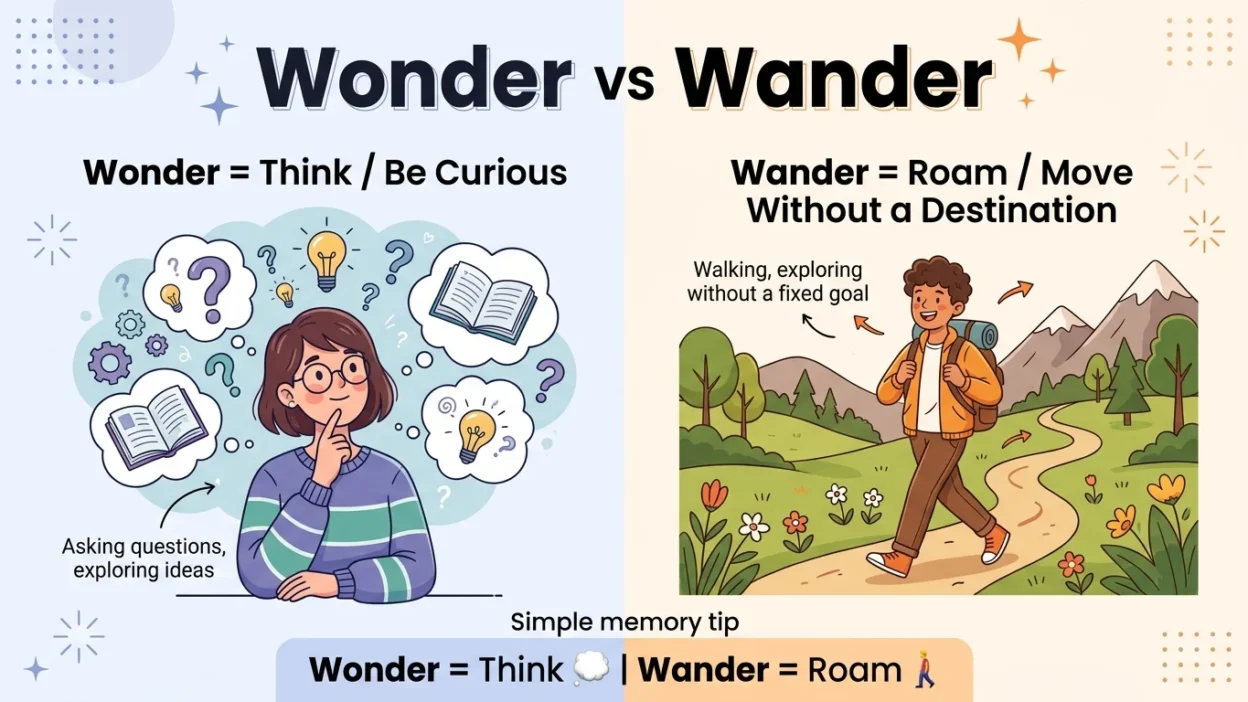
Wonder usually relates to thinking, curiosity, amazement, or a feeling of surprise. Wander means to move around without a clear destination or purpose.
Quick Answer
Wonder = to think about something, feel curious, or feel amazed.
I wonder where she went.
Wander = to walk or move around without a specific destination.
We wandered around the city for hours.
The easiest way to remember them is:
Wonder = think 💭
Wander = roam 🚶
What Does “Wonder” Mean?
Wonder has several related meanings.
As a verb, it can mean to think about something because you are curious about it.
I wonder what happened.
She wondered why he left early.
It can also mean to feel amazement or admiration.
I wonder at the beauty of the mountains.
As a noun, wonder can mean a feeling of amazement or something remarkable.
The Grand Canyon is a natural wonder.
The children looked at the fireworks in wonder.
What Does “Wander” Mean?
Wander means to move around without a particular destination, direction, or purpose.
We wandered through the streets.
He likes to wander around the park.
It can describe physical movement, but it can also be used figuratively.
For example:
My mind began to wander during the lecture.
Here, wander means that your thoughts started moving away from what you were supposed to be concentrating on.
Wonder vs Wander Pronunciation
The words have different vowel sounds.
Wonder
Wonder is pronounced approximately:
WUN-der
Wander
Wander is pronounced approximately:
WON-der
In many accents, the difference can be subtle, which is one reason learners sometimes confuse them.
Wonder vs Wander Examples
Wonder
I wonder what time the store closes.
Meaning: I am curious about what time it closes.
She wondered whether he would come.
Meaning: She thought about whether he would come.
I often wonder why people behave that way.
Meaning: I think about it because I am curious.
Wander
We wandered around the neighborhood.
Meaning: We walked around without a specific destination.
The tourists wandered through the market.
Meaning: They moved around the market casually.
Don’t wander too far from the group.
Meaning: Don’t move too far away without a specific direction.
Wonder vs Wander in a Sentence
Compare these sentences:
I wonder where he is.
Here, wonder means think or be curious.
I wander around the neighborhood.
Here, wander means walk around without a specific destination.
The difference is:
Wonder = a mental activity
Wander = physical or mental movement without a fixed direction
“I Wonder” Meaning
I wonder is extremely common in English.
It means:
I am curious about something.
For example:
I wonder what she’s doing.
I wonder where they went.
I wonder if he’ll call.
I wonder why she said that.
It can also be used as a polite way to introduce a question or request.
I wonder if you could help me.
This is a softer and more polite way of asking:
Could you help me?
“Wander Around” Meaning
Wander around means to move from place to place without a particular destination.
We wandered around the shopping mall.
She wandered around the city all afternoon.
He spent the morning wandering around the park.
It often suggests relaxed, aimless, or casual movement.
“Wander Off” Meaning
Wander off means to leave a place or group without intending to go very far or without a clear destination.
The child wandered off while his parents were shopping.
Don’t wander off without telling me.
The expression can also be used figuratively:
My thoughts wandered off during the meeting.
“Wonder About” Meaning
Wonder about means to think about something because you are curious.
I wonder about what happened to him.
She often wonders about her future.
Have you ever wondered about the meaning of that word?
Notice the difference:
I wonder about my future.
= I think about my future because I am curious.
I wander around my neighborhood.
= I walk around without a particular destination.
“Wonder If” vs “Wander”
These are particularly easy to confuse in writing.
I wonder if he will come.
Correct.
Here, wonder means be curious about whether something is true.
❌ I wander if he will come.
This is incorrect if you mean “I am curious whether he will come.”
Wonder vs Wander: Parts of Speech
Both words can be used in several grammatical ways.
Wonder as a Verb
I wonder what happened.
Wonder as a Noun
She looked at the painting in wonder.
Wander as a Verb
We wandered through the forest.
Wander is primarily used as a verb.
It can also have figurative uses:
His attention wandered during the lecture.
Figurative Meaning of Wander
Wander does not always involve walking.
It can describe thoughts, attention, or conversation moving away from the main subject.
Mind Wander
My mind started to wander.
This means you stopped concentrating and began thinking about unrelated things.
Thoughts Wander
Her thoughts wandered back to her childhood.
Her thoughts moved from the current subject to memories of her childhood.
Conversation Wander
The conversation wandered from politics to travel.
The conversation gradually moved away from its original topic.
Wonder vs Wander: Easy Memory Trick
A useful memory trick is:
Wonder = What?
When you wonder, you are asking yourself something:
I wonder what happened.
Think wonder = curiosity.
For wander, think:
Wander = walk around
You wander when you move around without a clear destination.
So:
Wonder = think 💭
Wander = walk/roam 🚶
Common Mistakes
Mistake 1: “I wander what happened”
❌ I wander what happened.
✅ I wonder what happened.
You are expressing curiosity, so wonder is correct.
Mistake 2: “We wondered around the city”
❌ We wondered around the city.
✅ We wandered around the city.
You are describing walking without a specific destination, so wandered is correct.
Mistake 3: “I wonder around the park”
❌ I wonder around the park.
✅ I wander around the park.
The correct verb for moving around aimlessly is wander.
Mistake 4: “I wandered if she was coming”
❌ I wandered if she was coming.
✅ I wondered if she was coming.
You are expressing uncertainty or curiosity, so use wondered.
Quick Comparison Table
| Word | Meaning | Example |
|---|---|---|
| Wonder | Think or be curious | I wonder what happened. |
| Wonder | Feel amazement | She looked at it in wonder. |
| Wander | Move without a clear destination | We wandered through the city. |
| Wander | Lose focus or move mentally | My mind wandered during class. |
Wonder vs Wander in Common Expressions
Common Expressions With Wonder
I wonder…
wonder about
wonder if
wonder why
in wonder
Examples:
I wonder if he’ll come.
She wondered why he was upset.
Common Expressions With Wander
wander around
wander off
wander through
wander away
mind wanders
Examples:
We wandered around the town.
The dog wandered off.
My mind wandered during the meeting.
Wonder vs Wander vs Wandering
Wonder:
I wonder what she means.
Wander:
We wander through the park.
Wandering:
We spent the afternoon wandering through the park.
Wandering is simply the -ing form of wander.
“Wonderful” and “Wandering”
The word wonderful comes from wonder, not wander.
She had a wonderful time.
Wandering comes from wander.
We went wandering through the old streets.
This distinction can help you recognize which word family you’re dealing with.
Is “Wonder” the Same as “Wander”?
No.
Although the words are similar in spelling and pronunciation, their meanings are different.
Wonder = think, be curious, or feel amazed.
Wander = move around without a clear destination.
For example:
I wonder where my keys are.
You are thinking about your keys.
I wandered around looking for my keys.
You physically moved around while looking for them.
Final Verdict
Wonder and wander are different words with different meanings.
Wonder is mainly connected with curiosity, thinking, or amazement.
I wonder why she left.
Wander means to move around without a definite destination, and it can also describe losing focus mentally.
We wandered around the city.
My mind wandered during the lecture.
The easiest way to remember the difference is:
Wonder = think 💭
Wander = roam 🚶
So if you’re asking yourself a question, you wonder. If you’re walking around without a clear destination, you wander.
FAQs
What is the difference between wonder and wander?
Wonder means to think about something with curiosity or to feel amazement. Wander means to move around without a specific destination or to lose focus mentally.
Is it “I wonder” or “I wander”?
Use “I wonder” when you mean “I am curious”.
I wonder where she is.
Wander means to move around.
I wander around the city.
Is it “wander around” or “wonder around”?
The correct expression for moving around without a specific destination is “wander around.”
We wandered around the town.
Is it “I wonder if” or “I wander if”?
The correct expression is “I wonder if.”
I wonder if he will come.
It means “I am curious whether he will come.”
What does “my mind wandered” mean?
“My mind wandered” means that you stopped concentrating on what you were doing and started thinking about other things.
My mind wandered during the meeting.
What does “wander off” mean?
Wander off means to move away from a place or group without a clear intention or destination.
The child wandered off while his parents were talking.
What is an easy way to remember wonder vs wander?
Remember:
Wonder = think
Wander = roam
If you are curious about something, you wonder. If you move around without a clear destination, you wander.
Conclusion
Wonder vs wander is an easy English distinction once you focus on the meaning of each word.
Wonder is associated with curiosity, thought, and amazement:
I wonder what happened.
Wander is associated with aimless movement or loss of mental focus:
We wandered around the city.
My mind wandered during the class.
Although the words look and sound similar, they should not be used interchangeably.
Remember: Wonder = think. Wander = roam.

Daniel Charles is a dedicated author and dream interpretation enthusiast at DrameyHut. He specializes in analyzing dream symbols and meanings, offering clear and insightful content for readers. His work aims to help individuals understand their subconscious thoughts, gain clarity, and explore the deeper messages hidden within their dreams.