“Eaten” and “ate” are both forms of the irregular verb eat, but they are used differently in English.
The main difference is simple:
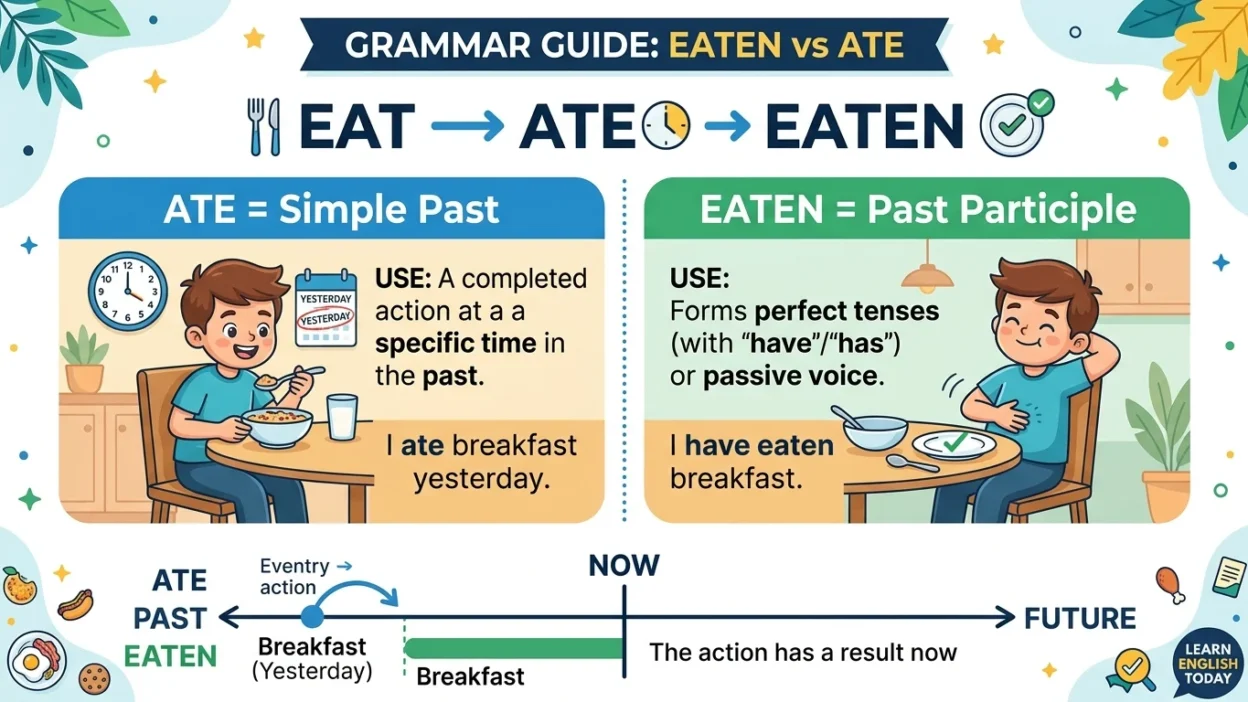
Ate is the simple past tense of eat.
Eaten is the past participle of eat and normally needs an auxiliary verb such as have, has, had, or be.
For example:
I ate breakfast this morning.
I have eaten breakfast already.
Both sentences refer to eating in the past, but their grammatical structures are different.
Quick Answer
Ate = simple past tense
She ate an apple yesterday.
Eaten = past participle
She has eaten an apple.
The easiest rule to remember is:
Eat → Ate → Eaten
| Form | Verb Form | Example |
|---|---|---|
| Eat | Base form | I eat breakfast every day. |
| Ate | Simple past | I ate breakfast earlier. |
| Eaten | Past participle | I have eaten breakfast. |
What Does “Ate” Mean?
Ate is the simple past tense of eat.
We use ate when talking about an action that happened in the past.
For example:
I ate lunch at noon.
The eating happened in the past.
More examples:
She ate a sandwich.
He ate all the cookies.
We ate dinner together.
They ate at a restaurant last night.
I ate breakfast before work.
What Does “Eaten” Mean?
Eaten is the past participle of eat.
Unlike ate, eaten is generally not used by itself to form a normal past-tense sentence.
It usually appears with an auxiliary verb.
For example:
I have eaten.
She has eaten already.
They had eaten before we arrived.
The food was eaten by the guests.
The word eaten indicates that eat is being used as a past participle rather than as a simple past verb.
Eat, Ate, and Eaten
The three principal forms of the verb are:
Eat → Ate → Eaten
Present
I eat breakfast every morning.
Simple Past
I ate breakfast this morning.
Past Participle
I have eaten breakfast already.
This pattern is important because eat is an irregular verb.
You cannot form its past tense by simply adding -ed.
❌ I eated breakfast.
✅ I ate breakfast.
❌ I have ate breakfast.
✅ I have eaten breakfast.
Ate vs Eaten: The Main Difference
The biggest difference is their grammatical role.
Ate
Ate is a finite verb in the simple past tense.
She ate the cake.
Eaten
Eaten is a past participle.
She has eaten the cake.
Notice the auxiliary verb has before eaten.
A useful rule is:
Ate can stand alone as the main past-tense verb.
Eaten usually needs a helping verb.
When to Use “Ate”
Use ate when describing a completed action in the past, especially when the time is stated or understood.
Example 1
I ate pizza yesterday.
The action happened yesterday.
Example 2
She ate breakfast at 8 a.m.
The sentence describes a completed past action.
Example 3
He ate the entire cake.
The eating happened in the past.
Example 4
We ate dinner together last night.
Again, ate is the simple past.
When to Use “Eaten”
Use eaten when forming perfect tenses or certain passive constructions.
Present Perfect
I have eaten.
She has eaten already.
Past Perfect
I had eaten before they arrived.
Future Perfect
By noon, I will have eaten lunch.
Passive Voice
The cake was eaten by the children.
In each case, eaten functions as a past participle.
“I Ate” vs “I Have Eaten”
This is one of the most common areas of confusion.
I Ate
I ate breakfast at 8 a.m.
This simply tells us that the action happened in the past.
I Have Eaten
I have eaten breakfast.
This is present perfect. It connects the past action with the present situation.
For example, if someone asks:
Do you want breakfast?
You might say:
No, thanks. I have eaten already.
The focus is on the current result: you are not hungry or do not need breakfast.
“I Ate” vs “I Have Ate”
This is an important grammar rule.
❌ I have ate breakfast.
✅ I have eaten breakfast.
Why?
Because after have or has, you need the past participle.
The forms are:
eat → ate → eaten
Therefore:
have + eaten ✅
not:
have + ate ❌
“I Had Ate” vs “I Had Eaten”
The same rule applies to had.
❌ I had ate before they arrived.
✅ I had eaten before they arrived.
After had, use the past participle:
had + eaten
For example:
She had eaten before the meeting started.
“I Will Have Eaten”
With the future perfect tense, use:
will have + eaten
For example:
By 9 p.m., I will have eaten dinner.
Not:
❌ By 9 p.m., I will have ate dinner.
Eaten in the Passive Voice
Eaten can also be used in passive constructions.
For example:
The cake was eaten by the children.
Here, the cake receives the action.
Another example:
All the food was eaten before the guests arrived.
Again, eaten is the past participle.
Ate vs Eaten in Questions
The same distinction applies to questions.
Simple Past
What did you eat?
Notice that after did, we use the base form of the verb, not ate.
❌ What did you ate?
✅ What did you eat?
Present Perfect
What have you eaten?
Here, have requires the past participle.
So:
What did you eat? ✅
What have you eaten? ✅
This is a very useful distinction.
Ate vs Eaten in Negative Sentences
Simple Past
Use did not + eat:
I did not eat breakfast.
Not:
❌ I did not ate breakfast.
Present Perfect
Use have not + eaten:
I have not eaten breakfast.
Not:
❌ I have not ate breakfast.
The pattern is:
did + eat
have/has + eaten
Common Mistakes
Mistake 1: “I have ate”
❌ I have ate lunch.
✅ I have eaten lunch.
After have, use eaten.
Mistake 2: “I had ate”
❌ I had ate before you arrived.
✅ I had eaten before you arrived.
After had, use eaten.
Mistake 3: “I did ate”
❌ I did ate breakfast.
For a normal simple past question or negative, use:
✅ I did eat breakfast.
However, did eat can be grammatically correct for emphasis:
I did eat breakfast!
Here, did emphasizes the action.
Mistake 4: “I eated”
❌ I eated breakfast.
✅ I ate breakfast.
Eat is an irregular verb, so its past form is ate, not eated.
Ate vs Eaten: Quick Comparison
| Sentence | Correct? | Reason |
|---|---|---|
| I ate breakfast. | ✅ | Simple past |
| I have eaten breakfast. | ✅ | Present perfect |
| I have ate breakfast. | ❌ | Have requires past participle |
| I had eaten before noon. | ✅ | Past perfect |
| I had ate before noon. | ❌ | Had requires past participle |
| I ate yesterday. | ✅ | Simple past |
| I did eat yesterday. | ✅ | Did + base verb |
| I did ate yesterday. | ❌ | Did requires base verb |
| I have eaten already. | ✅ | Present perfect |
| I eated already. | ❌ | Incorrect past form |
Ate vs Eaten vs Eat
It is helpful to understand all three forms together.
Eat
Eat is the base or present form.
I eat breakfast every day.
Ate
Ate is the simple past.
I ate breakfast yesterday.
Eaten
Eaten is the past participle.
I have eaten breakfast already.
Think:
Today: I eat.
Yesterday: I ate.
Already / before another event: I have eaten.
“Have Eaten” vs “Had Eaten”
Both use eaten, but the tenses are different.
Have Eaten
Present perfect:
I have eaten already.
The action happened before now and has relevance to the present.
Had Eaten
Past perfect:
I had eaten before she arrived.
One past action happened before another past action.
“Was Eaten” vs “Ate”
These sentences use different voices.
The children ate the cake.
Active voice. The children performed the action.
The cake was eaten by the children.
Passive voice. The cake received the action.
Both are grammatically correct, but they focus on different parts of the event.
Is “Eaten” a Verb?
Yes, eaten is a form of the verb eat. More specifically, it is the past participle.
It can be used:
- With have
- With has
- With had
- In perfect tenses
- In passive constructions
Examples:
I have eaten.
She has eaten.
They had eaten.
The food was eaten.
Is “Ate” a Verb?
Yes. Ate is the simple past form of eat.
He ate dinner.
They ate lunch.
She ate an apple.
Unlike eaten, ate can function as the main verb in a simple past sentence without an auxiliary verb.
How to Remember Ate vs Eaten
A simple memory trick is:
Ate = past
Eaten = with have/has/had
For example:
I ate it yesterday.
I have eaten it already.
Another useful pattern is:
Eat → Ate → Eaten
Think of these as the three principal forms you need to remember.
Final Verdict
Ate and eaten are both forms of eat, but they cannot normally be used interchangeably.
Ate is the simple past tense:
I ate dinner last night.
Eaten is the past participle:
I have eaten dinner already.
The most important rule is:
Ate = simple past
Eaten = past participle
Therefore:
I ate breakfast. ✅
I have eaten breakfast. ✅
I have ate breakfast. ❌
I eated breakfast. ❌
Remember the complete verb pattern:
Eat → Ate → Eaten
Once you know this pattern, choosing between ate and eaten becomes much easier.
FAQs
What is the difference between ate and eaten?
Ate is the simple past tense of eat, while eaten is the past participle.
I ate lunch yesterday.
I have eaten lunch already.
Is “I have ate” correct?
No. The correct sentence is:
I have eaten. ✅
After have or has, use the past participle eaten, not ate.
Is “I had ate” correct?
No. The correct form is:
I had eaten. ✅
Had is followed by the past participle.
Is “I ate” correct?
Yes. Ate is the simple past form of eat.
I ate breakfast this morning.
Is “I eated” correct?
No. Eat is an irregular verb.
The correct forms are:
eat → ate → eaten
Not:
❌ eat → eated → eated
Should I say “Did you eat?” or “Did you ate?”
The correct form is:
Did you eat? ✅
After did, use the base form eat, not ate.
Should I say “Have you eaten?” or “Have you ate?”
The correct form is:
Have you eaten? ✅
After have, use the past participle eaten.
Is “I have eaten” present or past tense?
I have eaten is the present perfect tense. It describes an action that happened in the past but has a connection to the present.
What are the three forms of eat?
The three principal forms are:
Eat → Ate → Eaten
Eat = base form
Ate = simple past
Eaten = past participle
Conclusion
Understanding ate vs eaten becomes simple when you remember that they serve different grammatical purposes.
Ate is the simple past form of eat and is used for completed actions in the past:
I ate breakfast at 8 a.m.
Eaten is the past participle and is normally used with auxiliary verbs such as have, has, or had, or in passive constructions:
I have eaten breakfast.
She had eaten before we arrived.
The cake was eaten by the children.
The most important pattern to remember is:
Eat → Ate → Eaten
So when talking about a straightforward past action, use ate. When you need a past participle after have, has, or had, use eaten.

Daniel Charles is a dedicated author and dream interpretation enthusiast at DrameyHut. He specializes in analyzing dream symbols and meanings, offering clear and insightful content for readers. His work aims to help individuals understand their subconscious thoughts, gain clarity, and explore the deeper messages hidden within their dreams.