Elegy and eulogy are often confused because both words are associated with death, mourning, and remembering someone who has died. They also look and sound somewhat similar, which makes the confusion understandable.
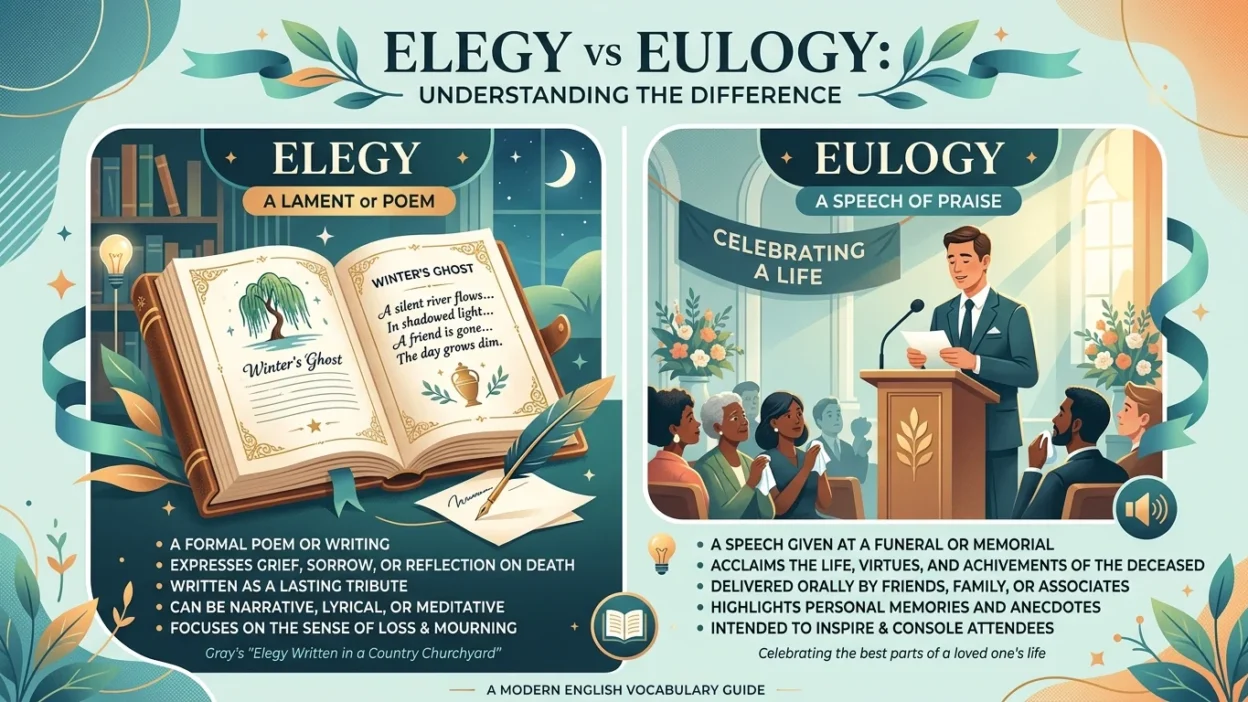
However, they describe different things. An eulogy is a speech or piece of writing that praises and remembers someone who has died, usually delivered at a funeral or memorial service. An elegy is a poem, song, or piece of writing expressing grief or mourning, especially for someone who has died.
Quick Answer
An eulogy is usually a speech that honors and praises someone who has died. An elegy is a poem or other literary work expressing grief or mourning. Think eulogy = tribute speech and elegy = mourning poem or work.
Why People Confuse It
The words are similar in spelling and both are strongly connected with death and remembrance.
But their purposes are different.
An eulogy focuses on praising and remembering a person.
An elegy focuses more on grief, loss, and mourning.
For example:
She delivered a eulogy at her father’s funeral.
The poet wrote an elegy for his friend.
Elegy
An elegy is a poem, song, or other literary work that expresses grief, sorrow, or mourning, traditionally for someone who has died.
Examples
- The poet wrote an elegy for his late friend.
- The poem is a moving elegy for the victims.
- He composed an elegy after his brother’s death.
- The novel reads like an elegy for a disappearing way of life.
The word can also be used more broadly for something that mourns the loss or decline of something.
For example:
The book is an elegy for a vanished era.
Here, nobody necessarily died. The word expresses sadness about something that has been lost.
Eulogy
A eulogy is a speech or piece of writing that praises and remembers a person who has died.
It is especially common at funerals and memorial services.
Examples
- She delivered a eulogy at her father’s funeral.
- His brother gave a touching eulogy.
- The family asked her to write the eulogy.
- He spoke warmly about his friend in the eulogy.
A eulogy usually includes memories, qualities, accomplishments, and stories about the person.
Comparison Table
| Feature | Elegy | Eulogy |
|---|---|---|
| Basic meaning | Work expressing grief or mourning | Speech or writing honoring someone who died |
| Common form | Poem, song, literary work | Speech or written tribute |
| Main focus | Grief and loss | Praise and remembrance |
| Usually associated with funerals | Sometimes | Very commonly |
| Can be about something other than a person | Yes | Usually about a person |
| Example | An elegy for a lost friend | A eulogy at a funeral |
When to Use Each
Use eulogy when referring to a speech or tribute honoring someone who has died.
She gave a beautiful eulogy at the funeral.
Use elegy when referring to a poem or artistic or literary expression of mourning.
He wrote an elegy for his mother.
A useful distinction is:
Eulogy = praise
Elegy = grief
Examples
- She delivered a touching eulogy at the funeral.
- His son gave the eulogy.
- The family asked her to prepare the eulogy.
- The eulogy included many funny memories.
- He wrote an elegy for his childhood friend.
- The poem is an elegy for the dead.
- The poet composed a moving elegy.
- The song became an elegy for a lost generation.
- Her speech was a heartfelt eulogy.
- The poem serves as an elegy for those who died.
- He was asked to give a eulogy at the memorial.
- The writer created an elegy expressing his grief.
Common Mistakes
Calling a funeral speech an elegy
If someone gives a speech honoring a person who died, the usual word is eulogy.
❌ She gave an elegy at the funeral.
✅ She gave a eulogy at the funeral.
Calling every eulogy an elegy
A eulogy and an elegy can both express sadness, but they are not the same thing.
A eulogy is primarily a tribute or praise.
An elegy is primarily an expression of mourning or grief.
Assuming an elegy must always be about a person
Not necessarily.
An elegy can mourn the loss of an era, culture, place, tradition, or way of life.
Memory Trick
Use this simple connection:
Eulogy → Eulogy at a funeral
Think of a person speaking about someone who has died.
Elegy → Emotion and grief
Think of a poem or artistic work expressing loss.
An even simpler trick:
Eulogy = praise
Elegy = grief
American vs British English
There is no significant difference between American and British English in the basic meanings of elegy and eulogy.
Both varieties use:
eulogy for a speech or tribute honoring someone who has died.
elegy for a work expressing grief or mourning.
Similar Words
Words Similar to Eulogy
- Tribute
- Memorial
- Funeral speech
- Commendation
- Homage
- Remembrance
Words Similar to Elegy
- Lament
- Dirge
- Mourning poem
- Requiem
- Lamentation
- Meditation on loss
These words are related but are not always interchangeable.
Final Verdict
The simplest difference is:
Eulogy = a tribute that praises and remembers someone who has died.
Elegy = a work that expresses grief or mourning.
So, if you’re talking about a speech at a funeral, use eulogy. If you’re talking about a poem or literary work expressing sorrow over a death or loss, elegy is usually the better word.
Remember This
Eulogy = praise and tribute ✅
Elegy = grief and mourning ✅
Think:
You GIVE a eulogy.
You WRITE an elegy.
This is a useful memory aid, although an elegy can take forms other than writing.
FAQs
What is the difference between an elegy and a eulogy?
A eulogy is a speech or written tribute that honors someone who has died. An elegy is a poem or other work expressing grief or mourning.
Is a eulogy a poem?
It can be written poetically, but a eulogy is most commonly a speech or tribute given at a funeral or memorial service.
Is an elegy always about death?
Traditionally, an elegy is associated with mourning a death, but the word can also describe a work expressing sadness about another kind of loss.
Can a eulogy be written?
Yes. A eulogy can be written before being delivered as a speech, and the term can also refer to a written tribute.
What is an easy way to remember elegy vs eulogy?
Remember:
Eulogy = praise
Elegy = grief
Is a funeral speech called an elegy or a eulogy?
A funeral speech honoring the deceased is generally called a eulogy.
Is an elegy the same as a lament?
They are closely related, but not exactly the same. An elegy is traditionally a work expressing mourning, while lament is a broader term for an expression of grief or sorrow.
Conclusion
Although elegy and eulogy are closely associated with death and remembrance, they have different meanings. A eulogy is primarily a tribute that praises and remembers someone who has died, while an elegy is a work that expresses grief or mourning.
The easiest way to remember the difference is eulogy equals praise, while elegy equals grief. If someone is speaking at a funeral about the life and character of the deceased, they are giving a eulogy. If a poet creates a work mourning a loss, it can be an elegy.

Daniel Charles is a dedicated author and dream interpretation enthusiast at DrameyHut. He specializes in analyzing dream symbols and meanings, offering clear and insightful content for readers. His work aims to help individuals understand their subconscious thoughts, gain clarity, and explore the deeper messages hidden within their dreams.