
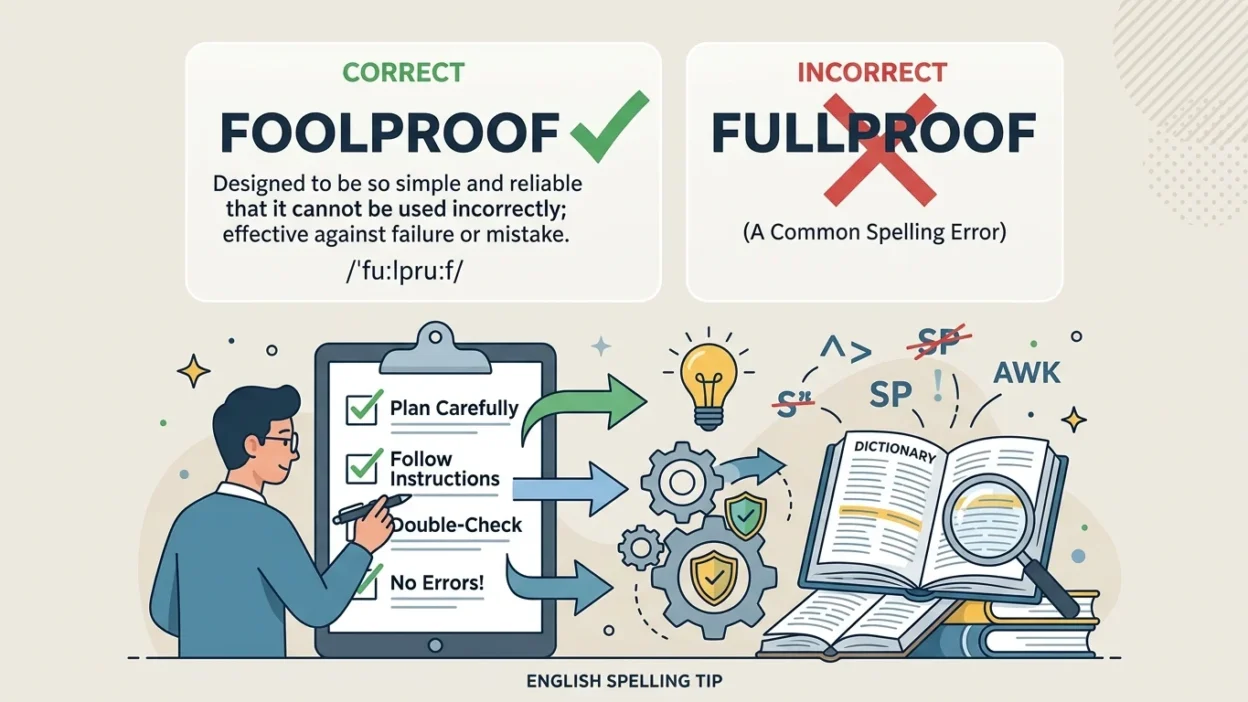
If you have seen the words foolproof and fullproof, you may wonder if they are two different words or simply different spellings of the same term. This confusion is understandable because “fullproof” sounds like a logical combination of the words full and proof. However, in standard English, only one of these forms is normally used for the meaning most people intend.
The correct word is foolproof. It describes something designed to be extremely simple, reliable, or difficult to use incorrectly. For example, you can say, “This system is foolproof,” meaning that even an inexperienced person is unlikely to make a mistake when using it.
Fullproof is not the standard spelling of this word. Understanding why foolproof is correct and learning a few simple examples can help you avoid this common spelling mistake.
Quick Answer
Foolproof is the correct spelling. It means something is so simple, reliable, or well designed that it is very difficult to use incorrectly or make a mistake with.
Fullproof is not the standard spelling for this meaning.
Example:
This is a foolproof way to organize your files.
Why People Confuse It
The confusion comes mainly from pronunciation and the way the word looks.
When people hear foolproof, they may interpret it as full proof, especially because full and proof are both English words.
However, foolproof is formed from fool + proof, not full + proof.
The idea is that something is designed to prevent a fool or inexperienced user from making an error.
So:
- foolproof = correct
- fullproof = incorrect for this meaning
Foolproof
Foolproof is an adjective meaning extremely simple, reliable, or unlikely to fail because it has been designed to prevent mistakes.
Examples:
The instructions are foolproof.
She developed a foolproof method for backing up the data.
There is no foolproof solution to every problem.
The word can describe:
- methods
- systems
- plans
- instructions
- procedures
- devices
- strategies
- recipes
- processes
- solutions
What Does “Foolproof” Literally Suggest?
The word combines:
fool + proof
The suffix -proof is used in English to mean protected against or resistant to something.
For example:
- waterproof = resistant to water
- fireproof = resistant to fire
- childproof = designed to prevent children from using something improperly
- foolproof = designed to prevent mistakes by an inexperienced or careless person
So foolproof essentially suggests something that is resistant to human error.
Fullproof
Fullproof is not the standard English spelling of foolproof.
For example:
❌ This method is fullproof.
The intended word should be:
✅ This method is foolproof.
The problem is that full is a real English word, so fullproof may look plausible. However, standard English does not normally use fullproof as a spelling of the adjective meaning “very difficult to use incorrectly.”
If you mean that something provides complete evidence or proof, you would normally express the idea differently, such as:
We need full proof of the claim.
Here, full and proof are separate words, and the phrase has a completely different grammatical structure.
Foolproof vs Fullproof
The easiest distinction is:
Foolproof is one word and means difficult to misuse or get wrong.
Full proof can theoretically occur as two separate words when full modifies the noun proof, meaning complete or sufficient evidence.
But fullproof as one word is not the standard spelling for the adjective foolproof.
Comparison Table
| Form | Correct? | Meaning | Example |
|---|---|---|---|
| foolproof | ✅ Yes | Very difficult to use incorrectly or fail | This is a foolproof method. |
| fullproof | ❌ No | Not standard English for this meaning | Fullproof is not the correct spelling. |
| full proof | ✅ Possible as separate words | Complete or sufficient proof | We need full proof of the claim. |
| fool-proof | Usually no | Older or occasional hyphenated form | Foolproof is the standard modern form. |
When to Use “Foolproof”
Use foolproof when something is designed to be very easy to use or unlikely to result in mistakes.
For instructions
These instructions are foolproof.
For a method
She created a foolproof method for remembering passwords.
For a plan
We need a foolproof plan before starting the project.
For a system
The new system is almost foolproof.
For a recipe
This is a foolproof recipe for beginners.
For a strategy
There is no foolproof strategy for predicting the market.
10+ Examples of “Foolproof”
- This is a foolproof method for organizing your documents.
- She gave me a foolproof way to solve the problem.
- The instructions are simple and almost foolproof.
- We need a foolproof plan before launching the project.
- He designed a foolproof system for tracking expenses.
- This recipe is foolproof, even for beginners.
- There is no foolproof solution to every problem.
- The security system is designed to be as foolproof as possible.
- She found a foolproof way to remember the steps.
- The device has a foolproof design.
- His explanation provided a foolproof method for checking the results.
- We need a foolproof procedure that anyone can follow.
Foolproof Does Not Mean Literally Perfect
An important point is that foolproof is often used informally to mean extremely reliable or easy to use. It does not necessarily mean that something is literally impossible to fail.
For example:
There is no foolproof way to predict the future.
This means there is no method that guarantees perfect results.
You can also say:
The instructions are designed to be foolproof.
This means the instructions minimize the possibility of mistakes.
Common Mistakes
1. Writing “fullproof”
This is the most common mistake.
❌ This is a fullproof method.
✅ This is a foolproof method.
2. Thinking “fullproof” means completely proven
The words full and proof can occur together as separate words, but that does not create the adjective fullproof.
If you mean complete evidence, write:
We need full proof of his claim.
However, in many contexts, complete proof or conclusive proof may sound more natural.
3. Confusing “foolproof” with “fool-proof”
The standard modern spelling is usually foolproof, as one word.
4. Thinking “foolproof” is insulting
The word contains fool, but foolproof usually describes the design or reliability of something rather than directly insulting a person.
The software is foolproof.
The speaker is saying the software is easy to use and resistant to mistakes.
Memory Trick
Remember:
Foolproof = fool + proof
Think:
A foolproof system is designed so even a fool is unlikely to make a mistake.
You can also connect it with other proof words:
waterproof
fireproof
childproof
foolproof
So if you mean difficult to get wrong, choose foolproof.
American vs British English
Foolproof is standard in both American and British English.
There is no significant difference in spelling or meaning between the two varieties.
Both use:
a foolproof method
a foolproof plan
a foolproof system
The incorrect spelling fullproof should be avoided in both American and British English when you mean “foolproof.”
Similar Words
Fail safe
Fail safe describes something designed to remain safe or prevent serious problems if something goes wrong.
The machine has a fail-safe system.
Idiot proof
Idiot proof is an informal expression meaning very easy to use or difficult to misuse. However, it can sound insulting or insensitive, so foolproof is often preferable.
Error proof
Error proof describes something designed to prevent mistakes.
The software has an error-proof system.
User friendly
User friendly means easy for people to understand or use.
The website has a very user-friendly interface.
Reliable
Reliable means dependable and likely to work as expected.
We need a reliable solution.
Foolproof vs Fail safe
These words are related but not identical.
Foolproof focuses on preventing human mistakes.
Fail safe focuses on preventing dangerous or undesirable consequences when something fails.
For example:
The instructions are foolproof.
The instructions are easy to follow.
The machine has a fail-safe mechanism.
The machine is designed to remain safe if something goes wrong.
Final Verdict
Foolproof is the correct word when you mean something that is extremely simple, reliable, or difficult to use incorrectly.
Fullproof is not the standard spelling of this adjective.
The word foolproof comes from fool + proof, expressing the idea that something is designed to resist human error.
If you are talking about complete evidence, you may use the separate words full proof, although expressions such as complete proof or conclusive proof may often be more natural.
So remember:
Foolproof = correct
Fullproof = incorrect as one word for this meaning
FAQs
Is “fullproof” a correct word?
No. Fullproof is not the standard English spelling of the adjective meaning “difficult to use incorrectly.” The correct word is foolproof.
Is it foolproof or fullproof?
It is foolproof.
This method is foolproof.
What does foolproof mean?
Foolproof means designed to be very simple, reliable, or difficult to use incorrectly or fail because of human mistakes.
Why is it called foolproof?
The word comes from fool + proof. It suggests that something is designed so that even an inexperienced or careless person is unlikely to make a mistake when using it.
Is foolproof one word?
Yes. Foolproof is normally written as one word.
Can I say “full proof”?
Yes, but full proof consists of two separate words and has a different meaning. It can refer to complete or sufficient evidence.
Is foolproof formal English?
Yes. Foolproof is a standard English adjective and can be used in professional and formal writing. However, in highly technical contexts, words such as reliable, error resistant, or fail safe may be more precise depending on what you mean.
What is another word for foolproof?
Depending on the context, alternatives include reliable, fail safe, error proof, user friendly, simple, dependable, and easy to use.
Conclusion
The correct spelling is foolproof, not fullproof, when you want to describe something that is extremely reliable or difficult to use incorrectly. The word combines fool and proof and refers to a method, system, plan, or design that minimizes the possibility of human error.
Although fullproof looks reasonable because full and proof are both English words, it is not the standard one-word adjective. If you remember that foolproof means “designed to prevent fools or inexperienced users from making mistakes,” you will have an easy way to remember the correct spelling.
Remember This
Foolproof = correct ✅
Fullproof = incorrect ❌
Foolproof means very difficult to get wrong or misuse.
Easy rule: Fool + proof = foolproof.

Daniel Charles is a dedicated author and dream interpretation enthusiast at DrameyHut. He specializes in analyzing dream symbols and meanings, offering clear and insightful content for readers. His work aims to help individuals understand their subconscious thoughts, gain clarity, and explore the deeper messages hidden within their dreams.