
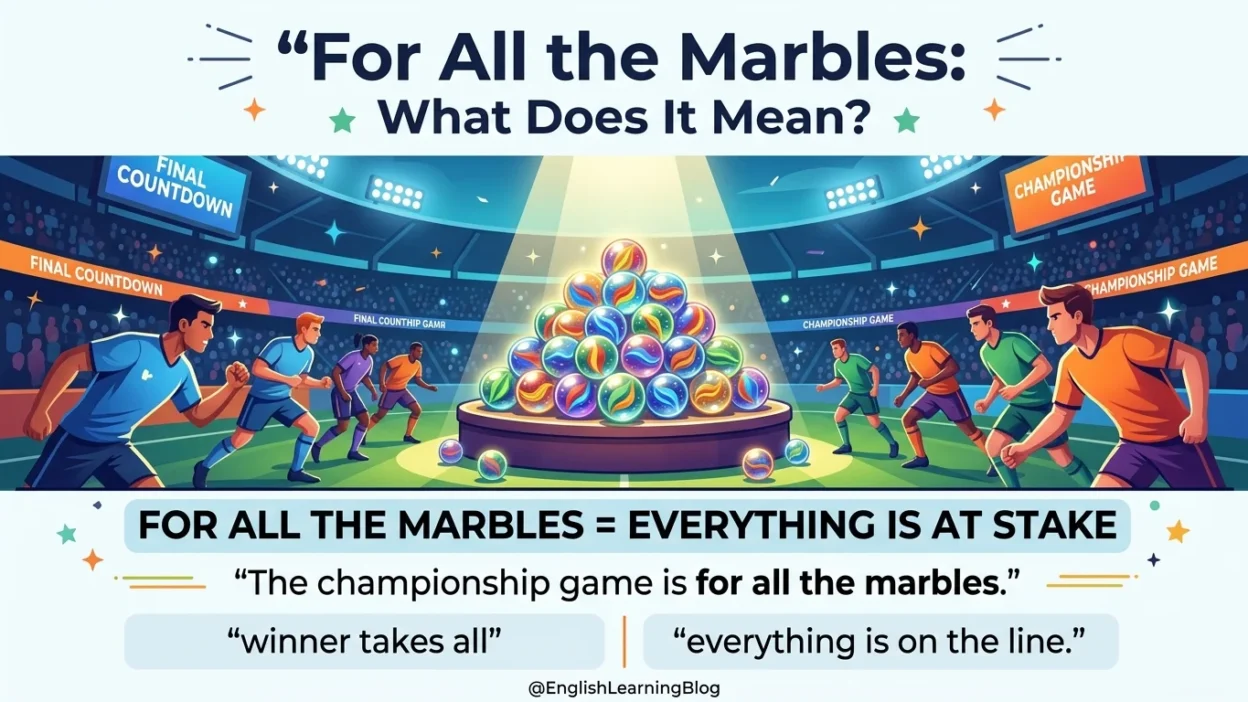
“For all the marbles” is a popular English idiom used to describe a high stakes situation in which everything is at stake and the outcome determines the ultimate winner.
In simple terms:
For all the marbles = for everything, with the winner taking the ultimate prize
For example:
The final game is for all the marbles.
This means the final game will determine who wins everything or takes the ultimate prize.
Quick Answer
For all the marbles means everything is at stake, especially in a competition where the outcome will determine the winner.
Example
Tonight’s championship game is for all the marbles.
Meaning:
Tonight’s game will determine the ultimate winner.
The phrase is particularly common in sports, but it can also describe important decisions, business deals, competitions, and other high stakes situations.
What Does “For All the Marbles” Mean?
The idiom for all the marbles describes a situation in which someone is competing for the entire prize, ultimate victory, or everything available to be won.
It often suggests a winner takes all situation.
For example:
The two teams are playing for all the marbles.
This means the teams are competing in a decisive contest where the outcome determines the overall winner.
Another example:
This final interview is for all the marbles.
Here, the speaker is using the expression figuratively to say that the interview could determine the entire outcome.
“For All the Marbles” in Simple English
You can understand the expression as:
- Everything is at stake
- The ultimate prize is at stake
- Winner takes all
- This is the deciding moment
- The outcome matters completely
- There is little or no room for another chance
The exact meaning depends on the context, but the central idea is maximum stakes.
Examples of “For All the Marbles”
Here are some natural examples:
This is the final match, and it’s for all the marbles.
The two teams will face each other tomorrow for all the marbles.
The last round is for all the marbles.
This negotiation could determine the company’s future. It’s for all the marbles.
The championship game is for all the marbles.
We’re down to the final round, and now we’re playing for all the marbles.
“Go for All the Marbles” Meaning
The expression can also appear as:
go for all the marbles
This means to make a final, all out attempt to win everything or achieve the ultimate goal.
For example:
We’re in the final round, so we’re going to go for all the marbles.
This means:
We’re going to give everything we have in an attempt to win.
“Playing for All the Marbles”
This is another common form:
playing for all the marbles
It means participating in a competition where the outcome determines the ultimate prize or victory.
For example:
The teams are playing for all the marbles tonight.
We’re playing for all the marbles in the final round.
The phrase is especially common in sports commentary.
“It’s for All the Marbles”
You can also simply say:
It’s for all the marbles.
This means:
Everything depends on this.
For example:
We’ve reached the final round. It’s for all the marbles.
The phrase emphasizes the importance of the moment.
For All the Marbles in Sports
Sports are one of the most common contexts for this idiom.
A championship final, deciding game, or final play may be described as for all the marbles.
For example:
Game 7 is for all the marbles.
This means the winner of Game 7 will win the series.
Another example:
The final penalty kick is for all the marbles.
This means the kick could determine the entire outcome.
The expression works particularly well in sports because competitions often have a clear final winner.
For All the Marbles in Business
The idiom can also be used outside sports.
For example:
This final presentation is for all the marbles.
The speaker means that the presentation is extremely important and could determine whether the company gets the deal.
Another example:
The companies are negotiating for all the marbles.
This suggests a highly competitive situation in which the stakes are enormous.
For All the Marbles in Everyday Life
You can use the expression figuratively for important personal situations too.
For example:
My final exam is for all the marbles.
This could mean the exam will determine whether the student passes the course.
Or:
This interview feels like it’s for all the marbles.
This means the interview feels extremely important and may determine whether the person gets the job.
For All the Marbles vs All or Nothing
These expressions are closely related.
For all the marbles emphasizes winning the ultimate prize or achieving total victory.
The final match is for all the marbles.
All or nothing emphasizes complete success or complete failure.
It’s an all or nothing decision.
They can sometimes be used in similar situations, but for all the marbles has a more playful, competitive tone.
For All the Marbles vs Winner Takes All
Winner takes all is a very close equivalent.
The final game is for all the marbles.
The final game is winner takes all.
Both suggest that the final result determines who gets the ultimate prize.
However, for all the marbles is more idiomatic and colorful, while winner takes all is more direct.
For All the Marbles vs Make or Break
Make or break describes something that will determine whether someone succeeds or fails.
This deal could make or break the company.
For all the marbles emphasizes competing for the ultimate prize.
The championship game is for all the marbles.
Both describe high stakes, but their emphasis is slightly different.
Origin of “For All the Marbles”
The expression comes from the children’s game of marbles, in which players competed to win one another’s marbles. The phrase developed from the idea of playing a game in which all the marbles were at stake.
In games played “for keeps,” the winner could keep the marbles won from other players. This created the idea of risking or competing for everything.
Over time, the literal expression became a figurative idiom for ultimate victory or an all-or-nothing contest.
Today, people generally don’t mean actual marbles when they use the expression.
Why Are They Called “Marbles”?
Marbles were once a popular children’s game and were used as objects of competition. A player could win another player’s marbles, making them a tangible prize.
So if someone played for all the marbles, they were essentially playing to win everything.
That simple image eventually became a metaphor for situations where the stakes are extremely high.
Is “For All the Marbles” Formal or Informal?
The expression is generally informal and conversational.
It is particularly natural in:
- Sports commentary
- Everyday conversation
- News writing
- Business discussions
- Interviews
- Informal articles
- Stories and dialogue
For highly formal writing, alternatives such as the decisive contest, the ultimate prize, or a decisive stage may be more appropriate.
Common Mistakes
Mistake 1: Taking the phrase literally
When someone says:
We’re playing for all the marbles.
they usually aren’t talking about actual marbles.
The phrase is an idiom meaning everything is at stake.
Mistake 2: Using it for an ordinary situation
The expression works best when the stakes are genuinely high.
For example:
❌ I’m deciding which sandwich to order. It’s for all the marbles.
This could be used humorously, but normally the expression is reserved for situations with significant consequences.
Mistake 3: Confusing it with “lose your marbles”
These are completely different idioms.
For all the marbles = everything is at stake.
Lose your marbles = become confused, irrational, or lose one’s composure.
They both contain marbles, but their meanings are unrelated.
Is “For All the Marbles” Still Used?
Yes. The expression remains recognizable and is especially common in American English, particularly in sports and other competitive contexts.
For example:
This is the final game, and it’s for all the marbles.
The phrase continues to work because its meaning is easy to understand from the metaphor of winning all the available prizes.
How to Use “For All the Marbles” Naturally
Use it when:
- The stakes are high.
- The situation is competitive or decisive.
- The outcome will determine the final result.
- You want to emphasize the importance of winning.
For example:
This is the final round. We’re playing for all the marbles.
That sounds natural because the competition has reached its decisive stage.
Easy Way to Remember
Think of a marble game in which you could win every marble belonging to your opponent.
If you win:
You get all the marbles.
So:
For all the marbles = competing for everything.
A simple memory phrase is:
All the marbles = everything at stake.
Quick Comparison
| Expression | Meaning |
|---|---|
| For all the marbles | Competing for everything or ultimate victory |
| Winner takes all | The winner gets the entire prize |
| All or nothing | Complete success or complete failure |
| Make or break | A situation that determines success or failure |
| On the line | At risk or at stake |
Final Verdict
“For all the marbles” means everything is at stake, especially when a competition has reached a decisive moment.
For example:
The championship game is for all the marbles.
This means the game will determine the ultimate winner.
The phrase comes from the game of marbles, where players could compete to win their opponents’ marbles. Over time, the literal idea of winning all the marbles became a figurative expression for ultimate victory and high stakes.
The easiest way to remember it is:
For all the marbles = everything is on the line.
FAQs
What does “for all the marbles” mean?
For all the marbles means everything is at stake, usually in a decisive competition where the winner gets the ultimate prize.
What does “it’s for all the marbles” mean?
It means the situation is decisive and the outcome will determine the ultimate result.
What does “go for all the marbles” mean?
Go for all the marbles means to make an all out effort to win everything or achieve the ultimate goal.
What does “playing for all the marbles” mean?
It means competing in a situation where the ultimate prize or victory is at stake.
Is “for all the marbles” an idiom?
Yes. It is an English idiom meaning everything is at stake or someone is competing for the entire prize.
Where did “for all the marbles” come from?
The expression comes from the children’s game of marbles, in which players could compete to win their opponents’ marbles. It later developed a figurative meaning.
Is “for all the marbles” formal?
It is generally informal and conversational. It is particularly common in sports and other competitive contexts.
What is another way to say “for all the marbles”?
Depending on context, you can say:
- Winner takes all
- All or nothing
- Everything is at stake
- Everything is on the line
- Make or break
Can “for all the marbles” be used outside sports?
Yes. It can describe any high stakes or decisive situation, including business negotiations, exams, job interviews, and major personal decisions.
Is “for all the marbles” the same as “winner takes all”?
They are very similar. Both can describe a situation where the winner gets the ultimate prize, although for all the marbles is a more colorful idiomatic expression.
Conclusion
The idiom “for all the marbles” means competing for everything, with the outcome determining the ultimate winner or prize.
For example:
The final match is for all the marbles.
It is especially common when describing championship games, final rounds, decisive contests, and other high stakes situations.
The expression comes from the game of marbles, where players could compete to win all the marbles at stake. That literal idea eventually became a metaphor for ultimate victory and winner takes all situations.
So, whenever you hear:
“This is for all the marbles.”
think:
“Everything is at stake.”

Christopher Thomas is a passionate writer and dream researcher dedicated to exploring the meanings behind dreams. As an author at DrameyHut, he creates insightful and easy-to-understand interpretations that help readers connect with their subconscious mind. His work focuses on guiding individuals toward self-discovery, clarity, and a deeper understanding of their inner thoughts.