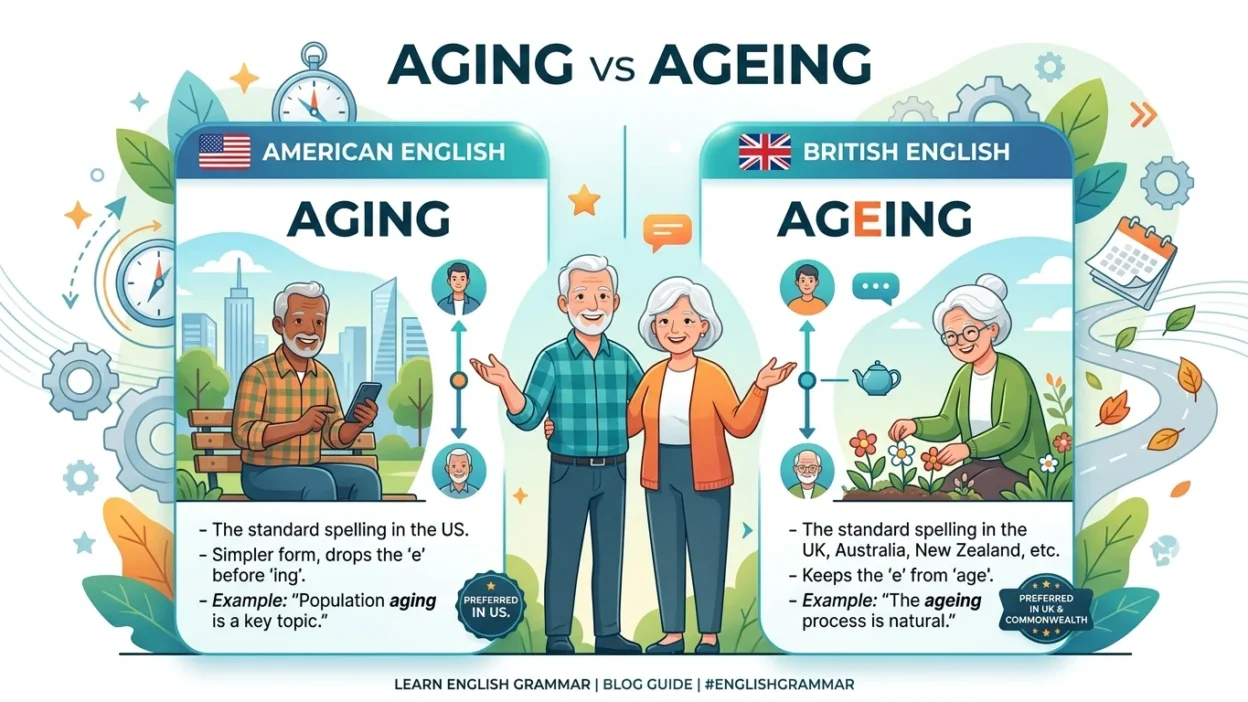
If you have ever wondered whether “ageing” or “aging” is the correct spelling, you are not alone. Both forms are correct, and they have exactly the same basic meaning. The main difference is regional spelling: aging is the standard spelling in American English, while ageing is more common in British English and many other varieties that follow British spelling conventions.
Both words come from the verb age, meaning to become older or to cause something to become older. You can use them to talk about people, animals, products, materials, populations, or anything else affected by the passage of time. For example, “The population is aging” and “The population is ageing” communicate the same idea.
Knowing which form to choose mainly depends on your audience and the variety of English you are using. Once you understand the American and British spelling patterns, the difference is easy to remember.
Quick Answer
Aging and ageing are both correct spellings. Aging is preferred in American English, while ageing is preferred in British English and many other forms of English. They have the same pronunciation and meaning, so the choice is mainly a matter of regional spelling style.
Why People Confuse It
The confusion comes from a common spelling difference between American and British English.
The verb is:
age
When adding -ing, English normally drops the silent e:
age + ing = aging
American English generally follows this form:
aging
British English commonly retains the e:
ageing
This creates the two accepted spellings:
aging
ageing
Neither spelling is inherently wrong.
The important thing is to use the spelling that matches your chosen variety of English and remain consistent throughout your writing.
Aging
Aging is the standard American English spelling.
It can mean becoming older or the process of becoming older.
Examples:
The population is aging rapidly.
Aging is a natural part of life.
The company is developing products for an aging population.
The aging building needs extensive repairs.
“Aging” can refer to people and living things, but it can also describe objects, materials, institutions, and systems.
Examples of Aging
The aging population requires better healthcare services.
Scientists are studying the effects of aging on the brain.
The aging infrastructure needs to be replaced.
The wine improves through careful aging.
His aging parents need additional support.
In American English, aging is the spelling you will normally see in newspapers, books, websites, academic writing, and professional documents.
Ageing
Ageing has the same meaning as aging but is the spelling more commonly associated with British English.
Examples:
The population is ageing rapidly.
Ageing is a natural part of life.
The country has an ageing population.
The building is showing signs of ageing.
Scientists are studying the effects of ageing.
The word can describe biological aging as well as the deterioration or development of objects over time.
For example:
The wood develops a beautiful appearance with ageing.
Here, “ageing” means the process that occurs as the wood becomes older.
Ageing vs Aging: Comparison Table
| Feature | Aging | Ageing |
|---|---|---|
| Meaning | Becoming or making older | Becoming or making older |
| Spelling | American English | British English |
| Pronunciation | Same | Same |
| Meaning difference | None | None |
| Common in | United States | United Kingdom and many British English varieties |
| Example | The population is aging. | The population is ageing. |
| Is it correct? | Yes | Yes |
When to Use Each
Use “aging” in American English
If your audience is primarily American, aging is generally the preferred spelling.
For example:
The country has an aging population.
Aging workers may require different workplace accommodations.
The effects of aging vary from person to person.
Use “ageing” in British English
If you are writing for a British audience, ageing is generally the preferred spelling.
For example:
The country has an ageing population.
Ageing workers may require different workplace accommodations.
The effects of ageing vary from person to person.
Be consistent
The most important rule is consistency.
If your article uses British spelling, use:
ageing
If your article uses American spelling, use:
aging
Avoid switching between the two without a reason.
For example, if you are writing an American English article, it is better to write:
The aging population is creating new challenges.
rather than:
The ageing population is creating new challenges.
Likewise, British English writing would normally use ageing.
Examples of Aging and Ageing
Here are examples showing that the two spellings can be substituted for each other.
American English
- The population is aging rapidly.
- Scientists are researching the effects of aging.
- The company serves an aging population.
- The aging infrastructure needs investment.
- Exercise can support healthy aging.
- The wine requires several years of aging.
- His aging parents moved closer to their children.
- The aging building needs repairs.
- The effects of aging become more noticeable over time.
- Researchers are studying healthy aging.
British English
- The population is ageing rapidly.
- Scientists are researching the effects of ageing.
- The company serves an ageing population.
- The ageing infrastructure needs investment.
- Exercise can support healthy ageing.
- The wine requires several years of ageing.
- His ageing parents moved closer to their children.
- The ageing building needs repairs.
- The effects of ageing become more noticeable over time.
- Researchers are studying healthy ageing.
Notice that the meaning does not change. Only the spelling changes.
Aging vs Ageing Pronunciation
Aging and ageing are pronounced the same way.
They are generally pronounced approximately:
AY-jing
The additional e in “ageing” does not create a different pronunciation.
So if you hear someone say the word, you cannot determine from pronunciation whether they would spell it aging or ageing.
The spelling difference is regional rather than phonetic.
Why Does British English Keep the “E”?
The difference comes from broader spelling conventions.
American English often simplifies certain spellings, while British English has retained some traditional forms.
Compare:
aging / ageing
You can also see similar regional spelling differences in words such as:
traveled / travelled
canceled / cancelled
labeled / labelled
modeling / modelling
However, spelling rules are not perfectly uniform across every word, so it is better to learn common patterns rather than assume every -ing word behaves exactly the same way.
Aging vs Ageing in Academic Writing
Both forms are appropriate in academic writing.
The important factor is the style guide or English variety being followed.
An American academic publication may use:
aging
A British publication may use:
ageing
If you are submitting an article, dissertation, research paper, or manuscript, follow the spelling conventions required by your institution, publisher, or style guide.
Consistency matters more than choosing one form as universally “correct.”
Aging vs Ageing in SEO Writing
For SEO content, both spellings can be useful because people search using both forms.
However, your primary spelling should normally match your target audience.
If your website targets American readers, use:
aging
If it targets British readers, use:
ageing
You can naturally mention the alternative spelling once when explaining the difference.
For example:
Aging, also spelled ageing in British English, refers to the process of becoming older.
This makes the content useful to readers from different English-speaking regions without awkward keyword repetition.
Common Mistakes
Mistake 1: Thinking “ageing” is incorrect
It is not.
Ageing is a standard spelling, particularly in British English.
Mistake 2: Thinking “aging” is incorrect
It is not.
Aging is the standard American English spelling.
Mistake 3: Assuming they have different meanings
They do not normally have different meanings.
Aging population
and
Ageing population
mean the same thing.
Mistake 4: Mixing spelling styles
A writer may use mostly American spellings but suddenly write “ageing.”
This is not necessarily grammatically wrong, but inconsistent regional spelling can make writing look less polished.
Choose a style and maintain it.
Mistake 5: Pronouncing “ageing” differently
The extra e does not normally change the pronunciation.
Both forms are pronounced essentially the same way.
Memory Trick
Use a simple regional association:
Aging = American English
Ageing = British English
Think:
America drops the extra E.
So:
age + ing → aging
British English commonly keeps the traditional spelling:
age + ing → ageing
You can also remember:
Aging = US
Ageing = UK
Both are correct.
American vs British English
This is one of the clearest American and British spelling differences.
American English
aging
Examples:
aging population
healthy aging
aging process
British English
ageing
Examples:
ageing population
healthy ageing
ageing process
Other varieties of English may also prefer ageing, particularly those influenced by British spelling conventions.
The important point is that neither variety has a different meaning for the word.
Related Words
The same regional distinction can appear in related forms.
Age
She is beginning to age.
This spelling is the same in both varieties.
Aged
He is an aged man.
The spelling is also generally the same.
Aging / Ageing
The aging process is natural.
The ageing process is natural.
Age-related
Age-related changes are common.
This form is also generally the same.
The most noticeable spelling difference is aging vs ageing.
Aging vs Ageing vs Ag(e)ing in Other Contexts
You may occasionally encounter unusual spellings or historical variations, but aging and ageing are the standard modern forms.
For normal contemporary writing, use:
aging for American English
ageing for British English
There is no need to invent another spelling.
Final Verdict
Aging and ageing are both correct. They have the same meaning and pronunciation.
The main difference is regional spelling:
Aging = American English
Ageing = British English
If you are writing for an American audience, choose aging. If you are writing for a British audience, choose ageing.
Neither form is more correct in an absolute sense. The best choice depends on your audience, publication style, and overall spelling system.
FAQs
Is “aging” or “ageing” correct?
Both are correct. Aging is the standard American spelling, while ageing is commonly used in British English.
Is ageing British or American?
Ageing is primarily associated with British English. American English generally uses aging.
Is aging American English?
Yes. Aging is the standard spelling in American English.
Do aging and ageing have the same meaning?
Yes. They normally have exactly the same meaning. Both refer to the process of becoming older or becoming affected by age.
Are aging and ageing pronounced the same?
Yes. They are normally pronounced the same way, approximately AY-jing.
Which spelling should I use in an SEO article?
Use the spelling that matches your target audience. Choose aging for American English readers and ageing for British English readers. You can mention the alternative spelling naturally to capture both search forms.
Is “ageing population” correct?
Yes. “Ageing population” is correct, especially in British English. American English normally uses “aging population.”
Is “healthy aging” or “healthy ageing” correct?
Both are correct. Healthy aging is preferred in American English, while healthy ageing is preferred in British English.
Conclusion
The choice between aging and ageing is not a question of correct versus incorrect spelling. Both are standard forms. The difference is mainly geographical: American English generally uses aging, while British English commonly uses ageing.
This spelling difference appears in everyday writing as well as academic, professional, medical, and SEO content. The meaning and pronunciation remain essentially the same, so readers will understand either form.
Remember This
Aging = American English
Ageing = British English
Both mean the process of becoming older.
When choosing between them, simply consider your audience and keep your spelling consistent throughout your writing.

Christopher Thomas is a passionate writer and dream researcher dedicated to exploring the meanings behind dreams. As an author at DrameyHut, he creates insightful and easy-to-understand interpretations that help readers connect with their subconscious mind. His work focuses on guiding individuals toward self-discovery, clarity, and a deeper understanding of their inner thoughts.