Have you ever heard someone say, “Stick a fork in it, it’s done”? This colorful English expression means that something is finished, completed, or ready to be considered over. It is especially common in casual American English and is often used when a task, project, event, or situation has reached its conclusion.
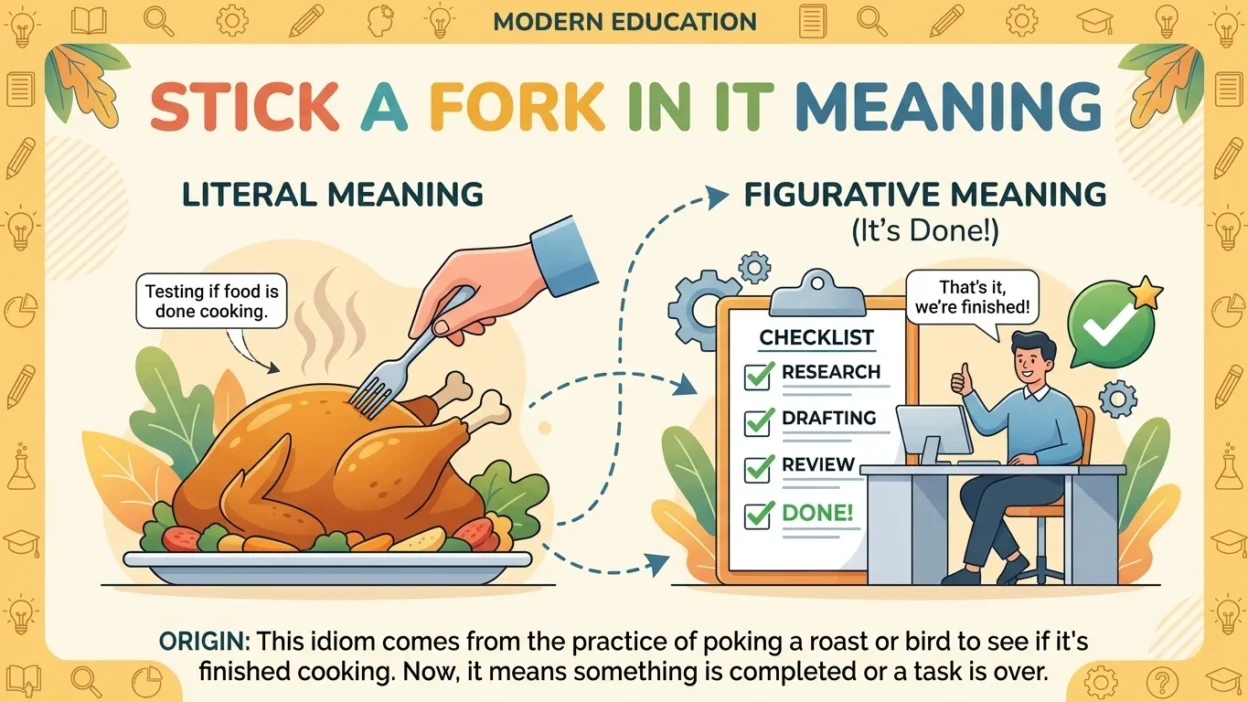
The phrase comes from the simple idea of checking if food is cooked by sticking a fork into it. If the food is ready, you can take it out and serve it. Over time, this literal image developed into a figurative expression meaning that something is finished.
Although “stick a fork in it” can be used seriously, it is often humorous or conversational. Understanding this idiom can help you recognize natural English in movies, television, conversations, sports commentary, and informal writing.
Quick Answer
“Stick a fork in it” means “finish it” or “consider it finished.” The expression is often shortened from “Stick a fork in it, it’s done.” It is informal and usually suggests that a task, project, event, or situation has reached its conclusion.
Why People Confuse It
The expression can be confusing if you interpret it literally.
Stick a fork in it.
Taken literally, this sounds like someone is telling you to put a fork into an object.
But idiomatically, it means:
It is finished.
The phrase is often associated with the longer expression:
Stick a fork in it, it’s done.
The “fork” creates a humorous image of checking whether food is cooked. Once the food is done, there is nothing more to do.
Today, however, the expression is not limited to food. It can refer to almost anything that has reached its end.
What Does “Stick a Fork in It” Mean?
“Stick a fork in it” means to declare something finished, completed, or over.
It can be used when:
- A project is complete
- A job is finished
- A game is essentially over
- An event has ended
- A discussion is finished
- A plan has been completed
- Someone should stop working on something
- A situation has reached its conclusion
For example:
We have finished all the paperwork. Stick a fork in it.
This means:
The paperwork is finished, so there is nothing more to do.
Another example:
We have scored three goals in the final five minutes. Stick a fork in it!
Here, the speaker humorously suggests that the game is effectively over.
The Literal Image Behind the Idiom
The expression is based on a cooking image.
When preparing food, particularly meat or vegetables, someone might use a fork to test whether the food is ready.
Once the food is cooked, you can say:
It’s done.
The idiom takes this simple idea and applies it to other situations.
So the figurative logic is:
Test it → It is done → Stop working on it.
That is why “stick a fork in it” can mean declare something finished.
“Stick a Fork in It, It’s Done”
This is the most recognizable version of the expression.
Stick a fork in it, it’s done.
The meaning is:
It is finished.
For example:
We have completed the final edits and sent the report. Stick a fork in it, it’s done.
The phrase can also be used humorously after completing something difficult:
Five hours of cleaning later, stick a fork in it. The house is finally clean.
The speaker does not actually want anyone to use a fork. It is simply an idiomatic way of emphasizing completion.
Examples of “Stick a Fork in It”
Here are some natural examples:
- We finished the project, so stick a fork in it.
- The report has been submitted. Stick a fork in it, it’s done.
- We have cleaned the entire house. Stick a fork in it!
- The team is ahead by twenty points with one minute left. Stick a fork in it.
- I have answered all the emails. Stick a fork in it.
- After three hours of work, we can finally stick a fork in it.
- The negotiations are over. Stick a fork in it.
- Once we finish this last section, we can stick a fork in the assignment.
- The party is winding down, so I think we can stick a fork in it.
- We have solved the problem. Stick a fork in it, we’re finished.
The expression works especially well in informal conversations because it adds a playful tone.
Is “Stick a Fork in It” Formal or Informal?
“Stick a fork in it” is informal.
It is perfectly understandable to native English speakers, particularly in American English, but it would usually be inappropriate in highly formal writing.
For example, instead of writing:
Stick a fork in the project.
in a formal report, you could write:
The project has been completed.
Or:
The project is now complete.
In casual conversation, however, “stick a fork in it” can sound natural and humorous.
“Stick a Fork in It” vs “It’s Done”
These expressions can communicate essentially the same idea, but they have different tones.
| Expression | Meaning | Tone |
|---|---|---|
| Stick a fork in it | Consider it finished | Informal, humorous |
| It’s done | It is finished | Neutral |
| It’s finished | It has been completed | Neutral |
| It’s over | Something has ended | Neutral |
| Call it done | Consider it complete | Informal |
| That’s a wrap | The activity is finished | Informal |
For everyday professional communication, “It’s done” or “It’s complete” is usually safer.
For casual conversation, “Stick a fork in it” can add personality.
When to Use “Stick a Fork in It”
You can use the expression when something has reached a clear stopping point.
After completing a task
I’ve finished the presentation. Stick a fork in it.
After finishing a project
The website is live and everything works. Stick a fork in it.
When a game is essentially over
They are twenty points ahead with ten seconds left. Stick a fork in it.
When an event is ending
Everyone is leaving, so I guess we can stick a fork in it.
When joking about being finished
After six hours of studying, stick a fork in it. I’m done.
The phrase is particularly effective when the speaker wants to make the statement sound lighthearted rather than simply saying “finished.”
Common Mistakes
Mistake 1: Taking it literally
Stick a fork in it.
Usually, this does not mean that you should literally put a fork into something.
The intended meaning may simply be:
It is finished.
Of course, context matters. In a kitchen, the phrase could theoretically be literal.
Mistake 2: Using it in highly formal writing
The expression is idiomatic and informal.
Instead of:
Stick a fork in the investigation.
a formal report might say:
The investigation has been completed.
Mistake 3: Thinking it only applies to food
The expression originated from a cooking image, but modern usage is much broader.
You can use it for:
- Work
- Projects
- Sports
- Events
- Discussions
- Plans
- Assignments
- Situations
Mistake 4: Assuming it always means something literally ended
Sometimes the expression means that something is effectively finished rather than technically finished.
For example:
They’re down by 40 points with one minute left. Stick a fork in it.
The game has not technically ended, but the speaker believes the outcome is already decided.
Memory Trick
Think about cooking.
When food is ready, you can test it with a fork and say:
It’s done.
Now transfer that idea to other situations:
Fork → test → done → finished
So:
Stick a fork in it = It’s done.
A simple memory sentence is:
“The project is done, so stick a fork in it.”
American vs British English
“Stick a fork in it” is strongly associated with American informal English.
It is understood in other varieties of English, including British English, but it is much more characteristically American.
Other informal expressions for completion may be more common in different English-speaking regions.
In both American and British English, however, the intended meaning is generally understandable from context.
Similar Expressions
Several expressions have a similar meaning.
That’s a wrap
That’s a wrap. We’re finished for today.
This means an activity or production session is finished.
Call it a day
We’ve done enough work. Let’s call it a day.
This means stop working for now.
Call it done
We’ve made the final changes, so call it done.
This means consider the work complete.
It’s over
The meeting is over.
This simply means something has ended.
It’s in the bag
This can mean something is essentially secured or successfully completed, although it does not always mean the activity itself has ended.
Done and dusted
The paperwork is done and dusted.
This informal expression means something has been successfully completed.
Is “Stick a Fork in It” an Idiom?
Yes. “Stick a fork in it” is an idiomatic expression.
Its meaning cannot always be understood simply by interpreting each word literally.
The literal phrase describes putting a fork into something, but the idiomatic meaning is:
Declare something finished or completed.
The longer form “Stick a fork in it, it’s done” makes the meaning particularly clear.
Final Verdict
“Stick a fork in it” means that something is finished, completed, or effectively over. It comes from the image of testing food with a fork to see whether it is done.
The phrase is informal and often humorous. You can use it for projects, assignments, games, events, tasks, discussions, and other situations that have reached their conclusion.
The easiest way to remember it is:
Stick a fork in it = It’s done.
If you are writing formally, use “completed,” “finished,” “concluded,” or “complete” instead. In casual conversation, however, “stick a fork in it” is a colorful and natural idiom.
FAQs
What does “stick a fork in it” mean?
“Stick a fork in it” means consider something finished or completed. It is an informal idiom often used humorously.
What does “stick a fork in it, it’s done” mean?
It means the thing is finished. The expression comes from the idea of checking food with a fork to see whether it is cooked.
Is “stick a fork in it” an American expression?
Yes. It is particularly associated with informal American English, although speakers of other varieties of English can understand it.
Can “stick a fork in it” be used for a project?
Yes. For example:
We have completed all the revisions. Stick a fork in it.
This means the project can now be considered finished.
Is “stick a fork in it” formal?
No. It is an informal and somewhat humorous expression. In formal writing, use phrases such as “the project has been completed” or “the matter has been concluded.”
Does “stick a fork in it” literally mean using a fork?
Not usually. In its idiomatic use, it means declare something finished. The literal image comes from testing cooked food with a fork.
What is another way to say “stick a fork in it”?
Depending on the context, you can say:
- It’s done.
- It’s finished.
- That’s a wrap.
- Call it a day.
- Call it done.
- It’s over.
- We’re finished.
Conclusion
The idiom “stick a fork in it” is a playful way to say that something is finished or can now be considered complete. Its full version, “Stick a fork in it, it’s done,” makes the meaning especially easy to understand.
The expression is based on cooking, where a fork can be used to test whether food is ready. In modern English, however, it can describe much more than food. You might hear it when someone finishes a project, completes an assignment, watches a game that is effectively decided, or reaches the end of a long task.
Remember This
Stick a fork in it = Consider it finished.
Think of cooked food being tested with a fork:
Fork → done → finished.
The phrase is informal, conversational, and often humorous, so it works best in casual situations rather than formal reports or academic writing.

Daniel Charles is a dedicated author and dream interpretation enthusiast at DrameyHut. He specializes in analyzing dream symbols and meanings, offering clear and insightful content for readers. His work aims to help individuals understand their subconscious thoughts, gain clarity, and explore the deeper messages hidden within their dreams.