Alright and all right are both widely used in English, but they have different levels of acceptance depending on the context.
The safest rule is:
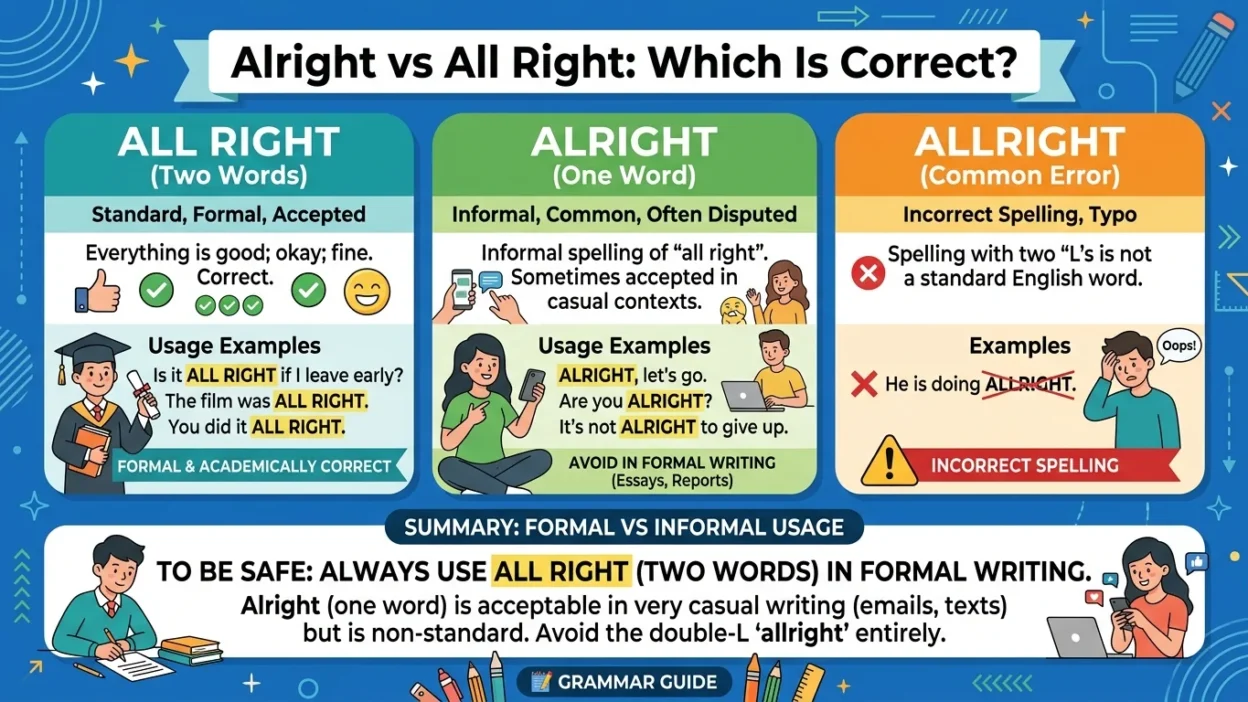
All right = traditional and universally accepted
Alright = common and widely used, especially in informal English
If you’re writing something formal, academic, or professional, all right is generally the safer choice.
Quick Answer
| Form | Correct? | Best Use |
|---|---|---|
| All right | ✅ | Formal and informal writing |
| Alright | ✅ | Mostly informal and everyday writing |
Examples:
Are you all right?
All right, let’s begin.
The food was all right.
Alright, I’ll help you.
Although alright is common in modern English, some traditional style guides still prefer all right.
What Does “All Right” Mean?
All right can mean several things depending on the context.
It can mean okay, satisfactory, safe, or acceptable.
For example:
Are you all right?
This means:
Are you okay?
You can also use it to describe something that is satisfactory:
The movie was all right.
This means the movie was acceptable or reasonably good, but not necessarily excellent.
“All Right” as an Expression
All right can also be used to show agreement or acceptance.
All right, I’ll do it.
All right, let’s go.
All right, you win.
Here, it functions as an informal conversational expression similar to okay.
What Does “Alright” Mean?
Alright is commonly used as a one-word alternative to all right.
It can mean:
- Okay
- Fine
- Acceptable
- Safe
- Satisfactory
- In agreement
For example:
Are you alright?
Alright, I’ll call you later.
Everything will be alright.
The movie was alright.
However, alright has historically been considered nonstandard or less formal by some usage authorities. Today, it is well established in informal English and is increasingly accepted in general usage.
Alright vs All Right: Main Difference
The biggest difference is style and convention, not meaning.
In most contexts:
alright ≈ all right
But all right has the advantage of being accepted in essentially all varieties of edited English.
So if you’re unsure:
Use “all right.”
Is “Alright” Correct?
Yes, alright is widely used and appears in contemporary English.
However, if you’re writing:
- An academic paper
- A formal report
- A business document
- A professional application
- Formal correspondence
all right is usually the safer choice.
For casual messages and everyday conversation, alright is very common.
All Right vs Alright in Formal Writing
For formal writing, prefer:
All right ✅
For example:
The patient is all right.
All right, we can proceed with the plan.
Instead of:
The patient is alright.
The one-word form isn’t necessarily confusing or unintelligible, but all right is the more conservative choice.
All Right vs Alright in Texting
In texting and casual communication, alright is extremely common.
For example:
Alright, see you tomorrow.
Are you alright?
Alright, let’s do it.
In informal contexts, alright often feels natural and conversational.
“All Right” Meaning “Okay”
One of the most common uses is to mean okay.
All right, I’ll meet you at six.
All right, let’s get started.
Are you all right?
In these sentences, all right can generally be replaced by okay.
“Alright” Meaning “Okay”
The same is true of alright:
Alright, I’ll meet you at six.
Alright, let’s get started.
Are you alright?
This is especially common in speech, texting, and informal writing.
“All Right” Meaning “Satisfactory”
All right can describe something as acceptable but not outstanding.
The food was all right.
The movie was all right, but I wouldn’t watch it again.
His performance was all right.
Here, all right means something like:
acceptable
okay
satisfactory
“Alright” Meaning “Satisfactory”
You will also frequently see alright used this way:
The food was alright.
The movie was alright.
The performance was alright.
Again, this is common in informal English.
“It’s All Right” vs “It’s Alright”
Both forms are widely encountered:
It’s all right.
It’s alright.
Both generally mean:
It’s okay.
However, It’s all right is the more traditionally accepted form and is the safer choice in formal writing.
“Everything Will Be All Right”
The traditional expression is:
Everything will be all right.
You will also frequently see:
Everything will be alright.
The second version is common in modern informal English.
If you want the most conservative or formal spelling, choose:
Everything will be all right.
“All Right, Then”
All right, then is a common expression used to indicate acceptance or move a conversation forward.
All right, then, let’s begin.
All right, then, I’ll see you tomorrow.
You can also encounter:
Alright, then, let’s begin.
The meaning remains the same.
All Right vs Okay
All right and okay can often be used interchangeably.
All right, let’s go.
Okay, let’s go.
Are you all right?
Are you okay?
Both are natural.
However, all right can sometimes carry slightly different shades of meaning depending on context.
All Right vs Fine
Similarly:
Are you all right?
Are you fine?
Both can ask whether someone is okay.
But fine can sometimes imply a stronger sense of being okay or can simply be a different conversational choice.
Common Mistakes
Mistake 1: Assuming “alright” is always wrong
This is too simplistic.
Alright is widely used in modern English, especially in informal contexts.
However, all right remains the safer choice for formal writing.
Mistake 2: Assuming “alright” and “all right” have completely different meanings
In most modern usage, they mean essentially the same thing.
The main difference is style, convention, and level of formality.
Mistake 3: Using “allright”
❌ Allright
This is not the standard spelling.
Use:
all right ✅
or:
alright ✅
There should not be an extra l in the middle.
Is “Allright” Correct?
No.
❌ allright
is not the standard spelling.
The two accepted forms are:
all right
alright
All Right or Alright in an Email?
For professional emails, all right is generally the better choice.
For example:
All right, I’ll send the document this afternoon.
For a casual email or message, alright can sound perfectly natural:
Alright, I’ll send it over later.
If you want to avoid any debate about the word, simply use okay:
Okay, I’ll send it this afternoon.
All Right or Alright in Academic Writing?
Use:
all right
Academic writing generally favors the more established and conservative form.
For example:
The results were all right, although further research is needed.
That said, academic writing may often benefit from a more precise word such as acceptable, satisfactory, or adequate, depending on the intended meaning.
Is “Alright” More Informal?
Generally, yes.
Alright is particularly common in:
- Text messages
- Social media
- Casual emails
- Dialogue
- Informal articles
- Everyday conversation
All right works in both formal and informal contexts.
How to Remember Alright vs All Right
Use this simple rule:
When in doubt, write “all right.”
Why?
Because all right is the traditional form and is accepted across formal and informal writing.
Think of it as the safe spelling.
Then remember:
Alright = common informal alternative
Quick Comparison
| Sentence | Recommended? |
|---|---|
| Are you all right? | ✅ Safest |
| Are you alright? | ✅ Common/informal |
| All right, let’s go. | ✅ Safest |
| Alright, let’s go. | ✅ Common/informal |
| Everything will be all right. | ✅ Safest |
| Everything will be alright. | ✅ Common/informal |
| Allright, let’s go. | ❌ Incorrect |
Final Verdict
Alright and all right generally have the same meaning, but all right is the safer and more traditionally accepted form.
Use:
All right ✅
when you want a form suitable for formal, professional, academic, and informal writing.
Use:
Alright ✅
in casual and conversational writing, where the one-word form is widely accepted.
Avoid:
Allright ❌
The easiest rule is:
Formal or unsure? Use “all right.”
Casual? “Alright” is commonly acceptable.
FAQs
Is alright or all right correct?
Both alright and all right are used in modern English. All right is the more traditional and universally safe choice, especially in formal writing.
Is alright one word?
Yes. Alright is written as one word and is widely used, particularly in informal English.
Is all right two words?
Yes.
all right
is written as two separate words.
Is “alright” grammatically correct?
It is widely used and accepted in contemporary English, although some formal style guides and editors still prefer all right.
Should I use alright or all right in formal writing?
Use all right in formal, academic, and professional writing because it is the more conservative and widely accepted form.
Is “allright” correct?
No. Allright is not the standard spelling.
Use all right or alright.
Are alright and all right pronounced the same?
Usually, yes. They are generally pronounced the same way.
What does “all right” mean?
Depending on context, all right can mean okay, safe, satisfactory, acceptable, or in agreement.
What does “alright” mean?
Alright generally has the same meanings as all right, including okay, fine, safe, satisfactory, or acceptable.
Is “Everything will be alright” correct?
It is widely used and understood. However, Everything will be all right is the more traditional and conservative form.
Which is better for SEO writing, alright or all right?
All right is generally the safer choice because it is the traditional standard form and works across formal and informal contexts. Alright can be used when a conversational tone is intentional.
Conclusion
The difference between alright vs all right is mainly about formality and usage preference rather than meaning.
All right is the traditional form and the safest choice in virtually any type of writing:
Everything will be all right.
Alright is a widely used one-word form, especially in casual and conversational English:
Alright, let’s go.
If you’re writing something formal or simply don’t want to risk criticism, choose all right.
The easiest rule to remember is:
All right = safest everywhere
Alright = common informal alternative
And never write allright.

Christopher Thomas is a passionate writer and dream researcher dedicated to exploring the meanings behind dreams. As an author at DrameyHut, he creates insightful and easy-to-understand interpretations that help readers connect with their subconscious mind. His work focuses on guiding individuals toward self-discovery, clarity, and a deeper understanding of their inner thoughts.