Indolence and insolence are two commonly confused words because they look and sound similar. However, they describe completely different kinds of behavior.
The easiest way to remember the difference is:
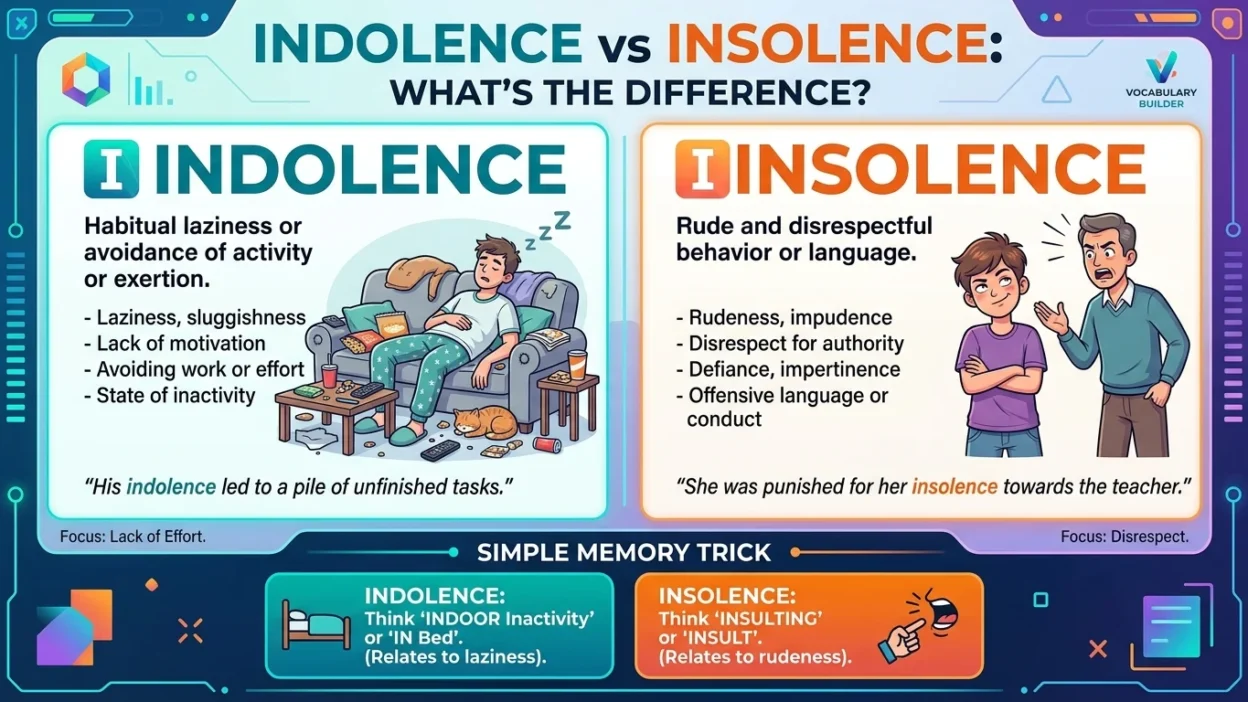
Indolence = laziness
Insolence = disrespect
So, if someone avoids work because they are lazy, their behavior may be described as indolent. If someone behaves rudely or disrespectfully toward another person, they may be described as insolent.
Quick Answer
| Word | Meaning | Example |
|---|---|---|
| Indolence | Laziness or avoidance of effort | His indolence prevented him from finishing the work. |
| Insolence | Rude, disrespectful, or arrogant behavior | The manager was shocked by the employee’s insolence. |
Easy Rule
Indolence → lazy
Insolence → disrespectful
What Does “Indolence” Mean?
Indolence is a noun meaning laziness, inactivity, or an unwillingness to make an effort.
An indolent person tends to avoid work or activity, especially when effort is required.
For example:
His indolence made it difficult for him to meet deadlines.
She was criticized for her indolence at work.
The student’s indolence affected his grades.
The word is usually somewhat formal and often carries a negative meaning.
What Does “Insolence” Mean?
Insolence is a noun meaning rude, disrespectful, or boldly arrogant behavior, especially toward someone who deserves respect or has authority.
For example:
The teacher was surprised by the student’s insolence.
His insolence toward his manager could cost him his job.
She would not tolerate such insolence.
The word often describes someone speaking or behaving in a disrespectful way.
Indolence vs Insolence: Main Difference
The main difference is what kind of behavior the word describes.
Indolence concerns effort and activity.
He doesn’t want to work because of his indolence.
Insolence concerns attitude and respect.
He spoke to his supervisor with insolence.
A simple way to remember them:
Indolence = I don’t want to work.
Insolence = I don’t respect you.
Indolence Meaning in Simple English
You can understand indolence as:
- Laziness
- Idleness
- Inactivity
- Lack of effort
- Unwillingness to work
For example:
His indolence kept him from completing his responsibilities.
This means his laziness prevented him from doing what he needed to do.
Insolence Meaning in Simple English
You can understand insolence as:
- Disrespect
- Rudeness
- Impudence
- Arrogance
- Defiance
For example:
The employee was reprimanded for his insolence.
This means the employee behaved rudely or disrespectfully.
Indolent vs Insolent
The related adjectives are:
Indolent = lazy
Insolent = rude or disrespectful
For example:
He is indolent and avoids hard work.
He is insolent and frequently speaks disrespectfully to his teachers.
The noun forms are:
indolence = laziness
insolence = disrespectful behavior
Examples of Indolence
Here are some natural examples:
His indolence caused him to miss several deadlines.
The company struggled because of employee indolence.
Her indolence kept her from pursuing her goals.
He spent the entire afternoon in indolence instead of working.
The manager was frustrated by his employee’s indolence.
Years of indolence had made it difficult for him to develop new skills.
Examples of Insolence
Here are some natural examples:
The teacher would not tolerate the student’s insolence.
His insolence toward his parents was shocking.
The employee was reprimanded for his insolence.
Her insolence angered the supervisor.
He responded with insolence when asked to follow the rules.
The officer was offended by the man’s insolence.
Indolence in a Sentence
Indolence usually appears in contexts involving work, effort, responsibility, or activity.
His indolence prevented him from reaching his goals.
The student’s indolence resulted in poor grades.
She was criticized for her indolence.
The word often has a formal or literary tone.
In everyday conversation, laziness is usually more natural:
His laziness prevented him from finishing the work.
Insolence in a Sentence
Insolence often appears in contexts involving authority, manners, respect, or social behavior.
The teacher punished him for his insolence.
Her insolence toward her boss was inappropriate.
I will not tolerate such insolence.
In everyday English, rudeness or disrespect may be more common.
Indolence vs Laziness
Indolence and laziness are very close in meaning.
His indolence is frustrating.
His laziness is frustrating.
The main difference is style.
Laziness is much more common in everyday English.
Indolence sounds more formal, literary, or sophisticated.
For example:
His laziness kept him from studying.
is more conversational than:
His indolence kept him from studying.
Insolence vs Rudeness
Similarly, insolence and rudeness are related.
His rudeness offended the teacher.
His insolence offended the teacher.
But insolence can suggest more than ordinary rudeness. It often implies bold, disrespectful, or defiant behavior, especially toward someone in authority.
Indolence vs Idleness
Indolence and idleness can also overlap.
Idleness means a state of not being occupied or active.
The workers were criticized for their idleness.
Indolence emphasizes an unwillingness to make an effort.
His indolence prevented him from completing the task.
Therefore, indolence is more strongly associated with laziness.
Insolence vs Arrogance
Insolence and arrogance are related but not identical.
Arrogance means having an exaggerated sense of one’s own importance or superiority.
His arrogance annoyed everyone.
Insolence describes openly disrespectful or impudent behavior.
His insolence toward the teacher was unacceptable.
A person can be arrogant without directly behaving insolently.
Common Mistakes
Mistake 1: Using indolence for disrespect
❌ The teacher was angry about his indolence toward her.
If you mean disrespectful behavior, use:
✅ The teacher was angry about his insolence toward her.
Mistake 2: Using insolence for laziness
❌ His insolence prevented him from completing his work.
If you mean laziness, use:
✅ His indolence prevented him from completing his work.
Mistake 3: Confusing indolent and insolent
Remember:
Indolent = lazy
Insolent = disrespectful
These adjectives are just as easy to confuse as the nouns.
How to Remember Indolence vs Insolence
A useful memory trick is to associate the first parts with different behaviors.
Indolence = Lack of Effort
Think:
INDOLENCE = IDLE
Both relate to not working or being inactive.
Insolence = Lack of Respect
Think:
INSOLENCE = INSULT
They aren’t etymologically identical, but this association can help you remember that insolence involves disrespectful behavior.
So remember:
Indolence → idle → lazy
Insolence → insult → disrespectful
Indolence vs Insolence: Quick Comparison
| Feature | Indolence | Insolence |
|---|---|---|
| Meaning | Laziness | Disrespectful behavior |
| Related adjective | Indolent | Insolent |
| Main idea | Lack of effort | Lack of respect |
| Common synonym | Laziness | Rudeness |
| Typical context | Work and effort | Authority and manners |
| Example | His indolence hurt his career. | His insolence offended his boss. |
Can Someone Be Both Indolent and Insolent?
Yes.
A person could be both lazy and disrespectful.
For example:
The employee’s indolence and insolence eventually led to his dismissal.
Here:
Indolence = he was lazy or unwilling to work.
Insolence = he behaved disrespectfully.
The two words can therefore appear together when describing different negative behaviors.
Indolence and Insolence in the Workplace
These words are particularly useful when describing workplace behavior.
Indolence
The manager was concerned about the employee’s indolence.
This suggests the employee was lazy or unwilling to work.
Insolence
The manager was concerned about the employee’s insolence.
This suggests the employee was disrespectful or defiant.
Both
The employee was dismissed because of repeated indolence and insolence.
This means the employee demonstrated both poor effort and disrespectful behavior.
Indolence and Insolence in School
The distinction is just as useful in an educational context.
Indolence:
The student’s indolence resulted in unfinished assignments.
Insolence:
The student’s insolence toward the teacher resulted in disciplinary action.
The first describes a problem with effort.
The second describes a problem with behavior and respect.
Final Verdict
The difference between indolence vs insolence comes down to two simple ideas:
Indolence = laziness or lack of effort
Insolence = rudeness or lack of respect
The related adjectives make the distinction even clearer:
Indolent = lazy
Insolent = disrespectful
For example:
His indolence prevented him from finishing his work.
His insolence offended his supervisor.
The easiest memory trick is:
Indolence → idle → lazy
Insolence → insult → disrespectful
Once you connect indolence with a lack of effort and insolence with a lack of respect, it becomes much easier to choose the correct word.
FAQs
What is the difference between indolence and insolence?
Indolence means laziness or unwillingness to make an effort, while insolence means rude, disrespectful, or defiant behavior.
Does indolence mean laziness?
Yes. Indolence means laziness, idleness, or a lack of willingness to make an effort.
Does insolence mean disrespect?
Yes. Insolence means rude, disrespectful, or boldly defiant behavior.
What is the difference between indolent and insolent?
Indolent means lazy or inactive. Insolent means rude, disrespectful, or impudent.
Is indolence a negative word?
Yes. Indolence usually has a negative meaning because it describes an unwillingness to work or make an effort.
Is insolence a negative word?
Yes. Insolence is strongly negative and describes disrespectful or offensive behavior.
What is an example of indolence?
His indolence prevented him from completing his responsibilities.
Here, indolence means laziness.
What is an example of insolence?
The student’s insolence toward the teacher was unacceptable.
Here, insolence means disrespectful behavior.
What is a synonym for indolence?
Common synonyms include laziness, idleness, inactivity, and sloth.
What is a synonym for insolence?
Common synonyms include rudeness, disrespect, impudence, defiance, and impertinence.
Can a person be indolent and insolent?
Yes. Someone can be both lazy and disrespectful. The words describe different aspects of behavior.
Conclusion
Indolence and insolence may look almost the same, but their meanings are quite different.
Indolence refers to laziness, idleness, or a lack of effort:
His indolence prevented him from completing the project.
Insolence refers to rude, disrespectful, or defiant behavior:
His insolence toward his manager was unacceptable.
The best way to remember the difference is:
Indolence = idle = lazy
Insolence = insult = disrespectful
So, when you’re talking about someone who doesn’t want to work, think indolence. When you’re talking about someone who behaves disrespectfully, think insolence.

Daniel Charles is a dedicated author and dream interpretation enthusiast at DrameyHut. He specializes in analyzing dream symbols and meanings, offering clear and insightful content for readers. His work aims to help individuals understand their subconscious thoughts, gain clarity, and explore the deeper messages hidden within their dreams.