
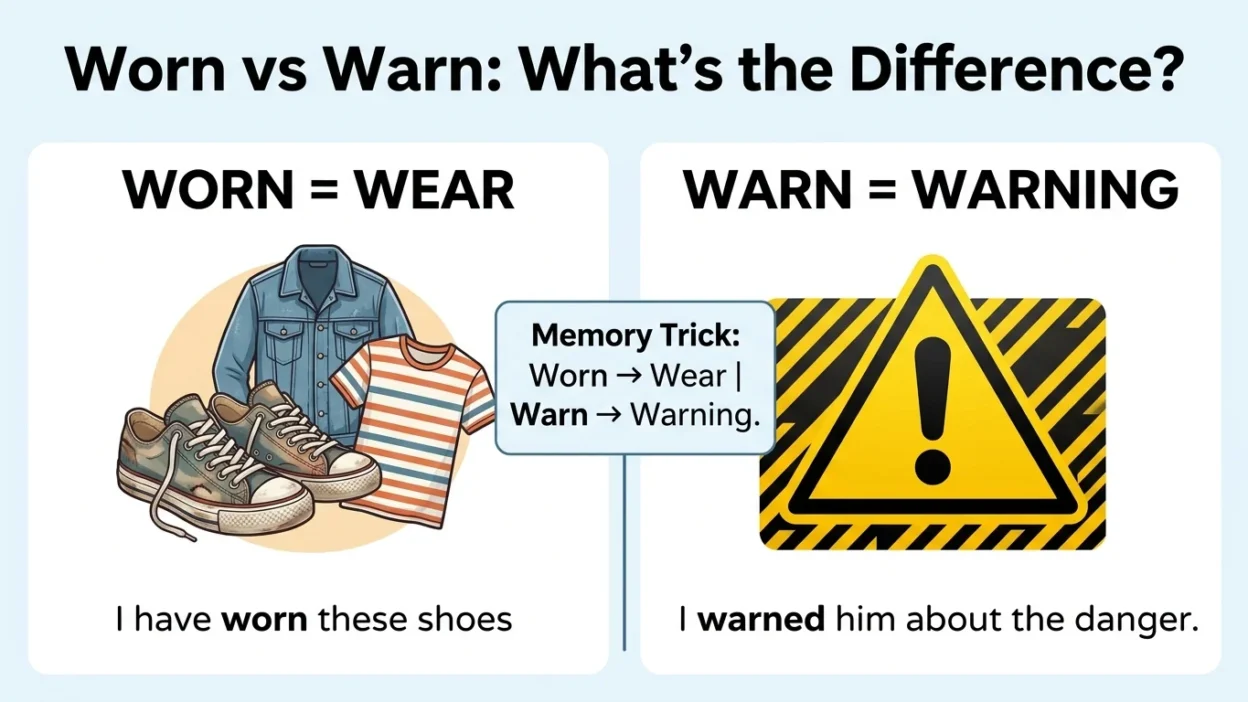
Worn and warn are commonly confused English words because they sound similar, but they have completely different meanings.
The simple rule is:
Worn = past participle of wear 👕
Warn = tell someone about a possible danger or problem ⚠️
For example:
I have worn these shoes many times.
She warned me about the traffic.
Quick Answer
| Word | Meaning | Example |
|---|---|---|
| Worn | Past participle of wear; used or damaged from use | These shoes are worn. |
| Warn | To tell someone about a danger or possible problem | I warned him about the risk. |
Easy Memory Trick
Think:
Worn → wear → clothes
Warn → warning → danger
What Does “Worn” Mean?
Worn is the past participle of the verb wear.
The forms of wear are:
wear → wore → worn
We use worn with helping verbs such as have, has, had, and be.
Examples:
I have worn this shirt before.
She has worn that dress several times.
He had worn the shoes until they were damaged.
The jacket was badly worn.
Worn Meaning “Used or Damaged”
Worn can also be an adjective describing something that has become damaged, thin, faded, or less attractive because of repeated use.
For example:
These shoes look worn.
The carpet is badly worn.
He was wearing a worn leather jacket.
The book has worn edges.
Here, worn means something has deteriorated through use.
Worn Out Meaning
The phrase worn out can mean very tired when describing a person.
I am completely worn out after work.
It can also mean used so much that something is no longer in good condition.
My old shoes are worn out.
So:
worn out person = extremely tired
worn out object = heavily used or damaged
Worn vs Wore
Don’t confuse worn with wore.
Wore is the simple past tense:
I wore this shirt yesterday.
Worn is the past participle:
I have worn this shirt before.
A simple rule:
Yesterday → wore
Have/has/had → worn
Examples:
She wore a red dress last night.
She has worn that dress before.
What Does “Warn” Mean?
Warn is a verb meaning to tell someone about a possible danger, problem, or unpleasant consequence.
For example:
I warned him about the slippery floor.
The teacher warned the students not to run.
They warned us about the storm.
The purpose of a warning is usually to help someone avoid danger, trouble, or a mistake.
Warn in a Sentence
Here are some examples:
I warned you not to touch it.
She warned me about the difficult road.
The doctor warned him about the risks.
They warned us that the weather could change.
He warned his children to stay away from the river.
Warn vs Warning
Warn is the verb:
The police warned drivers about the icy roads.
Warning is the noun or present participle:
The police issued a warning about the icy roads.
You can remember:
warn → warning
just as:
wear → worn
Worn vs Warn: Pronunciation
In many varieties of English, worn and warn have very similar pronunciations, and in some accents they may sound nearly identical.
That is one reason the words are easily confused in speech.
The spelling and meaning, however, are completely different.
When writing, focus on the meaning:
Worn → something has been worn or used.
Warn → someone is being told about a danger or problem.
Worn vs Warn Examples
Compare these sentences:
I have worn these boots all winter.
Here, worn comes from wear.
I warned him about the icy road.
Here, warned means told him about a possible danger.
Another pair:
She has worn the necklace before.
She warned me not to lose the necklace.
The meanings are completely different.
Common Mistakes
Mistake 1: Using “warn” when you mean “wear”
❌ I have warn this jacket before.
✅ I have worn this jacket before.
Mistake 2: Using “worn” when you mean “warn”
❌ I worn him about the danger.
✅ I warned him about the danger.
Notice that the past tense of warn is:
warned
not worn.
Mistake 3: Confusing “worn” and “warned”
worn = from wear
warned = past tense of warn
Examples:
I have worn these shoes.
I warned him about the shoes.
Worn vs Warned
This is an especially important distinction.
Worn:
I have worn this coat many times.
Warned:
I warned him about the cold weather.
If you’re talking about clothing or something being used, choose worn.
If you’re talking about giving someone information about danger or a problem, choose warned.
Worn Clothes
You can use worn to describe clothing that has been used.
She wore a worn pair of jeans.
His jacket looked old and worn.
The shirt was faded and worn.
Here, worn can suggest that the item looks old because it has been used repeatedly.
Warn Someone About Something
A very common grammatical pattern is:
warn someone about something
Examples:
She warned me about the traffic.
The doctor warned him about the side effects.
They warned us about the weather.
Another common pattern is:
warn someone not to do something
Examples:
I warned him not to drive too fast.
She warned me not to touch the machine.
The teacher warned the students not to run.
Warn Someone That…
You can also use:
warn someone that + clause
For example:
He warned me that the road was dangerous.
She warned us that the store might be closed.
They warned him that the deadline was approaching.
Warn vs Advise
Warn and advise are related but different.
Advise means to recommend what someone should do.
I advised him to leave early.
Warn emphasizes a possible danger or negative consequence.
I warned him that he might miss the flight.
A warning is generally stronger than ordinary advice.
Worn vs Used
Worn can mean something has been used, especially clothing.
I bought a worn leather jacket.
But used is much broader:
I bought a used car.
You cannot always replace worn with used, because worn can specifically suggest visible deterioration caused by use.
Easy Way to Remember Worn vs Warn
Use this simple association:
Worn → Wear
wear → wore → worn
Think about clothes, shoes, and objects.
Warn → Warning
warn → warning
Think about danger, risks, and advice.
So:
Worn = wear
Warn = warning
Quick Comparison
| Word | Part of Speech | Meaning | Example |
|---|---|---|---|
| worn | Verb/adjective | Past participle of wear; used or damaged | I have worn these shoes before. |
| warn | Verb | Tell someone about danger or a problem | I warn you to be careful. |
| wore | Verb | Past tense of wear | I wore these shoes yesterday. |
| warned | Verb | Past tense of warn | I warned him about the danger. |
| warning | Noun/verb | Notice of danger; telling someone about risk | He gave me a warning. |
Final Verdict
The difference between worn vs warn is easy once you connect each word to its related word:
Worn → wear → clothes or things used
Warn → warning → danger or possible problems
For example:
I have worn this jacket many times.
I warned him about the cold weather.
Remember that worn is the past participle of wear:
wear → wore → worn
Meanwhile, warn is a regular verb:
warn → warned → warned
So if you’re talking about wearing something, use worn. If you’re talking about telling someone about a danger or problem, use warn.
FAQs
What is the difference between worn and warn?
Worn is the past participle of wear and can also describe something damaged through use. Warn means to tell someone about a possible danger or problem.
Is worn the past tense of wear?
No. Wore is the simple past tense of wear, while worn is its past participle.
I wore it yesterday.
I have worn it before.
Is “worn” a verb or an adjective?
It can be both. Worn is the past participle of wear, and it can also function as an adjective meaning used or damaged from use.
What is the past tense of warn?
The past tense of warn is warned.
She warned me about the danger.
What does worn out mean?
Worn out can mean extremely tired when describing a person or heavily used and no longer in good condition when describing an object.
What is an example of warn?
The teacher warned the students about the slippery floor.
What is an example of worn?
I have worn these shoes many times.
Are worn and warn pronounced the same?
They can sound very similar, and in some accents they may be nearly identical. Their meanings and spellings are different.
Is it “I have wore” or “I have worn”?
The correct form is:
I have worn.
Use worn after have, has, or had.
Is it “I worn him” or “I warned him”?
The correct form is:
I warned him.
Warned is the past tense of warn.
Conclusion
Worn and warn may sound similar, but they have completely different meanings.
Use worn when talking about wearing something or something becoming damaged through use:
I have worn these shoes many times.
Use warn when you mean to tell someone about a danger, risk, or problem:
I warned him about the storm.
The easiest memory trick is:
Worn → wear → wore → worn
Warn → warning → danger
Once you connect worn with wear and warn with warning, you’ll rarely confuse these two words again.

Nancy Lisa is a passionate writer and contributor at DrameyHut, focused on uncovering the deeper meanings behind dreams. She creates engaging and insightful content that helps readers interpret their dreams and understand their subconscious thoughts. Her work inspires self-reflection, clarity, and a stronger connection to inner emotions.