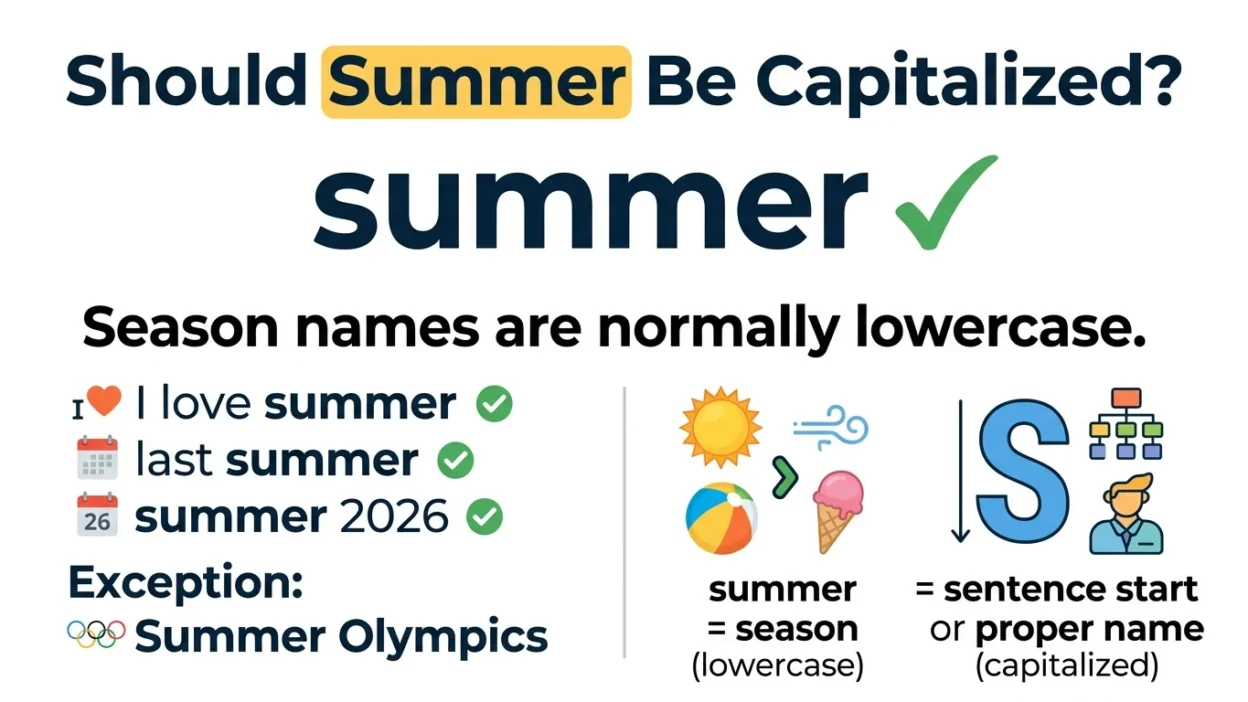
Should you capitalize “summer”? Usually, no. The seasons spring, summer, fall, and winter are generally lowercase unless they are part of a proper name, title, or another expression that requires capitalization.
The simple rule is:
summer = lowercase in most situations ✅
Summer = uppercase only in specific cases ✅
Quick Answer
Use summer with a lowercase s when you are simply referring to the season:
I love summer.
We usually travel in summer.
Summer is my favorite season. ❌
The last sentence should normally be:
Summer is my favorite season.
Actually, there is an important distinction here: capitalization at the beginning of a sentence is always required, so Summer is capitalized there because it starts the sentence, not because it is the name of a season.
Compare:
Summer is my favorite season. ✅
I love summer. ✅
Are Seasons Capitalized?
In standard English, the names of the four seasons are generally not capitalized:
- spring
- summer
- fall
- autumn
- winter
Examples:
We went to the beach last summer.
Flowers bloom in spring.
The leaves change color in fall.
It gets very cold in winter.
I enjoy autumn more than summer.
When Should “Summer” Be Capitalized?
There are several situations where Summer should be capitalized.
1. At the Beginning of a Sentence
Like any word at the beginning of a sentence, summer becomes Summer.
Summer is my favorite season.
Summer can be extremely hot here.
The capitalization is required because the word begins the sentence.
2. In a Proper Name
If Summer is part of an official name, it may be capitalized.
For example:
Summer Olympics
Summer Paralympics
Here, Summer is part of the official event name.
3. In a Title or Heading
Capitalization can depend on the style used for titles and headings.
For example, in title case:
Summer Vacation Ideas
Summer Travel Guide
Best Summer Activities for Families
In sentence case, however, you might write:
Best summer activities for families
So the capitalization may depend on the publication’s chosen style.
4. When “Summer” Is a Name
If Summer is someone’s personal name, it is capitalized because names are proper nouns.
Summer is coming to the party.
Here, Summer refers to a person, not the season.
Summer in a Sentence
When summer appears in the middle of a normal sentence and refers to the season, use lowercase:
I usually visit my grandparents in summer.
We spent last summer in the mountains.
The weather is extremely hot during summer.
I have always loved summer.
Our school closes for summer vacation.
“Summer Vacation” Capitalization
In ordinary sentences, summer vacation is usually lowercase:
We are planning our summer vacation.
I can’t wait for summer vacation.
She spent her summer vacation with her family.
Do not capitalize Summer simply because it appears before vacation.
❌ Summer Vacation is coming soon.
✅ summer vacation is coming soon.
However, if it is being used as a title or official name, capitalization may be appropriate.
“Summer Break” Capitalization
Similarly, summer break is normally lowercase:
School starts again after summer break.
I have big plans for my summer break.
We are looking forward to summer break.
Not:
❌ Summer Break
unless it is part of a title or official name.
“Summer School” Capitalization
Summer school is normally lowercase when used as a general term:
My son is attending summer school.
She signed up for summer school.
He has to take a class during summer school.
If it is the official name of a program, however, capitalization may be appropriate.
“Summer Semester” Capitalization
Usually:
summer semester
For example:
I am taking two classes during the summer semester.
But an institution may capitalize it as part of an official program name:
Summer Semester Program
Follow the organization’s official style when it is a formal name.
“Summer 2026” Capitalization
When referring to a season and year, summer is normally lowercase:
We are planning to travel in summer 2026.
The project will begin in summer 2026.
However, you may see Summer 2026 in calendars, event titles, marketing materials, or headings where title-style capitalization is being used.
For example:
Summer 2026 Travel Guide
Here, the capitalization is primarily a title or heading convention.
“In Summer” or “In the Summer”
Both can be correct, depending on the variety of English and context.
American English
In the summer is very common:
We usually travel in the summer.
British English
In summer is also common:
We usually travel in summer.
Neither construction changes the capitalization rule:
in the summer ✅
in summer ✅
“This Summer” Capitalization
When summer appears in the middle of a sentence, it is lowercase:
I’m going to the beach this summer.
What are you doing this summer?
We have several projects planned for this summer.
At the beginning of a sentence:
Summer will be here soon.
Again, capitalization is determined by sentence position.
“Last Summer” and “Next Summer”
Use lowercase when the season appears in the middle of the sentence:
We visited Europe last summer.
I’m going to start a new job next summer.
What did you do last summer?
What are you planning to do next summer?
Not:
❌ last Summer
❌ next Summer
unless Summer is part of a proper name or title.
Summer vs Summer’s
When talking about something belonging to or associated with the season, summer’s is also lowercase in normal sentences.
Summer’s hot weather can be difficult to tolerate.
Here, Summer’s is capitalized only because it begins the sentence.
In the middle of a sentence:
I love summer’s warm evenings.
“Summer Months” Capitalization
The phrase summer months is normally lowercase:
The summer months are usually very hot.
Tourism increases during the summer months.
Similarly:
winter months
spring months
fall months
are normally lowercase.
Summer Capitalization in Academic Writing
In academic writing, seasons are generally lowercase unless they are part of a proper noun or official title.
For example:
The study was conducted during summer 2025.
Temperatures increased during the summer months.
Participants were recruited in spring.
There is generally no reason to capitalize summer simply because it refers to a season.
Summer Capitalization in Titles
This is where things can become confusing.
If you use title case, important words are capitalized:
How to Stay Cool This Summer
Best Summer Activities for Kids
Summer Travel Tips
If you use sentence case, only the first word and proper nouns are normally capitalized:
How to stay cool this summer
Best summer activities for kids
Summer travel tips
Both may be correct depending on the publication’s style guide.
Summer Olympics Capitalization
One important exception is Summer Olympics.
When referring to the Olympic Games officially, Summer Olympics is capitalized:
The Summer Olympics attract athletes from around the world.
Here, Summer is part of the event’s name.
However, when simply discussing the season:
The Olympics took place during the summer.
Here, summer is lowercase.
Summer vs. Summer Olympics
Compare:
I love summer. ✅
The word refers to the season.
I watched the Summer Olympics. ✅
The word is part of an official event name.
This distinction is important because proper names are capitalized, while ordinary season names generally are not.
Common Mistakes
Mistake 1: Capitalizing every season
❌ I love Summer.
If this is not at the beginning of a sentence, use:
✅ I love summer.
Mistake 2: Capitalizing “summer vacation”
❌ We are planning our Summer Vacation.
Better:
✅ We are planning our summer vacation.
Unless it is an official title or heading.
Mistake 3: Capitalizing “summer 2026”
❌ The project starts in Summer 2026.
Normally:
✅ The project starts in summer 2026.
Mistake 4: Assuming seasons are proper nouns
Unlike names such as January, June, and December, season names are generally common nouns.
Therefore:
January ✅
June ✅
summer ✅
winter ✅
Seasons vs. Months
This is an important distinction.
Months
Months are proper nouns and are capitalized:
January
February
March
April
May
June
July
August
September
October
November
December
Seasons
Seasons are normally common nouns:
spring
summer
fall
autumn
winter
So:
I was born in July.
but:
I was born in summer.
Summer Capitalization by Context
| Context | Correct Form |
|---|---|
| General season | summer |
| Beginning of sentence | Summer |
| Summer vacation | summer vacation |
| Summer break | summer break |
| Summer months | summer months |
| Summer 2026 | summer 2026 |
| Official event name | Summer Olympics |
| Title/heading | Depends on style |
| Person’s name | Summer |
Easy Rule to Remember
Here’s the simplest capitalization rule:
Season names are lowercase unless they begin a sentence or form part of a proper name/title.
So write:
I love summer.
We traveled last summer.
Summer is hot here.
I watched the Summer Olympics.
Final Verdict
Summer is generally not capitalized when it refers to the season.
Use:
summer ✅
Examples:
I love summer.
We traveled last summer.
I’m planning a trip for summer 2026.
Capitalize Summer when:
- It begins a sentence.
- It is part of a proper name.
- It appears in a title or heading that uses title case.
- It is someone’s personal name.
The easiest rule is:
spring, summer, fall, and winter are normally lowercase.
So, unless a specific capitalization rule applies, write summer, not Summer.
FAQs
Should summer be capitalized?
Usually, no. Summer is normally lowercase when it refers to the season.
I love summer.
Is “summer 2026” capitalized?
Normally, write:
summer 2026
The season name is lowercase, while the year is written normally.
Is summer vacation capitalized?
Usually, no:
summer vacation
Capitalize it only when it is part of a title, heading, or official name.
Is summer break capitalized?
Normally:
summer break
It does not need capitalization simply because it refers to a school holiday.
Are all seasons lowercase?
Generally, yes. spring, summer, fall, autumn, and winter are normally lowercase unless they begin a sentence or are part of a proper name or title.
Why is January capitalized but summer lowercase?
January is the name of a month and is treated as a proper noun. Summer is the general name of a season and is normally treated as a common noun.
Should I capitalize summer in a title?
It depends on the capitalization style. In title case, you may write Summer. In sentence case, you would normally write summer unless it is the first word or a proper noun.
Is “this summer” capitalized?
Normally:
this summer
For example:
I’m traveling this summer.
Is “last summer” capitalized?
Normally:
last summer
For example:
We went to the beach last summer.
Is “Summer Olympics” capitalized?
Yes. Summer Olympics is capitalized when referring to the official event name.
Conclusion
The basic summer capitalization rule is simple: summer is normally lowercase when it refers to the season.
Write:
I love summer.
We traveled last summer.
I’m planning a trip for summer 2026.
Capitalize it when it begins a sentence:
Summer is my favorite season.
or when it is part of a proper name:
Summer Olympics
In titles and headings, capitalization depends on whether you are using title case or sentence case.
So the easiest rule to remember is:
Season names are lowercase: spring, summer, fall, autumn, winter.

Joseph Richard is the administrator and a dedicated author at DrameyHut, overseeing the platform’s operations and content quality. Alongside his administrative role, he writes insightful articles on dream meanings, helping readers understand their subconscious mind. His work supports the mission of providing clear, meaningful, and engaging dream interpretations.