
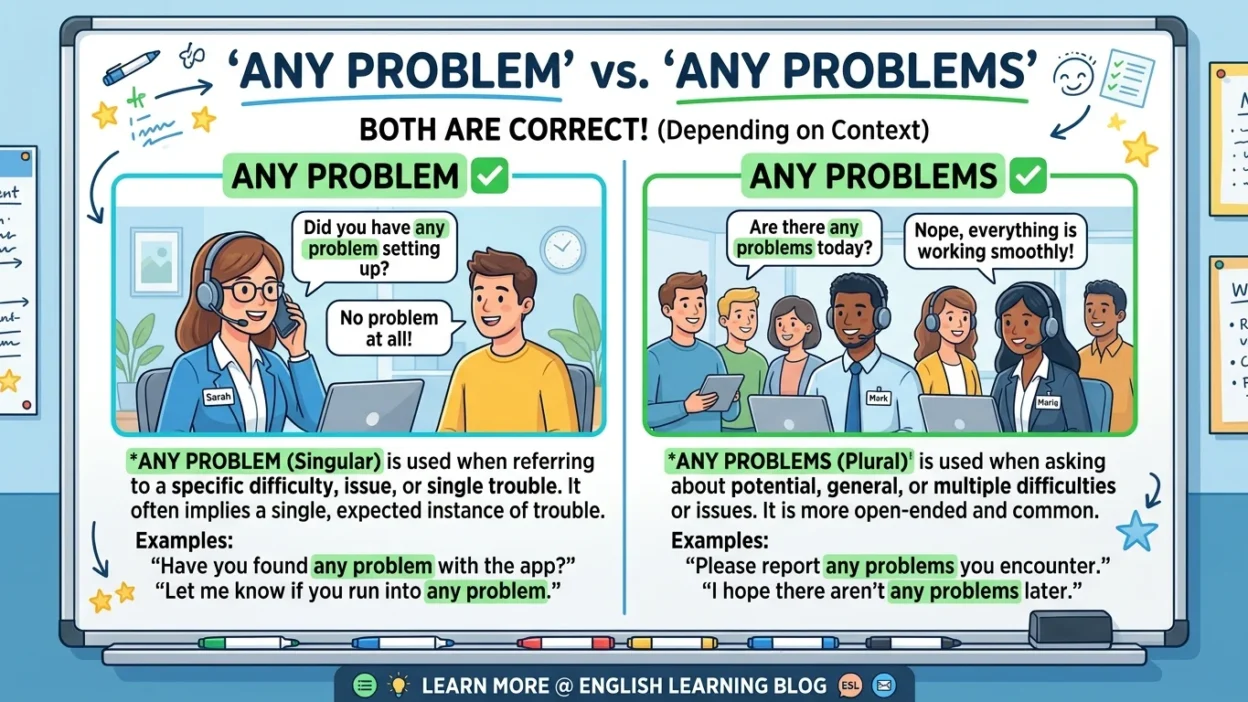
Many English learners are unsure if they should say any problem or any problems. Since both phrases are common in everyday English, choosing the right one can be confusing. The correct choice depends on whether you’re referring to one possible problem or problems in general.
Understanding the difference between any problem vs any problems will help you speak and write more naturally in both formal and informal English.
Quick Answer
Both any problem and any problems are correct, but they are used in different contexts. Any problems is more common when asking or talking about problems in general, while any problem is usually used when referring to a single problem or after words like if, without, or in case of.
Why People Confuse It
The confusion happens because any can be followed by both singular and plural nouns.
The choice depends on the meaning:
- Any problem = one possible problem.
- Any problems = one or more problems in general.
Any Problem
Any problem uses a singular noun.
Meaning
It refers to:
- One possible issue.
- A specific problem that may occur.
Examples
- If you have any problem, let me know.
- Contact us if any problem arises.
- Without any problem, the installation was completed.
- In case of any problem, call customer support.
- We can solve any problem together.
Any Problems
Any problems uses a plural noun.
Meaning
It refers to:
- One or more issues.
- Problems in general.
This is the more common form in everyday conversation.
Examples
- Do you have any problems?
- Were there any problems during the meeting?
- We didn’t experience any problems.
- Are there any problems with the software?
- Let me know if you have any problems.
Comparison Table
| Feature | Any Problem | Any Problems |
|---|---|---|
| Correct English | ✅ Yes | ✅ Yes |
| Refers to one possible issue | ✅ Yes | ❌ No |
| Refers to problems in general | ❌ Rarely | ✅ Yes |
| Common in everyday conversation | Sometimes | ✅ Very common |
| Natural after “Do you have…” | Less common | ✅ Yes |
When to Use Each
Use any problem when:
- Referring to one possible issue.
- Using phrases like if any problem arises.
- Writing formal instructions or notices.
Use any problems when:
- Asking about issues in general.
- Talking about multiple or unspecified problems.
- Having everyday conversations.
Examples
- If you have any problem, please contact us.
- In case of any problem, call this number.
- We can handle any problem that comes our way.
- Without any problem, the event was successful.
- Report any problem immediately.
- Do you have any problems with your laptop?
- Were there any problems during the exam?
- We didn’t encounter any problems.
- Let me know if you have any problems.
- Are there any problems with the new update?
- She solved the task without any problem.
- The trip went smoothly without any problems.
Common Mistakes
Many learners make these errors.
- Using any problem when asking a general question.
- Assuming only one form is correct.
- Forgetting that plural nouns are often more natural after any in questions.
Correct:
- Do you have any problems?
- If you have any problem, let us know.
Less natural:
- Do you have any problem?
Memory Trick
Remember this simple rule:
General question = Any problems.
One possible issue = Any problem.
If you’re asking whether someone has issues in general, choose the plural form.
American vs British English
There is no significant difference between American and British English.
Both varieties commonly use any problems in everyday conversation, while any problem is more common in formal instructions and notices.
Similar Words
You may also confuse these expressions:
- Any Question vs Any Questions
- Any Concern vs Any Concerns
- Any Issue vs Any Issues
- Some Problem vs Some Problems
- No Problem vs No Problems
- Much Trouble vs Many Troubles
- Little Problem vs Small Problem
- Few Mistakes vs A Few Mistakes
- Any Error vs Any Errors
- Any Difficulty vs Any Difficulties
Final Verdict
Both any problem and any problems are correct, but they serve different purposes. Any problem refers to a single possible issue and is often used in formal instructions or conditional sentences. Any problems is the more natural choice when asking or talking about issues in general.
When in doubt, any problems is usually the better option in everyday English.
Remember This
Any problem = One possible issue. ✅
Any problems = One or more issues in general. ✅
Think:
If you have any problem, call us.
Do you have any problems?
FAQs
Which is correct, any problem or any problems?
Both are correct. Any problems is more common for general questions, while any problem refers to one possible issue.
Is “Do you have any problem?” correct?
It is grammatically correct, but Do you have any problems? sounds more natural in everyday English.
When should I use “any problem”?
Use it when referring to a single possible issue, especially in phrases like if any problem arises.
Why is “any problems” more common?
Because people are usually asking about one or more possible issues rather than a single specific problem.
Do British and American English use these phrases differently?
No. Both varieties follow the same usage patterns.
Can I say “without any problem”?
Yes. It is grammatically correct, although without any problems is also very common.
Which form sounds more natural in conversation?
Any problems is generally the more natural choice in everyday speech.
Conclusion
The difference between any problem and any problems depends on what you’re referring to. Use any problem when talking about one possible issue, especially in formal or conditional contexts. Use any problems when asking about or discussing issues in general.
Choosing the right form will make your English sound more natural and grammatically

Joseph Richard is the administrator and a dedicated author at DrameyHut, overseeing the platform’s operations and content quality. Alongside his administrative role, he writes insightful articles on dream meanings, helping readers understand their subconscious mind. His work supports the mission of providing clear, meaningful, and engaging dream interpretations.