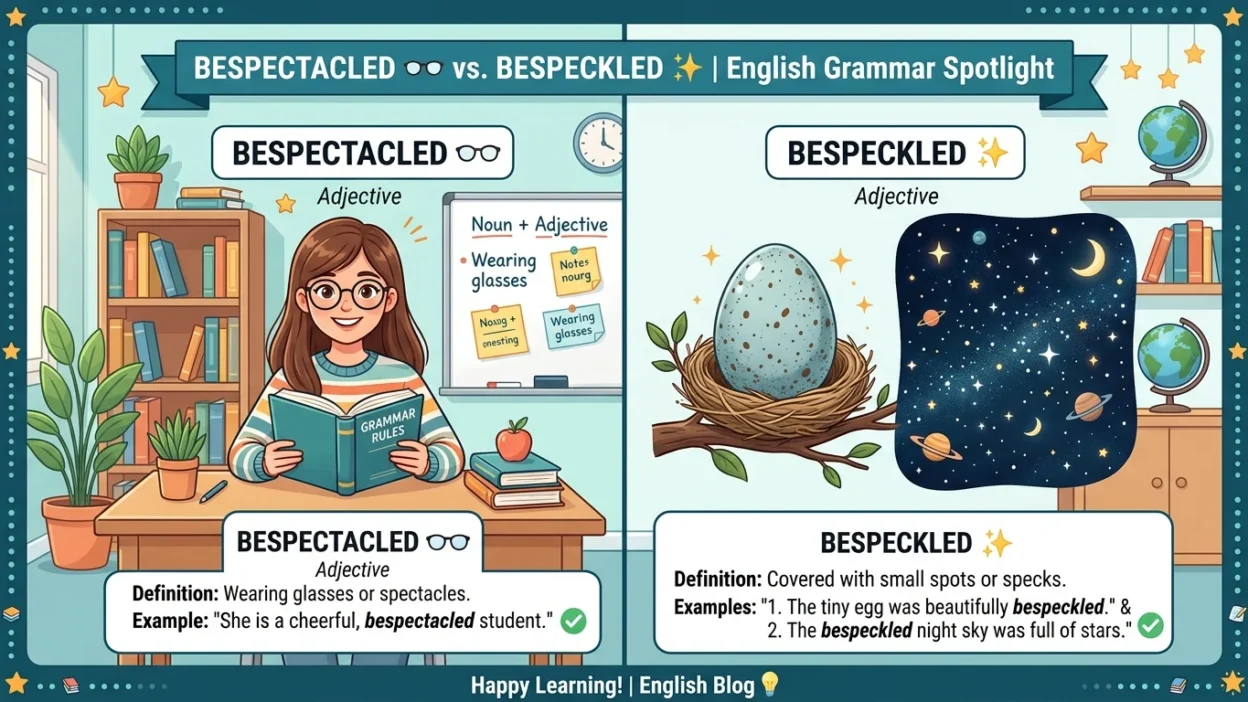
Many English learners confuse bespectacled and bespeckled because the words look and sound similar. However, they have completely different meanings and are used in different contexts.
Understanding the difference between bespectacled vs bespeckled will help you choose the correct word when describing a person’s appearance or something covered with small spots.
Quick Answer
Bespectacled means wearing glasses, while bespeckled means covered with small spots, specks, or marks. Although both are correct English words, they are not interchangeable.
Why People Confuse It
The confusion happens because:
- Both words begin with be-.
- Their spellings are very similar.
- Both are adjectives describing appearance.
Despite their similarity, they describe completely different things.
Bespectacled
Bespectacled is an adjective.
Meaning
It means:
- Wearing glasses or spectacles.
It is commonly used in books, news articles, and descriptive writing.
Examples
- The bespectacled teacher smiled warmly.
- A bespectacled student raised his hand.
- The detective was a quiet, bespectacled man.
- She recognized the bespectacled librarian immediately.
- The bespectacled professor explained the theory.
Bespeckled
Bespeckled is also an adjective.
Meaning
It means:
- Covered with small spots, dots, or specks.
- Marked with tiny scattered particles.
Examples
- The leaves were bespeckled with raindrops.
- Her dress was bespeckled with paint.
- The sky was bespeckled with stars.
- The eggs were brown and bespeckled.
- The window was bespeckled with mud.
Comparison Table
| Feature | Bespectacled | Bespeckled |
|---|---|---|
| Correct English | ✅ Yes | ✅ Yes |
| Means wearing glasses | ✅ Yes | ❌ No |
| Means covered with spots | ❌ No | ✅ Yes |
| Refers to people | ✅ Usually | Sometimes |
| Refers to objects or surfaces | ❌ Rarely | ✅ Yes |
When to Use Each
Use bespectacled when:
- Describing someone who wears glasses.
- Writing stories or character descriptions.
- Referring to a person’s appearance.
Use bespeckled when:
- Describing something with tiny spots or marks.
- Talking about paint, dust, stars, raindrops, or patterns.
- Referring to objects, animals, or surfaces.
Examples
- The bespectacled doctor greeted the patient.
- A bespectacled woman entered the room.
- The bespectacled scientist won the award.
- Everyone noticed the bespectacled speaker.
- The young, bespectacled boy loved reading.
- The path was bespeckled with fallen leaves.
- The table was bespeckled with flour.
- Her boots were bespeckled with mud.
- The night sky was bespeckled with stars.
- The butterfly had bespeckled wings.
- The bespectacled librarian recommended a great novel.
- The stone was naturally bespeckled with minerals.
Common Mistakes
Many learners make these errors.
- Using bespeckled to describe someone wearing glasses.
- Using bespectacled to describe spotted objects.
- Assuming the words have the same meaning because of their similar spelling.
Correct:
- The bespectacled teacher entered the classroom.
- The wall was bespeckled with paint.
Incorrect:
- The bespeckled teacher entered the classroom. (Unless the teacher was literally covered with spots.)
Memory Trick
Remember this simple rule:
Spectacles = Glasses → Bespectacled.
Specks = Tiny spots → Bespeckled.
Think:
- Spectacles → Bespectacled 👓
- Specks → Bespeckled ✨
American vs British English
There is no major difference between American and British English.
Both varieties use bespectacled to describe someone wearing glasses and bespeckled to describe something covered with small spots.
Similar Words
You may also confuse these words:
- Speckled vs Spotted
- Glasses vs Spectacles
- Bespectacled vs Four-eyed
- Freckled vs Speckled
- Dotted vs Spotted
- Blotched vs Speckled
- Stained vs Speckled
- Eyeglasses vs Goggles
- Binoculars vs Spectacles
- Spotless vs Speckled
Final Verdict
The difference between bespectacled and bespeckled is easy to remember once you know their roots. Bespectacled refers to a person wearing glasses, while bespeckled describes something covered with tiny spots or specks.
Using the correct word will make your writing more accurate and descriptive.
Remember This
Bespectacled = Wearing glasses. 👓 ✅
Bespeckled = Covered with tiny spots. ✨ ✅
Think:
A bespectacled teacher.
A bespeckled egg.
FAQs
Which is correct, bespectacled or bespeckled?
Both are correct, but they have different meanings. Bespectacled means wearing glasses, while bespeckled means covered with small spots.
What does bespectacled mean?
It means wearing spectacles or eyeglasses.
What does bespeckled mean?
It means covered with tiny spots, specks, or marks.
Can I describe a person as bespeckled?
Only if the person is literally covered with small spots, such as mud or paint. To describe someone wearing glasses, use bespectacled.
Is bespectacled a formal word?
Yes. It is commonly used in formal writing, literature, and journalism.
Do British and American English use these words differently?
No. Both varieties use them with the same meanings.
What is another word for bespectacled?
Common alternatives include wearing glasses, wearing spectacles, or four-eyed (informal and sometimes offensive).
Conclusion
Although bespectacled and bespeckled look alike, they describe completely different things. Bespectacled refers to someone who wears glasses, while bespeckled describes something marked with tiny spots or specks.
Remembering the connection between spectacles and bespectacled, and between specks and bespeckled, will help you choose the correct word every time.

Nancy Lisa is a passionate writer and contributor at DrameyHut, focused on uncovering the deeper meanings behind dreams. She creates engaging and insightful content that helps readers interpret their dreams and understand their subconscious thoughts. Her work inspires self-reflection, clarity, and a stronger connection to inner emotions.