“Looking forward to working with you” is a common and professional English expression used when you are excited or pleased about starting a professional relationship with someone. You may see it in emails, business messages, interviews, and workplace conversations.
Although the phrase is very common, many people are unsure about the grammar after looking forward to. Should you say working, work, or to work? The answer is straightforward once you understand how look forward to works.
Quick Answer
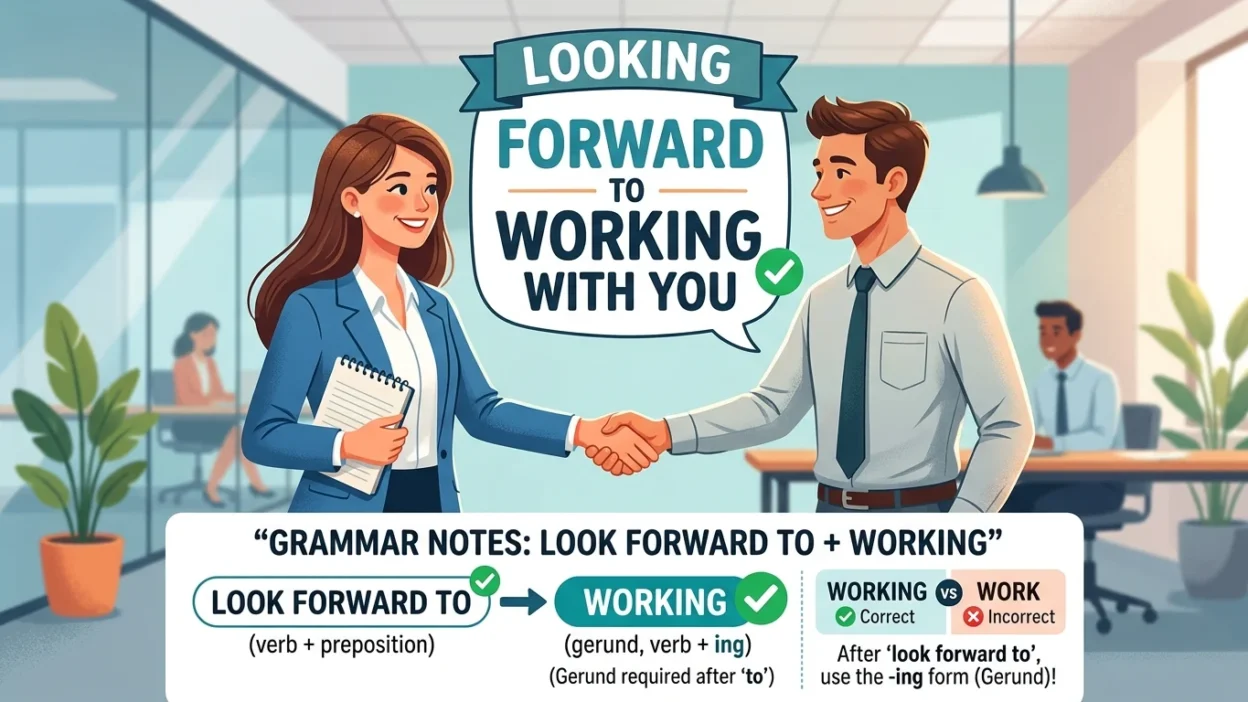
“Looking forward to working with you” is correct. The word to is a preposition here, so it should be followed by a gerund, such as working, not the base verb work.
Why People Confuse It
The confusion comes from the word to.
Usually, to appears before an infinitive:
- I want to work.
- I hope to work.
- I plan to work.
But in look forward to, to is a preposition. Therefore, it is followed by a noun or gerund.
- I look forward to working with you. ✅
- I look forward to work with you. ❌
Looking Forward to Working With You
This phrase means:
You are pleased or excited about the opportunity to work with the person in the future.
It is especially common in professional communication.
Examples
- I’m looking forward to working with you.
- We’re looking forward to working with your team.
- I’m really looking forward to working with you on this project.
- Thank you for the opportunity. I’m looking forward to working with you.
- It was great speaking with you. I’m looking forward to working with you.
Looking Forward to Work With You
“Looking forward to work with you” is incorrect.
The problem is that to in look forward to is a preposition, so it cannot normally be followed directly by the base form work.
❌ I’m looking forward to work with you.
✅ I’m looking forward to working with you.
Looking Forward to Working With You vs Looking Forward to Work With You
| Phrase | Correct? | Explanation |
|---|---|---|
| Looking forward to working with you | ✅ | Correct gerund after the preposition |
| Looking forward to work with you | ❌ | Incorrect verb form |
| I look forward to working with you | ✅ | Correct and professional |
| I look forward to work with you | ❌ | Incorrect |
| Looking forward to collaborating with you | ✅ | Correct alternative |
| Looking forward to our collaboration | ✅ | Correct noun phrase |
When to Use It
Use “looking forward to working with you” when:
- Starting a new job or project.
- Beginning a business relationship.
- Joining a new team.
- Responding positively to a professional opportunity.
- Ending a professional email.
Professional Examples
After accepting a job:
I’m excited to join the team and look forward to working with you.
After starting a project:
Thank you for the information. I’m looking forward to working with you on this project.
After meeting a client:
It was a pleasure meeting you. I’m looking forward to working with you.
Examples
- I’m looking forward to working with you.
- We’re looking forward to working with your team.
- I’m really looking forward to working with everyone.
- She is looking forward to working with the new manager.
- We are looking forward to working together.
- I look forward to working with you on this exciting project.
- Thank you for the opportunity. I look forward to working with you.
- I’m looking forward to working with you and your colleagues.
- Our team looks forward to working with you.
- I’m excited and looking forward to working with you.
Common Mistakes
1. Using “work” after “to”
❌ I’m looking forward to work with you.
✅ I’m looking forward to working with you.
2. Saying “looking forward for”
❌ I’m looking forward for working with you.
✅ I’m looking forward to working with you.
3. Forgetting “to”
❌ I’m looking forward working with you.
✅ I’m looking forward to working with you.
Memory Trick
Remember:
Look forward to + noun or gerund
For example:
- I look forward to the meeting.
- I look forward to working with you.
- I look forward to hearing from you.
- I look forward to meeting you.
A useful shortcut is:
Look forward to + ING
American vs British English
There is no significant difference between American and British English in this construction.
Both use:
I look forward to working with you. ✅
The expression is standard and widely used in professional communication in both varieties.
Similar Expressions
You can also say:
- I’m excited to work with you.
- I’m pleased to be working with you.
- I look forward to collaborating with you.
- I’m excited about working with you.
- I’m looking forward to our collaboration.
- I look forward to working together.
- I’m eager to work with you.
Notice the difference:
I’m excited to work with you. ✅
Here, to work is an infinitive.
I’m looking forward to working with you. ✅
Here, to working uses a preposition followed by a gerund.
Final Verdict
“Looking forward to working with you” is completely correct. It is a natural, polite, and professional way to express enthusiasm about a future working relationship.
The key grammar rule is simple: look forward to + gerund. Therefore, use working, not work, after to in this expression.
Remember This
Look forward to + working ✅
Look forward to + work ❌
So write:
I’m looking forward to working with you. ✅
Not:
I’m looking forward to work with you. ❌
FAQs
Is “looking forward to working with you” correct?
Yes. It is grammatically correct and commonly used in professional English.
Is it “looking forward to work” or “working”?
The correct form is looking forward to working.
Why do we use “working” after “to”?
Because to in look forward to is a preposition. A gerund can follow a preposition.
Can I say “I look forward to working with you”?
Yes. I look forward to working with you is a particularly common and professional expression.
Is “looking forward to working with you” formal?
Yes. It is appropriate for professional emails, workplace communication, business relationships, and formal messages.
Can I say “looking forward to work with you”?
No. In standard English, use looking forward to working with you.
Is “I look forward to working with you” better than “I’m looking forward to working with you”?
Both are correct. I look forward to working with you can sound slightly more formal, while I’m looking forward to working with you can sound warmer and more conversational.
Conclusion
“Looking forward to working with you” is a correct and natural English expression. It communicates enthusiasm about a future professional relationship and is commonly used in workplace emails, business messages, and professional conversations.
The most important grammar point is that look forward to is followed by a noun or gerund. That’s why working is correct: I look forward to working with you.

Joseph Richard is the administrator and a dedicated author at DrameyHut, overseeing the platform’s operations and content quality. Alongside his administrative role, he writes insightful articles on dream meanings, helping readers understand their subconscious mind. His work supports the mission of providing clear, meaningful, and engaging dream interpretations.