Many English learners confuse at the house and in the house because both expressions refer to a house. While they may seem similar, they describe different situations. Choosing the correct phrase depends on if you’re talking about location in general or being inside the building.
Understanding the difference between at the house vs in the house will help you speak and write more naturally. If you’re having a conversation, writing an email, or describing where someone is, this guide explains the correct usage with simple examples and easy to remember tips.
Quick Answer
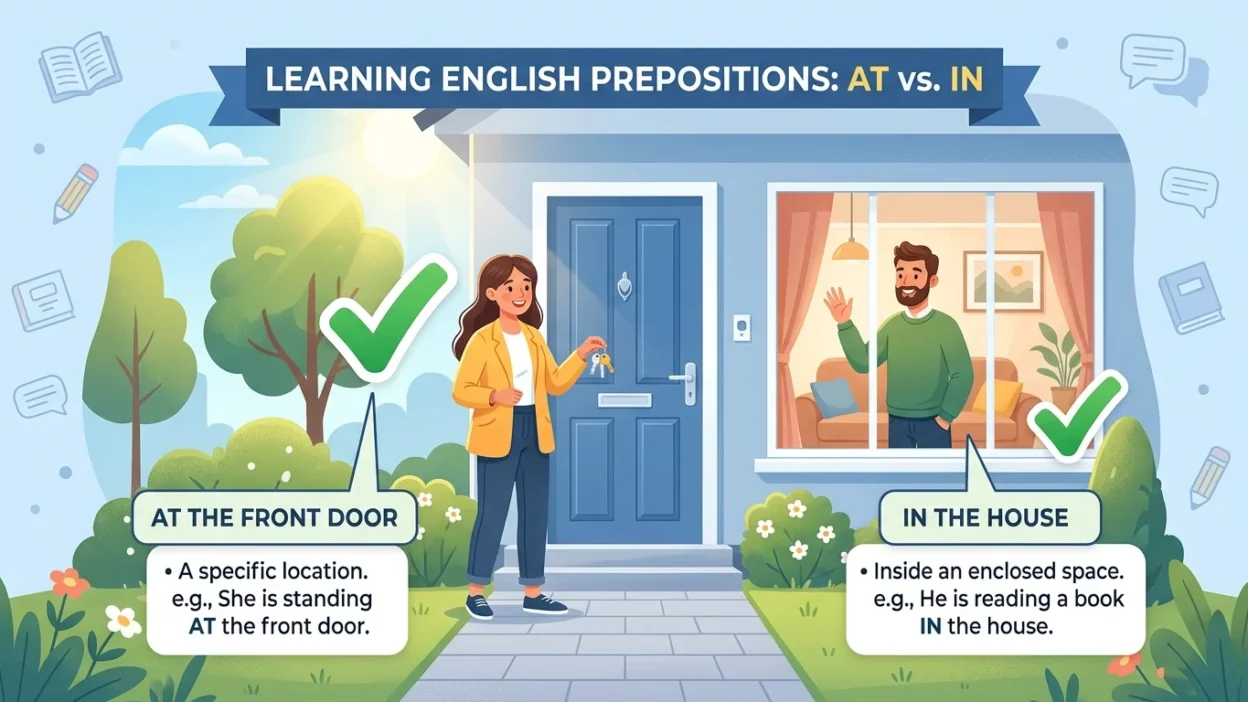
At the house refers to someone’s general location or presence at the property. In the house means someone or something is physically inside the building. Use at for a general location and in when you mean inside.
Why People Confuse It
The confusion happens because both phrases refer to the same place.
However, at focuses on the location as a point or destination, while in focuses on being inside the building itself.
At the House
At the house refers to being at the property or location.
It does not necessarily mean someone is inside the building. They could be outside in the garden, driveway, or front yard.
Meaning
At the house means at the location of the house.
Examples
- I’ll meet you at the house after work.
- She’s waiting at the house for the delivery.
- We arrived at the house before sunset.
- The plumber is at the house now.
- Everyone gathered at the house before the trip.
In the House
In the house means someone or something is physically inside the house.
Meaning
It refers to being within the walls of the building.
Examples
- The children are in the house.
- We stayed in the house because it was raining.
- There is no one in the house.
- She left her keys in the house.
- The dog is sleeping in the house.
Comparison Table
| Feature | At the House | In the House |
|---|---|---|
| Refers to general location | ✅ Yes | ❌ No |
| Means inside the building | ❌ Not necessarily | ✅ Yes |
| Used for arrival or meeting places | ✅ Yes | Sometimes |
| Describes physical position indoors | ❌ No | ✅ Yes |
| Common in everyday English | ✅ Yes | ✅ Yes |
When to Use Each
Use at the house when:
- Talking about someone’s location.
- Describing where you will meet someone.
- Referring to a property in general.
- Mentioning arrival or presence.
Use in the house when:
- Someone is inside the building.
- Talking about activities indoors.
- Describing where an object is located.
- Referring to people or things within the house.
Examples
- I’ll be at the house by six o’clock.
- The electrician is at the house today.
- We met at the house before leaving.
- Everyone was waiting at the house.
- The guests arrived at the house early.
- The children are in the house watching television.
- She left her phone in the house.
- Nobody is in the house right now.
- We ate dinner in the house because it was cold.
- The cat is sleeping in the house.
- I’ll see you at the house after lunch.
- They spent the evening in the house.
Common Mistakes
Many learners make these errors.
- Using at the house when they mean inside the house.
- Using in the house when referring to arriving at someone’s property.
- Assuming both expressions always mean the same thing.
Correct:
- I’m at the house now.
- I’m in the house now.
The first means you’re at the property.
The second means you’re inside the building.
Memory Trick
Remember this simple rule:
At = Location
In = Inside
If you can walk through the front door and you’re talking about being inside, use in the house.
American vs British English
There is no significant difference between American and British English.
Both use at the house for a general location and in the house for being inside the building.
Similar Words
You may also hear these location phrases:
- At home
- In the home
- At school
- In school
- At work
- In the office
- At the park
- In the building
- At the hotel
- In the room
Final Verdict
The difference between at the house and in the house is simple once you understand the focus of each phrase. At the house refers to the property or general location, while in the house means physically inside the building.
Choosing the correct expression makes your English more accurate and natural. When talking about where someone is in relation to a house, ask yourself whether you mean the location or the inside of the building.
Remember This
At the house = At the property or location. ✅
In the house = Inside the building. ✅
Think:
I’ll meet you at the house.
I’m waiting in the house.
FAQs
What is the difference between at the house and in the house?
At the house refers to the property’s location, while in the house means physically inside the building.
Is at the house grammatically correct?
Yes. It is commonly used when talking about someone’s location or meeting place.
Is in the house grammatically correct?
Yes. It means someone or something is inside the house.
Can I use at the house instead of in the house?
Not always. Use at the house for the general location and in the house only when referring to being inside.
Do native speakers use both expressions?
Yes. Both are common, but they are used in different contexts.
Is there a difference between British and American English?
No. Both varieties follow the same usage.
Which phrase should I use if I’m inside?
Use in the house because it specifically means you are inside the building.
Conclusion
The confusion between at the house vs in the house is common, but the distinction is straightforward. At the house refers to being at the property’s location, while in the house means being physically inside the building.
By remembering At = Location and In = Inside, you’ll choose the correct phrase with confidence. This small difference can make your spoken and written English sound much more natural and precise.

Daniel Charles is a dedicated author and dream interpretation enthusiast at DrameyHut. He specializes in analyzing dream symbols and meanings, offering clear and insightful content for readers. His work aims to help individuals understand their subconscious thoughts, gain clarity, and explore the deeper messages hidden within their dreams.