Many English writers wonder if they should write timeslot as one word or time slot as two words. The confusion is understandable because English often combines two separate words into one over time.
While some compound words become standard, others remain separate depending on style guides and dictionaries.
If you’re unsure about timeslot vs time slot, this guide explains the correct spelling, when to use each form, and which one is preferred in professional and everyday writing. You’ll also find examples, common mistakes, and a simple memory trick.
Quick Answer
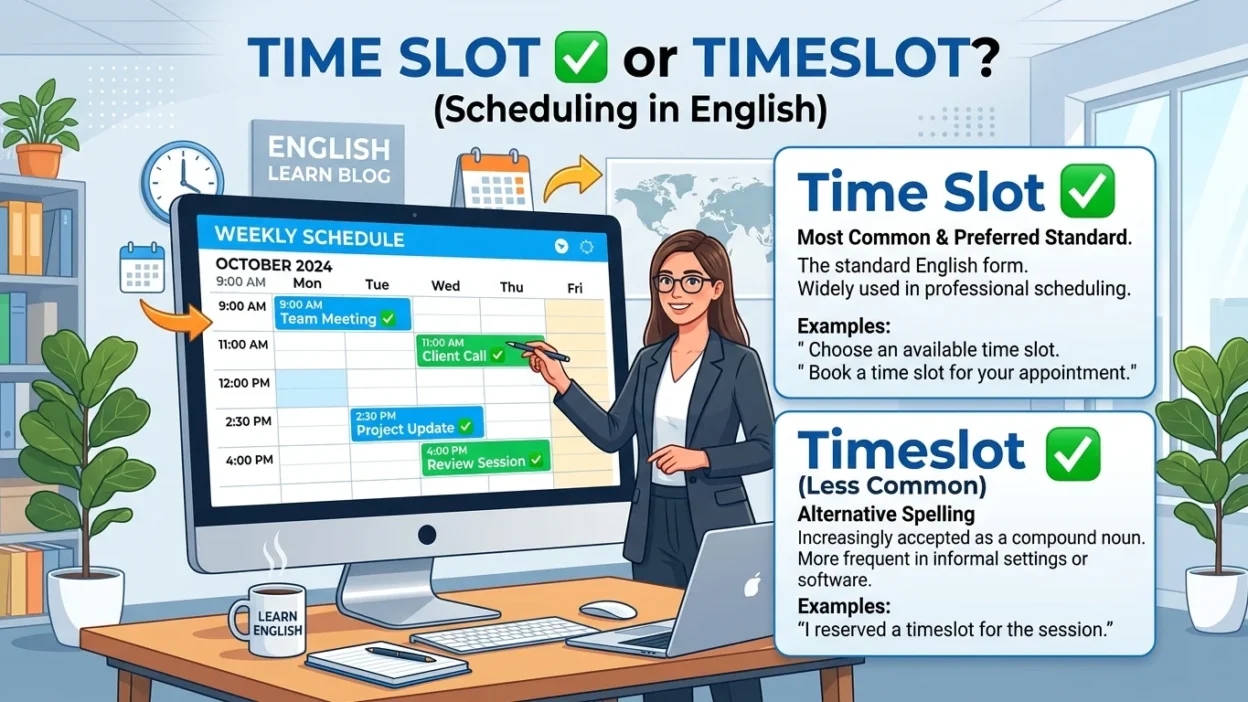
Time slot is the standard and widely accepted spelling in English. Timeslot is also used, especially in technology, software, and scheduling platforms, but time slot is generally preferred in formal writing and most dictionaries.
Why People Confuse It
The confusion happens because many compound words eventually become one word, such as notebook, website, and workplace.
Since scheduling software and online booking systems often use timeslot as one word, many people assume it is the standard spelling. However, time slot remains the preferred form in most dictionaries and style guides.
Time Slot
Time slot is the standard spelling.
It is a noun referring to a specific period reserved for an activity, appointment, programme, or event.
Meaning
A time slot is a scheduled block of time assigned for a particular purpose.
Examples
- Please choose a time slot for your appointment.
- The meeting has been moved to a different time slot.
- Every speaker has a thirty minute time slot.
- Our preferred time slot is Friday morning.
- The television show airs in a prime time slot.
Timeslot
Timeslot is an alternative spelling.
It appears in some software applications, booking systems, and business documents, but it is less common in formal English.
Meaning
It has the same meaning as time slot.
Examples
- Select your preferred timeslot in the booking system.
- Each timeslot can accommodate twenty participants.
- The website displays every available timeslot.
Although these examples are understandable, many editors would still prefer time slot.
Comparison Table
| Feature | Time Slot | Timeslot |
|---|---|---|
| Grammatically correct | ✅ Yes | ✅ Yes |
| Preferred in dictionaries | ✅ Yes | Sometimes |
| Common in formal writing | ✅ Yes | Less common |
| Common in software and booking systems | ✅ Yes | ✅ Yes |
| Recommended for academic writing | ✅ Yes | ❌ Usually not |
When to Use Each
Use time slot when:
- Writing formal documents.
- Preparing academic papers.
- Creating business reports.
- Writing emails.
- Following standard English style.
Use timeslot when:
- Following a company’s branding or software interface.
- Referring to wording used in an app or booking platform.
- Matching an existing product or website style.
Examples
- Please reserve a time slot for the interview.
- We selected the earliest time slot available.
- Each presentation has a fifteen minute time slot.
- The doctor has an open time slot tomorrow.
- Choose your preferred time slot online.
- The booking system displays every available timeslot.
- Your timeslot has been confirmed by email.
- The app automatically assigns a timeslot.
- Another time slot became available this afternoon.
- They requested a morning time slot.
- Our chosen timeslot was fully booked.
- The event organiser changed our time slot.
Common Mistakes
Many learners make these errors.
- Assuming timeslot is always the preferred spelling.
- Mixing both spellings within the same document.
- Using different forms inconsistently in professional writing.
Correct:
- Please choose a time slot.
Also acceptable in some contexts:
- Please choose a timeslot.
Memory Trick
Remember this simple rule:
If you’re writing formally, leave a space.
Time slot is the safest choice for most writing.
American vs British English
There is no major difference between American and British English.
Both varieties generally prefer time slot in formal writing, although timeslot is becoming more common in digital products, booking systems, and software interfaces.
Similar Words
You may also come across these related terms:
- Appointment
- Schedule
- Booking
- Time frame
- Session
- Meeting
- Availability
- Reservation
- Calendar
- Time period
Final Verdict
Both time slot and timeslot are understood by English speakers. However, time slot is the standard spelling and is preferred in formal, academic, and professional writing.
Timeslot is mostly found in technology, online booking systems, and company specific style guides.
When in doubt, choose time slot. It is the more widely accepted and recommended form.
Remember This
Time slot ✅ Standard and preferred
Timeslot ✅ Acceptable in some digital and business contexts
For the safest and most professional writing, use time slot.
FAQs
Which is correct, timeslot or time slot?
Time slot is the standard and preferred spelling, although timeslot is also accepted in some contexts.
Is timeslot one word?
Yes. Timeslot is used by some companies and software platforms, but time slot is generally preferred.
Is time slot two words?
Yes. Time slot is the standard spelling in most dictionaries and style guides.
Can I use timeslot in business writing?
You can if it matches your company’s style guide, but time slot is usually the safer choice.
Is there a difference in meaning?
No. Both refer to a scheduled period of time reserved for a particular activity.
Do British and American English prefer different spellings?
No. Both generally favour time slot, especially in formal writing.
Why do some websites use timeslot?
Many software developers and booking platforms use timeslot as part of their branding or interface design, even though time slot remains the standard form.
Conclusion
The difference between timeslot vs time slot is mainly one of style rather than meaning. Both spellings refer to a scheduled period reserved for a specific activity, appointment, or event. However, time slot is the standard form recommended by most dictionaries and style guides.
If you’re writing professionally, academically, or for a broad audience, time slot is the best choice. Use timeslot only when following a specific brand, software interface, or organisational style guide.

Daniel Charles is a dedicated author and dream interpretation enthusiast at DrameyHut. He specializes in analyzing dream symbols and meanings, offering clear and insightful content for readers. His work aims to help individuals understand their subconscious thoughts, gain clarity, and explore the deeper messages hidden within their dreams.