Many English learners are unsure if the correct word is passersby, passerbyers, or passerby. The confusion comes from the unusual way this compound noun forms its plural. Unlike most English nouns, you don’t simply add -s or -es to the end of the entire word.
Understanding the difference between passersby vs passerbyers vs passerby will help you avoid a common grammar mistake. This guide explains the correct singular and plural forms with simple examples, grammar rules, and an easy memory trick.
Quick Answer
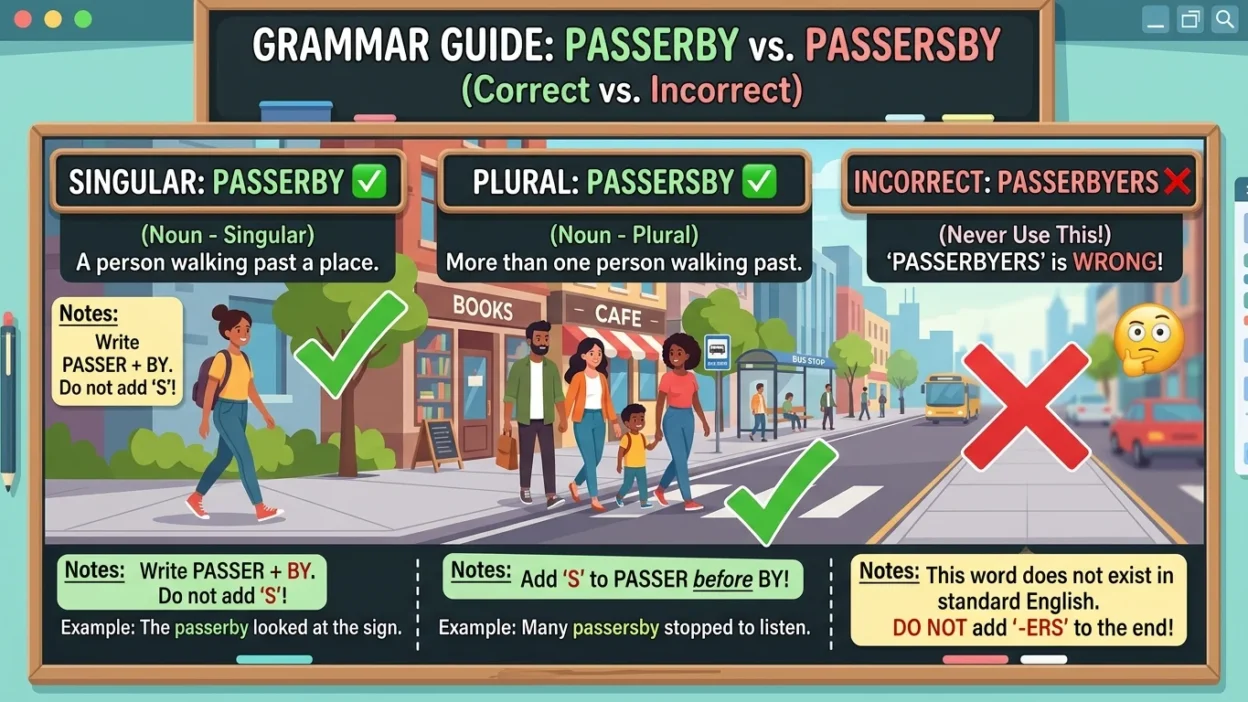
Passerby is the correct singular form. Passersby is the correct plural form. Passerbyers is incorrect and is not a standard English word.
Why People Confuse It
The confusion happens because passerby is a compound noun made up of passer and by.
Many learners naturally try to make it plural by adding -s or -ers to the end, creating passerbyers, but English pluralizes the main noun (passer), not the word by.
Passerby
Passerby is the singular form.
Meaning
A passerby is a person who is walking past a place without stopping.
Examples
- A passerby helped the injured cyclist.
- The passerby noticed the lost child.
- Every passerby looked at the street performer.
- A friendly passerby gave us directions.
- The passerby reported the accident.
Passersby
Passersby is the correct plural form.
Meaning
Passersby refers to two or more people who are passing a place.
Examples
- Several passersby stopped to watch the parade.
- Passersby helped move the fallen tree.
- The loud music attracted many passersby.
- Police questioned nearby passersby.
- Curious passersby gathered around the scene.
Passerbyers
Passerbyers is not a correct English word.
Although it may seem logical, standard English does not use this form.
Always replace passerbyers with passersby.
Comparison Table
| Feature | Passerby | Passersby | Passerbyers |
|---|---|---|---|
| Correct English | ✅ Yes | ✅ Yes | ❌ No |
| Singular | ✅ Yes | ❌ No | ❌ No |
| Plural | ❌ No | ✅ Yes | ❌ No |
| Used in formal writing | ✅ Yes | ✅ Yes | ❌ No |
| Found in dictionaries | ✅ Yes | ✅ Yes | ❌ No |
When to Use Each
Use passerby when referring to one person.
Use passersby when referring to two or more people.
Never use passerbyers.
Examples
- A passerby called the police.
- The passerby smiled politely.
- One passerby offered assistance.
- Every passerby admired the artwork.
- A passerby found the missing wallet.
- Several passersby witnessed the accident.
- Passersby stopped to take photos.
- Many passersby enjoyed the street performance.
- The noise surprised nearby passersby.
- Police interviewed the passersby.
- Curious passersby gathered outside the building.
- Friendly passersby helped the tourists.
Common Mistakes
Many learners make these errors.
- Writing passerbyers instead of passersby.
- Using passerby when referring to several people.
- Assuming the -s always goes at the end of compound nouns.
Correct:
- A passerby helped me.
- Several passersby stopped.
Incorrect:
- Several passerbyers stopped.
- Many passerby stopped.
Memory Trick
Remember this simple rule:
The main noun is passer, so that’s the part that becomes plural.
Passer → Passers
Passerby → Passersby
American vs British English
There is no difference between American and British English.
Both varieties use:
- Passerby for one person.
- Passersby for more than one person.
Passerbyers is incorrect in both.
Similar Words
These compound nouns form their plurals in a similar way:
- Mother-in-law → Mothers-in-law
- Brother-in-law → Brothers-in-law
- Attorney general → Attorneys general
- Court martial → Courts martial
- Commander in chief → Commanders in chief
- Editor in chief → Editors in chief
- Runner-up → Runners-up
- Hanger-on → Hangers-on
- Notary public → Notaries public
- Onlooker → Onlookers
Final Verdict
The answer is straightforward.
Passerby is the correct singular form.
Passersby is the correct plural form.
Passerbyers is not a word in standard English and should never be used. Remember that compound nouns often have irregular plural forms, so the plural marker is added to the main noun rather than the final word.
Remember This
Passerby = One person ✅
Passersby = More than one person ✅
Passerbyers = Incorrect ❌
Think:
One passerby.
Many passersby.
FAQs
Which is correct, passersby or passerbyers?
Passersby is correct. Passerbyers is incorrect.
What is the plural of passerby?
The correct plural is passersby.
Is passerby singular or plural?
Passerby is singular.
Why is it passersby instead of passerbys?
Because passerby is a compound noun, the main noun (passer) takes the plural form, resulting in passersby.
Is passerbyers a real word?
No. It is not recognized in standard English.
Do British and American English use passersby?
Yes. Both use passersby as the standard plural form.
Can I say several passerby?
No. Say several passersby because the noun must be plural.
Conclusion
The confusion between passersby, passerbyers, and passerby comes from the unusual plural pattern of compound nouns. While many English nouns simply add -s at the end, passerby changes to passersby because the main noun passer becomes plural.
Whenever you’re referring to one person, use passerby. When talking about two or more people, use passersby. Avoid passerbyers, as it is not a correct English word.

Christopher Thomas is a passionate writer and dream researcher dedicated to exploring the meanings behind dreams. As an author at DrameyHut, he creates insightful and easy-to-understand interpretations that help readers connect with their subconscious mind. His work focuses on guiding individuals toward self-discovery, clarity, and a deeper understanding of their inner thoughts.