Many English learners get confused between by which and in which because both are common relative phrases used to connect ideas in formal writing.
Although they may look similar, they have different meanings and cannot always be used interchangeably. Choosing the correct phrase depends on the relationship between the action and the noun.
Understanding the difference between by which vs in which will help you write clearer essays, reports, emails, and academic papers. This guide explains the meanings, grammar rules, examples, and memory tricks so you can confidently use each phrase.
Quick Answer
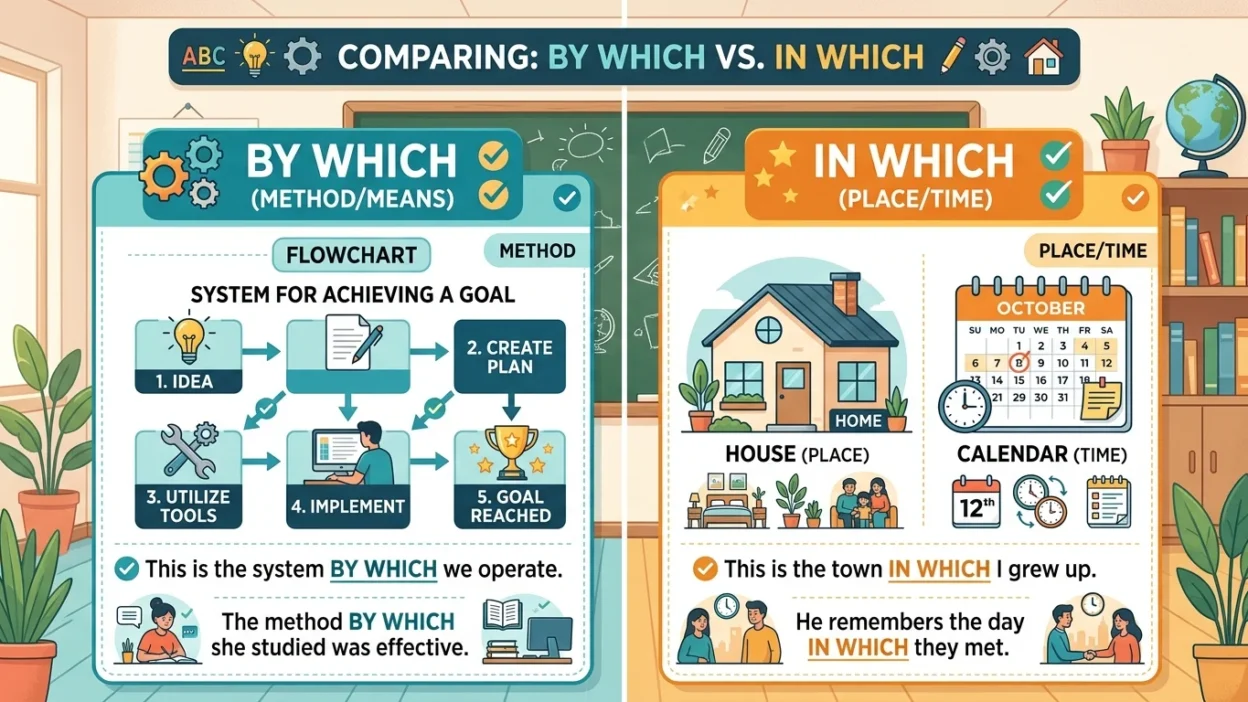
By which means through which, using which, or because of which. In which means inside which, during which, or within which. Use by which to show the method or means, and in which to show location, time, or situation.
Why People Confuse It
The confusion happens because both phrases begin with a preposition followed by which.
However, by usually introduces the method, means, or cause, while in refers to place, time, or a situation.
By Which
By which introduces the method, process, means, or reason something happens.
Meaning
By which means:
- Through which
- Using which
- By means of which
- Because of which
Examples
- This is the method by which we solve the problem.
- The law by which the company operates has changed.
- The process by which plants grow is fascinating.
- They explained the system by which payments are made.
- The route by which goods are transported is safe.
In Which
In which refers to a place, time, condition, or situation.
Meaning
In which means:
- Inside which
- During which
- Within which
- Under which circumstances
Examples
- This is the room in which I study.
- The year in which we graduated was unforgettable.
- The situation in which they found themselves was difficult.
- The country in which she was born is beautiful.
- We discussed the case in which the evidence was missing.
Comparison Table
| Feature | By Which | In Which |
|---|---|---|
| Refers to method or means | ✅ Yes | ❌ No |
| Refers to place or location | ❌ No | ✅ Yes |
| Refers to time or situation | ❌ Rarely | ✅ Yes |
| Common in formal writing | ✅ Yes | ✅ Yes |
| Can often mean “through which” | ✅ Yes | ❌ No |
When to Use Each
Use by which when talking about:
- A method
- A process
- A tool
- A means of doing something
- A reason or cause
Use in which when talking about:
- A place
- A room or building
- A country or city
- A period of time
- A situation or condition
Examples
- The method by which the machine works is simple.
- The process by which water is purified is effective.
- This is the system by which orders are processed.
- The rule by which we live is honesty.
- They described the procedure by which the results were calculated.
- The house in which I grew up has been renovated.
- The city in which he lives is very busy.
- The meeting in which the decision was made lasted three hours.
- The book in which the story appears is a bestseller.
- The situation in which we met was unusual.
- The school in which she teaches is nearby.
- The experiment by which scientists tested the theory was successful.
Common Mistakes
Many learners make these errors.
- Using in which when describing a method.
- Using by which when referring to a place.
- Replacing one phrase with the other without considering the meaning.
Correct:
- The process by which electricity is generated.
- The laboratory in which the experiment took place.
Incorrect:
- The process in which electricity is generated. (when you mean the method)
- The laboratory by which the experiment took place.
Memory Trick
Remember this simple rule:
By = Method
In = Place or Situation
If you can replace the phrase with through which, use by which.
If you can replace it with inside which or during which, use in which.
American vs British English
There is no difference between American and British English.
Both varieties use by which and in which in the same way, especially in formal and academic writing.
Similar Words
You may also find these relative phrases useful:
- Through which
- With which
- On which
- At which
- For which
- From which
- Of which
- During which
- Under which
- To which
Final Verdict
The difference between by which and in which depends on what you want to express. Use by which when referring to the method, process, or means of doing something. Use in which when referring to a place, time, or situation.
Learning this distinction will make your writing more precise and help you produce more natural, grammatically correct English.
Remember This
By which = Method or Means ✅
In which = Place, Time, or Situation ✅
Think:
The method by which it works.
The room in which we met.
FAQs
What is the difference between by which and in which?
By which refers to the method or means of something, while in which refers to a place, time, or situation.
Is by which grammatically correct?
Yes. It is commonly used in formal and academic English.
When should I use in which?
Use in which when referring to a location, time period, or situation.
Can by which and in which be used interchangeably?
No. They have different meanings and should be used according to the context.
Is by which formal English?
Yes. It frequently appears in academic, legal, and professional writing.
Do British and American English use these phrases differently?
No. Both follow the same grammar rules.
What can I use instead of by which?
Depending on the sentence, you may use through which, using which, or by means of which.
Conclusion
Although by which and in which may appear similar, they serve different grammatical purposes. By which explains how something happens, focusing on the method or means, while in which tells you where, when, or under what circumstances something happens.
By remembering By = Method and In = Place or Situation, you’ll be able to choose the correct phrase with confidence. This small distinction can make your writing more accurate, formal, and natural.

Nancy Lisa is a passionate writer and contributor at DrameyHut, focused on uncovering the deeper meanings behind dreams. She creates engaging and insightful content that helps readers interpret their dreams and understand their subconscious thoughts. Her work inspires self-reflection, clarity, and a stronger connection to inner emotions.