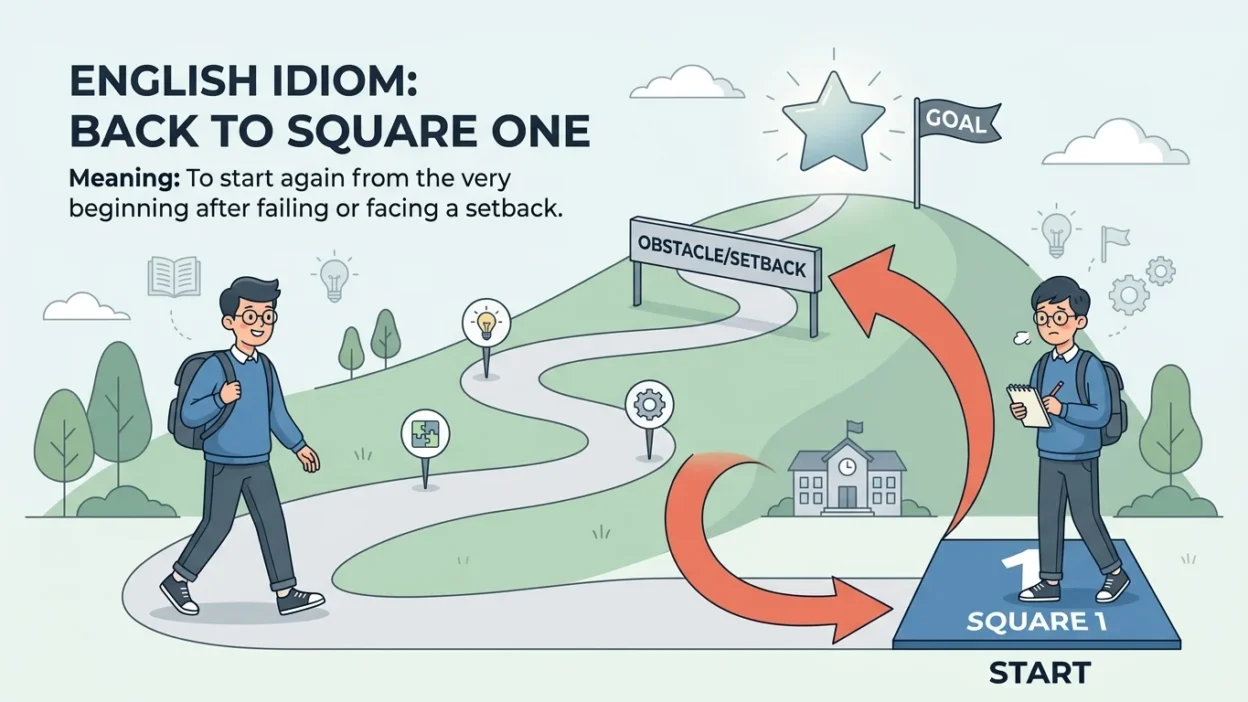
The phrase “back to square one” is a common English idiom used when someone has to return to the beginning of a situation, process, plan, or problem because their previous efforts have failed or produced no useful result. It often describes the frustrating feeling of having to start again after making progress.
For example, if you spend weeks working on a project but discover that your entire approach is wrong, you might say, “We are back to square one.” The phrase does not literally mean returning to a numbered square. Instead, it uses “square one” as a figurative way of referring to the starting point.
The expression is common in everyday American and British English and can be used in conversations, writing, business, education, and many other contexts.
Quick Answer
“Back to square one” means having to return to the beginning of a process because your previous efforts have failed, been unsuccessful, or can no longer be used. It is often used when someone has to start again from the beginning.
What Does “Back to Square One” Mean?
The idiom “back to square one” means back at the starting point after making unsuccessful progress.
It is commonly used when:
- A plan fails
- An attempt does not work
- A solution creates another problem
- Previous progress is lost
- Someone needs to start the process again
For example:
The computer crashed and deleted all our work, so we are back to square one.
This means the people have lost their progress and must start again.
Another example is:
Our first business idea did not work, so we are back to square one.
Here, the speaker means that the original plan failed and they must develop a new approach from the beginning.
Back to Square One Meaning in Simple English
In very simple English:
Back to square one = back to the beginning.
It often carries an additional idea:
Back to the beginning because something did not work.
For example:
The experiment failed, so we are back to square one.
In other words:
The experiment failed, so we have to start again.
The phrase often expresses frustration, disappointment, or the realization that previous work has not solved the problem.
Why Do People Say “Back to Square One”?
The expression uses square one as a figurative name for the starting position.
Imagine a board game where you begin on the first square. If you have to return to that starting position, you are effectively starting over.
In modern English, however, you do not need to think about an actual board or numbered squares to understand the idiom.
When someone says:
We are back to square one.
They mean:
We have returned to the beginning of the process.
The expression can describe physical situations, but it is much more commonly used figuratively.
Origin of “Back to Square One”
The exact origin of “back to square one” is uncertain.
One commonly discussed explanation connects the expression with radio broadcasts of football or soccer matches, where imaginary or numbered sections of a playing field may have been used to help listeners follow the action. Another explanation connects it with games, diagrams, or instructional systems in which a process was divided into numbered squares.
However, the precise origin is not firmly established.
The phrase became established in English during the twentieth century and is now a familiar idiom in both American and British English.
Because the origin is uncertain, it is better to focus on the modern meaning rather than claiming one specific origin as proven.
How to Use “Back to Square One”
The expression is normally used after something has gone wrong or failed.
After a failed plan
Our marketing strategy did not work, so we are back to square one.
After losing progress
The computer crashed, and now we are back to square one.
After an unsuccessful attempt
The repair did not solve the problem, so we are back to square one.
During problem solving
If this solution fails, we will be back to square one.
In business
The investors rejected the proposal, putting the company back to square one.
The phrase works naturally with be, go, put, and similar expressions.
15 Examples of “Back to Square One”
- The first plan failed, so we are back to square one.
- The experiment produced unexpected results, and now we are back to square one.
- Our computer crashed before we saved the document, so we are back to square one.
- The negotiations broke down, putting both sides back to square one.
- The treatment did not work, so the doctors had to go back to square one.
- Our original design was rejected, which sent us back to square one.
- The new software caused even more problems, leaving us back at square one.
- We thought we had solved the issue, but the latest test put us back to square one.
- The project lost its funding, and the team was back to square one.
- If this idea does not work, we will be back to square one.
- The landlord rejected our proposal, so we are back to square one.
- After the deal fell through, the company was back to square one.
- I deleted the wrong file, and now I am back to square one.
- The investigation revealed that our original assumption was wrong, taking us back to square one.
- We spent months developing the product, but one major problem sent us back to square one.
“Back to Square One” in Different Situations
At Work
The client rejected the proposal, so we are back to square one.
This means the team needs to reconsider the project from the beginning.
In Education
My first research topic was too broad, so I am back to square one.
The student needs to rethink the topic and start the process again.
In Technology
The update caused more problems, putting us back to square one.
The previous solution did not work.
In Relationships
We tried to resolve the disagreement, but the conversation made things worse. Now we are back to square one.
The couple has returned to the original problem.
In Business
The investors rejected the proposal, so the company is back to square one.
The business needs to develop another plan.
In Everyday Life
I lost my keys again. Now I am back to square one.
The speaker has to restart the search.
Is “Back to Square One” Negative?
Usually, the expression has a negative or frustrating tone because it suggests that previous efforts have not produced the desired result.
For example:
We spent three months working on the project, only to end up back at square one.
The speaker is clearly disappointed.
However, the phrase does not always express strong negativity. Sometimes it can simply describe a change in circumstances.
The first design was not suitable, so we are back to square one and can try something completely different.
Here, the speaker may see starting again as an opportunity rather than a disaster.
Back to Square One vs Start Over
These expressions are similar but not exactly identical.
Start over simply means begin again.
The program crashed, so I had to start over.
Back to square one emphasizes returning to the original starting point, usually because previous progress has been lost or a previous approach has failed.
The entire strategy failed, so we are back to square one.
The idiom therefore often carries a stronger sense of lost progress.
Back to Square One vs Back to the Drawing Board
These idioms are closely related.
Back to square one
Means returning to the beginning of a process.
The proposal failed, so we are back to square one.
Back to the drawing board
Means returning to the planning or design stage because an idea or plan did not work.
The design failed the safety test, so we are back to the drawing board.
The two expressions can sometimes be used interchangeably, but back to the drawing board specifically suggests rethinking or redesigning something.
Comparison Table
| Expression | Meaning | Typical Situation |
|---|---|---|
| Back to square one | Return to the beginning | Previous progress or approach failed |
| Start over | Begin again | A task needs to be repeated |
| Back to the drawing board | Return to planning or designing | An idea or design failed |
| Begin from scratch | Start with nothing already prepared | No useful previous work remains |
| Start from the beginning | Return to the first stage | A process needs to be repeated |
Common Mistakes
Mistake 1: Taking It Literally
Back to square one is usually an idiom.
It does not normally mean physically returning to a square.
We are back to square one.
means:
We have returned to the beginning.
Mistake 2: Saying “Back at Square One”
Back at square one can be used, especially when emphasizing a state or position.
However, the established idiom is:
back to square one
For example:
The plan failed, so we are back to square one.
Mistake 3: Assuming It Always Means Total Failure
The expression usually suggests unsuccessful progress, but it does not necessarily mean that absolutely everything has been lost.
Someone may still have gained knowledge or experience.
We are back to square one, but at least we know what does not work.
Mistake 4: Confusing It With “Back to the Drawing Board”
The phrases overlap, but back to the drawing board focuses more specifically on redesigning or rethinking a plan.
Mistake 5: Using It for Any Kind of Repetition
Simply repeating something does not always mean you are back to square one.
The phrase is most appropriate when you have returned to the starting point because progress was unsuccessful or a previous approach no longer works.
Memory Trick
Think:
Square one = the starting point.
So:
Back to square one = back to the starting point.
A simple memory sentence is:
When the plan fails, you go back to square one.
This will help you remember both the meaning and the typical context.
American vs British English
“Back to square one” is widely used in both American and British English.
There is no important difference in meaning between the two varieties.
For example, both American and British speakers can say:
The plan failed, so we are back to square one.
The idiom is common in everyday conversations, journalism, business discussions, education, and informal writing.
Similar Expressions
Start over
Means begin again.
We made a mistake, so let’s start over.
Begin again
A straightforward alternative to start over.
We need to begin again.
Start from scratch
Means begin with no useful existing work or preparation.
We had to start from scratch.
Back to the drawing board
Means rethink or redesign a plan.
The proposal failed, so we went back to the drawing board.
Return to the starting point
A more literal and formal alternative.
The process has returned to the starting point.
Begin from the beginning
Means return to the first stage.
Let’s begin from the beginning and review the problem.
Can “Back to Square One” Be Used in Formal Writing?
Yes, but its suitability depends on the type of writing.
The phrase is common and widely understood, so it can appear in journalism, business writing, commentary, and general nonfiction.
However, in highly formal or technical writing, a more precise expression may be preferable.
Instead of:
The process went back to square one.
You might write:
The process returned to its initial stage.
The idiom is not grammatically incorrect. It is simply more conversational and figurative.
Final Verdict
“Back to square one” means returning to the beginning of a process after an attempt has failed, progress has been lost, or a previous approach is no longer useful.
It is a common English idiom used in conversations about work, business, education, technology, relationships, problem solving, and everyday situations.
Remember that square one represents the starting point. When something sends you “back to square one,” you have to reconsider the situation and begin again from the beginning.
Frequently Asked Questions
What does “back to square one” mean?
It means returning to the beginning of a process, usually because previous efforts failed or progress was lost.
Is “back to square one” an idiom?
Yes. It is a common English idiom with a figurative meaning.
Is “back to square one” negative?
It often has a negative or frustrated tone because it suggests that previous efforts did not work. However, the tone depends on context.
What is another way to say “back to square one”?
You can say start over, begin again, start from scratch, or return to the starting point.
What is the difference between “back to square one” and “back to the drawing board”?
Back to square one means returning to the beginning. Back to the drawing board specifically suggests rethinking or redesigning a plan.
Can I use “back to square one” at work?
Yes. It is very common in workplace conversations.
The client rejected the proposal, so we are back to square one.
Can “back to square one” be used for people?
Yes. It can describe a person’s situation or progress.
After losing the job, he felt like he was back to square one.
What is the opposite of “back to square one”?
There is no single exact opposite, but expressions such as making progress, moving forward, or reaching the next stage can express the opposite idea.
Conclusion
The idiom “back to square one” is used when someone returns to the beginning of a process because an earlier attempt failed, progress was lost, or a previous solution no longer works. It is a useful expression for describing situations in which people have to reconsider their plans and begin again.
The phrase is common in American and British English and works naturally in everyday conversations, professional discussions, education, business, and problem solving. If you remember that square one represents the starting point, the meaning is easy to understand: back to square one means back to the beginning.
Remember This
Back to square one = back to the beginning, usually because something did not work.
The plan failed, so we are back to square one.
Think of square one as the starting point, and you will never forget the meaning.

Nancy Lisa is a passionate writer and contributor at DrameyHut, focused on uncovering the deeper meanings behind dreams. She creates engaging and insightful content that helps readers interpret their dreams and understand their subconscious thoughts. Her work inspires self-reflection, clarity, and a stronger connection to inner emotions.