
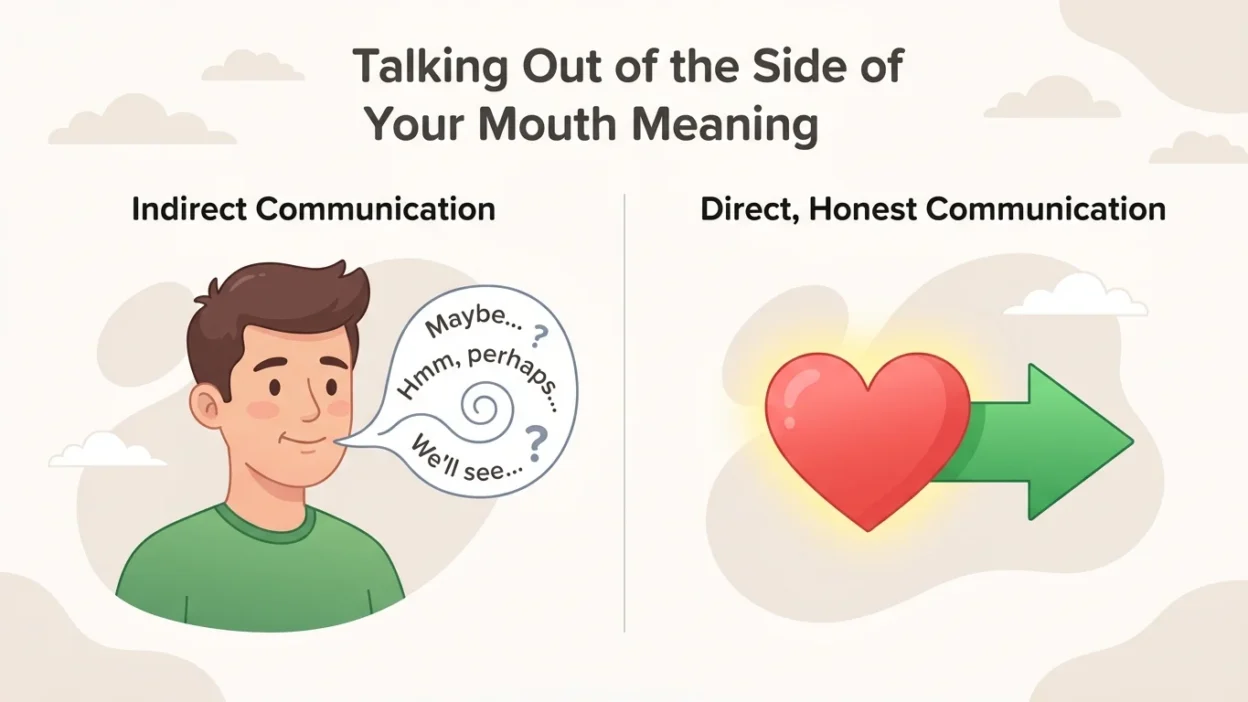
“Talking out of the side of your mouth” is an informal English expression that usually means speaking indirectly, saying something you do not fully mean, or making a comment in a sly, insincere, or evasive way. The exact meaning depends on context.
Sometimes the phrase is used more literally to describe someone who is actually speaking with their mouth positioned to one side. However, in everyday conversation, it is more often figurative. A person may use it when they believe someone is avoiding a direct answer, making a dishonest remark, or saying something privately or indirectly rather than openly.
The expression can also suggest that someone is speaking sarcastically or making a side comment, especially when their words do not match what they really think. Because it is informal and can sound critical, it is most common in casual conversations rather than formal writing.
Quick Answer
“Talking out of the side of your mouth” usually means speaking indirectly, slyly, sarcastically, or insincerely instead of saying something openly and directly. Depending on context, it can also mean literally speaking with your mouth turned to one side.
Why Do People Say “Talking Out of the Side of Your Mouth”?
The expression creates a visual image of someone not speaking straight toward another person.
Instead of communicating openly, the person appears to be talking from the side. Figuratively, this can suggest that their words are indirect, evasive, dishonest, or delivered with a hidden attitude.
For example:
“Stop talking out of the side of your mouth and tell me what you really think.”
Here, the speaker is not necessarily talking about the person’s physical mouth. They are accusing the person of not being straightforward.
What Does “Talking Out of the Side of Your Mouth” Mean?
The phrase can have several related meanings.
1. Speaking indirectly
It can mean avoiding a direct statement.
“If you have something to say, say it directly. Don’t talk out of the side of your mouth.”
2. Speaking insincerely
It may suggest that someone’s words are not completely genuine.
“He was talking out of the side of his mouth when he said everything was fine.”
3. Making a sly or sarcastic comment
The phrase can describe someone making a remark with an attitude or hidden meaning.
“She was talking out of the side of her mouth all evening.”
4. Speaking while avoiding someone directly
It can also suggest that a person is unwilling to communicate openly.
“He kept talking out of the side of his mouth instead of answering my question.”
5. Literally speaking from the side of the mouth
Sometimes the expression can be completely literal.
“The dentist noticed that he was talking out of the side of his mouth because his jaw was sore.”
The surrounding context tells you which meaning is intended.
Is “Talking Out of the Side of Your Mouth” an Idiom?
Yes, it can function as an informal idiomatic expression, particularly when it is used figuratively.
The literal meaning involves physically speaking from one side of the mouth. The figurative meaning describes communication that seems indirect, sly, evasive, or insincere.
It is important to remember that the exact shade of meaning changes with context.
Talking Out of the Side of Your Mouth vs Speaking Directly
| Expression | Meaning | Tone |
|---|---|---|
| Talking out of the side of your mouth | Speaking indirectly, slyly, evasively, or insincerely | Informal and often critical |
| Speaking directly | Saying exactly what you mean | Neutral or positive |
| Being straightforward | Communicating honestly and clearly | Usually positive |
| Talking around the issue | Avoiding the main point | Often critical |
| Beating around the bush | Avoiding a direct answer | Informal and critical |
| Speaking under your breath | Speaking very quietly, often because of annoyance | Informal |
Examples of “Talking Out of the Side of Your Mouth”
Here are some natural examples:
- “Stop talking out of the side of your mouth and tell me what happened.”
- “I don’t like the way he talks out of the side of his mouth when he is angry.”
- “She was talking out of the side of her mouth instead of giving me a straight answer.”
- “If you disagree with me, just say it. Don’t talk out of the side of your mouth.”
- “He sounded like he was talking out of the side of his mouth when he apologized.”
- “Why are you talking out of the side of your mouth? Just tell us what you think.”
- “She kept talking out of the side of her mouth and making little comments.”
- “He wasn’t being straightforward. He was talking out of the side of his mouth.”
- “Don’t talk out of the side of your mouth about someone if you have a problem with them.”
- “I could tell he was talking out of the side of his mouth because he didn’t want to answer directly.”
- “She talks out of the side of her mouth whenever she is trying to avoid the truth.”
- “Instead of talking out of the side of your mouth, have an honest conversation with him.”
Common Mistakes
Mistake 1: Thinking it always means literal speech
The expression is often figurative.
“He’s talking out of the side of his mouth.”
This can mean that he is being indirect or insincere, not necessarily that his mouth is physically turned sideways.
Mistake 2: Assuming it always means lying
The expression can suggest dishonesty, but it does not automatically mean that someone is lying.
It may simply mean they are being indirect, evasive, sarcastic, or unclear.
Mistake 3: Using it in formal writing
This is an informal expression. In formal writing, alternatives such as speaking indirectly, being evasive, or not being straightforward are usually more appropriate.
Mistake 4: Confusing it with “talking behind someone’s back”
These expressions are different.
Talking out of the side of your mouth can mean speaking indirectly or insincerely.
Talking behind someone’s back means discussing someone when that person is absent, often in a negative way.
Memory Trick
Think of it this way:
Straight talk = direct and honest.
Side talk = indirect or not completely straightforward.
So, when someone is talking out of the side of their mouth, imagine that they are not speaking straight to the point.
American vs British English
“Talking out of the side of your mouth” is understood in American English, particularly in informal conversation.
British English speakers can understand the expression as well, although other expressions such as talking around the subject, being evasive, or beating around the bush may be more natural depending on the situation.
The figurative meaning is generally clear from context.
Similar Expressions
If you want to express a similar idea, you can use:
Speaking indirectly: not saying something clearly or directly.
Being evasive: avoiding a direct answer.
Beating around the bush: avoiding the main point.
Talking around the issue: failing to address the central matter.
Not being straightforward: failing to communicate openly.
Speaking with a hidden meaning: saying something that has an implied message.
Talking behind someone’s back: discussing someone when they are not present.
Final Verdict
“Talking out of the side of your mouth” is an informal expression that usually describes indirect, sly, evasive, sarcastic, or insincere speech.
It does not necessarily mean that someone is lying. The phrase can describe anyone who is avoiding a direct statement or communicating with a hidden attitude.
It can also have a literal meaning when someone is physically speaking from the side of their mouth.
FAQs
What does “talking out of the side of your mouth” mean?
It usually means speaking indirectly, evasively, slyly, or insincerely instead of saying something clearly and directly.
Is “talking out of the side of your mouth” an insult?
It can sound critical or insulting because it often suggests that someone is being dishonest, evasive, or insincere. However, the strength of the expression depends on context.
Does it mean lying?
Not necessarily. Someone who talks out of the side of their mouth may be avoiding a direct answer without actually telling a lie.
What is another way to say “talking out of the side of your mouth”?
You can say being evasive, speaking indirectly, beating around the bush, talking around the issue, or not being straightforward.
Is the phrase literal or figurative?
It can be either. Literally, it can describe someone physically speaking from the side of their mouth. Figuratively, it describes indirect or insincere communication.
Is “talking out of the side of your mouth” formal English?
No. It is an informal expression and is more suitable for casual conversation than formal or academic writing.
Is the phrase common in American English?
Yes. It is recognized as an informal American English expression, although the exact meaning can vary according to context.
Conclusion
“Talking out of the side of your mouth” usually means that someone is not speaking openly or directly. The expression can suggest evasiveness, insincerity, sarcasm, or a hidden attitude. It is often used when someone believes another person should simply say what they really mean.
The phrase can also be literal when someone is physically speaking from the side of their mouth. Therefore, context matters. If the conversation is about someone’s attitude or honesty, the figurative meaning is usually intended.
Remember This
Talking out of the side of your mouth = speaking indirectly, slyly, evasively, or insincerely.
It does not always mean lying. It can simply mean not speaking straight or directly.

Daniel Charles is a dedicated author and dream interpretation enthusiast at DrameyHut. He specializes in analyzing dream symbols and meanings, offering clear and insightful content for readers. His work aims to help individuals understand their subconscious thoughts, gain clarity, and explore the deeper messages hidden within their dreams.