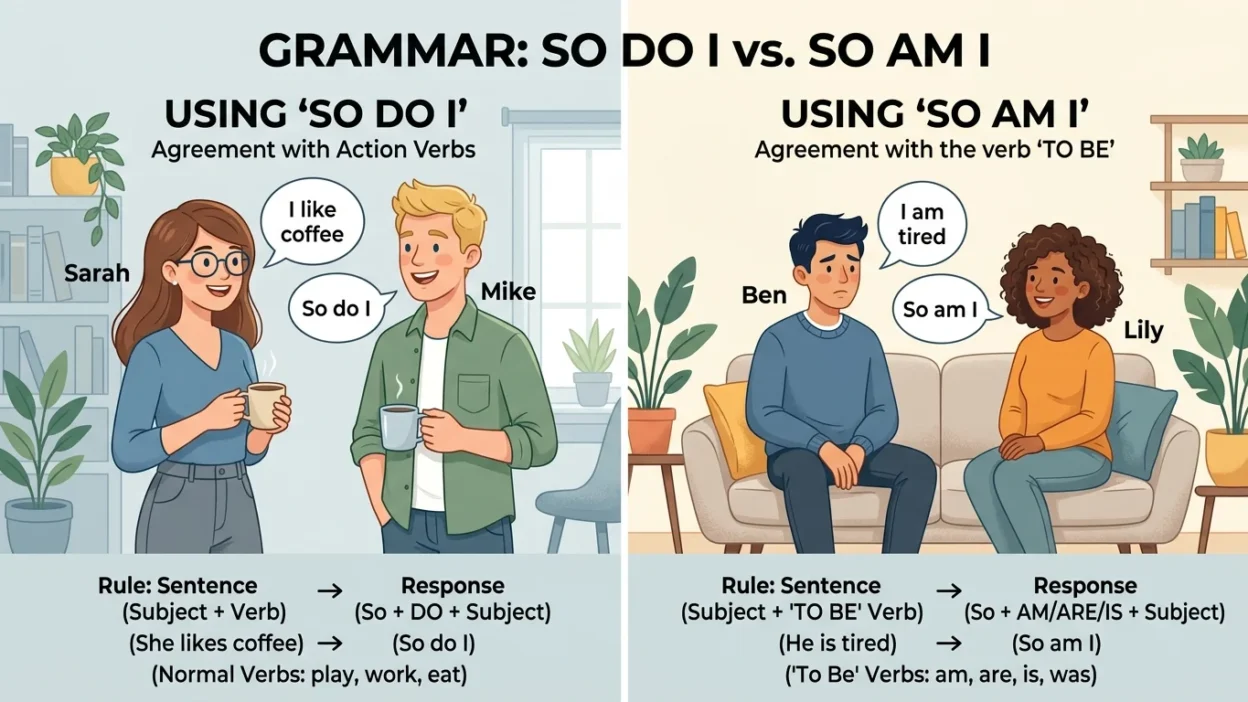
“So do I” and “so am I” are both correct expressions, but they are not interchangeable. The correct choice depends on the verb used in the original statement. This is one of those small grammar points that can confuse English learners because both expressions are used to agree with someone.
For example, if someone says, “I love coffee,” you can respond, “So do I.” But if someone says, “I am tired,” the natural response is “So am I.” The key is to match the auxiliary or helping verb from the original sentence. Once you understand this simple rule, choosing between “so do I” and “so am I” becomes much easier.
Quick Answer
“So do I” is used to agree with a statement that uses do as the auxiliary verb or has a main verb that requires do in the response. “So am I” is used when the original statement uses am, usually with an adjective, noun phrase, or present participle. Match the helping verb to the original sentence.
Why People Confuse “So Do I” and “So Am I”
The confusion happens because both expressions mean roughly:
I feel the same way.
or:
The same is true for me.
For example:
I like this song.
So do I.
and:
I am tired.
So am I.
Both responses express agreement, but the auxiliary verb changes.
The easiest way to understand this is to look at the original sentence.
If the original sentence uses am, use so am I.
If the original sentence uses a normal present simple verb such as like, love, work, or enjoy, use so do I.
So Do I Meaning
“So do I” means “I do too” or “I also do.”
It is used to agree with another person’s positive statement when the main verb is in the simple present and uses do as the auxiliary in the corresponding structure.
For example:
I like chocolate.
So do I.
The full meaning is:
I like chocolate too.
Another example:
I enjoy reading.
So do I.
This means:
I enjoy reading too.
Examples
I love this movie.
So do I.
I play tennis.
So do I.
I need some coffee.
So do I.
I enjoy traveling.
So do I.
I want to go home.
So do I.
The important point is that do represents the main verb from the original statement.
So Am I Meaning
“So am I” means “I am too” or “I also am.”
It is used when the original statement uses am.
For example:
I am tired.
So am I.
This means:
I am tired too.
You can also use it with adjectives:
I am hungry.
So am I.
I am nervous.
So am I.
I am excited.
So am I.
You can also use it with a present participle:
I am working late.
So am I.
Here, am is the auxiliary verb in the original sentence, so the response uses am.
So Do I vs So Am I
| Expression | When to Use It | Example |
|---|---|---|
| So do I | With simple present verbs that use do | I like tea. So do I. |
| So am I | With statements using am | I am tired. So am I. |
| So does he | With a third person singular subject | She likes tea. So does he. |
| So are we | With a statement using are | We are ready. So are we. |
| So did I | With simple past statements | I visited London. So did I. |
| So will I | With future statements using will | I will go. So will I. |
| So can I | With statements using can | I can swim. So can I. |
| So have I | With present perfect statements | I have finished. So have I. |
The central rule is simple:
Match the auxiliary verb.
When to Use “So Do I”
Use “so do I” when agreeing with a positive statement whose main verb is in the simple present.
Example 1
I like pizza.
So do I.
Example 2
I enjoy classical music.
So do I.
Example 3
I work from home.
So do I.
Example 4
I speak English.
So do I.
Example 5
I want to travel.
So do I.
Example 6
I love reading.
So do I.
In each case, do stands for the main verb.
For example:
I like pizza.
becomes:
I like pizza too.
or:
So do I.
When to Use “So Am I”
Use “so am I” when agreeing with a statement that uses am.
Example 1
I am tired.
So am I.
Example 2
I am hungry.
So am I.
Example 3
I am excited.
So am I.
Example 4
I am nervous.
So am I.
Example 5
I am ready.
So am I.
Example 6
I am studying for the exam.
So am I.
In each example, the original sentence contains am, so the response keeps am.
12 Examples of “So Do I”
Here are natural examples:
- I like coffee. So do I.
- I love this song. So do I.
- I enjoy cooking. So do I.
- I work on weekends. So do I.
- I need a break. So do I.
- I want to see that movie. So do I.
- I speak Spanish. So do I.
- I remember that place. So do I.
- I understand the problem. So do I.
- I watch the news every morning. So do I.
- I prefer tea. So do I.
- I believe that too. So do I.
12 Examples of “So Am I”
Here are natural examples:
- I am tired. So am I.
- I am hungry. So am I.
- I am happy. So am I.
- I am excited. So am I.
- I am nervous. So am I.
- I am ready. So am I.
- I am busy today. So am I.
- I am worried about the test. So am I.
- I am interested in the project. So am I.
- I am feeling better now. So am I.
- I am looking forward to the trip. So am I.
- I am working late tonight. So am I.
The Main Grammar Rule
The most important rule is:
Use the same auxiliary verb in the response that appears in the original statement.
For example:
I am tired.
So am I.
Here, the auxiliary is am.
But:
I like coffee.
So do I.
Here, the simple present verb like needs do in this type of short agreement structure.
The same pattern works with many other auxiliary verbs.
Be
I am happy.
So am I.
Do
I like it.
So do I.
Have
I have finished.
So have I.
Can
I can swim.
So can I.
Will
I will go.
So will I.
Did
I enjoyed the movie.
So did I.
This is why learning “so do I” and “so am I” also helps you understand auxiliary verbs more generally.
Common Mistakes
Mistake 1: Saying “So Am I” After Every Positive Statement
This is incorrect.
For example:
I like pizza.
You should not normally say:
So am I.
Instead:
So do I.
The verb in the original statement is like, not am.
Mistake 2: Saying “So Do I” After “I Am”
This is also incorrect.
I am tired.
Not:
So do I.
Correct:
So am I.
Mistake 3: Using “So I Do”
“So I do” can be grammatical, but it does not normally serve as the standard agreement structure.
Compare:
I like coffee.
So do I.
This is the normal agreement structure.
“So I do” can have a different use, often for emphasis.
You never listen to me.
So I do!
The second example has a different structure and meaning.
Mistake 4: Forgetting the Inversion
The standard structure is:
So + auxiliary verb + subject.
Therefore:
So do I.
not:
So I do.
And:
So am I.
not:
So I am.
Mistake 5: Thinking “So Do I” Means Only “I Do”
It means that the same statement applies to you.
I love coffee.
So do I.
means:
I love coffee too.
So Do I vs Me Too
“Me too” is a simpler and more conversational way to agree with a positive statement.
I love pizza.
Me too.
You can also say:
So do I.
Both are natural.
However, “so do I” follows a specific grammatical structure, while “me too” is more flexible in casual conversation.
Compare:
I am tired.
Me too.
or:
So am I.
Both are correct.
So Am I vs Me Too
The same idea applies here.
I am excited.
So am I.
or:
Me too.
Me too is often the easiest response in casual conversation.
So am I emphasizes the grammatical relationship with the original sentence.
American vs British English
There is no significant difference between American and British English in the use of “so do I” and “so am I.”
Both varieties use these structures in essentially the same way.
For example:
I love coffee.
So do I.
and:
I am tired.
So am I.
are standard in both American and British English.
Casual speakers in both varieties may also use “me too” frequently.
Similar Expressions
Me too
A casual way to agree with a positive statement.
I love chocolate.
Me too.
I do too
Another way to agree with a statement involving a simple present verb.
I like jazz.
I do too.
I am too
Used to agree with a statement using am.
I am tired.
I am too.
Neither do I
Used to agree with a negative statement.
I do not like coffee.
Neither do I.
Neither am I
Used to agree with a negative statement using am.
I am not tired.
Neither am I.
So have I
Used with a present perfect statement.
I have seen that movie.
So have I.
Positive and Negative Agreement
Understanding so do I and so am I also helps with negative agreement.
For positive statements:
I like tea.
So do I.
For negative statements:
I do not like tea.
Neither do I.
For positive statements with am:
I am tired.
So am I.
For negative statements with am:
I am not tired.
Neither am I.
This gives you a useful pattern:
Positive = so + auxiliary + subject
Negative = neither + auxiliary + subject
Final Verdict
“So do I” and “so am I” are both correct, but they are used in different grammatical situations.
Use “so do I” when agreeing with a simple present statement such as:
I like coffee.
So do I.
Use “so am I” when agreeing with a statement that uses am:
I am tired.
So am I.
The easiest rule is to look at the auxiliary verb in the original sentence and use the same auxiliary in your response.
Frequently Asked Questions
Is “so do I” correct?
Yes. “So do I” is correct when agreeing with a positive statement that uses a simple present verb requiring do in the response.
Is “so am I” correct?
Yes. “So am I” is correct when agreeing with a statement that uses am.
What is the difference between “so do I” and “so am I”?
“So do I” agrees with statements such as “I like coffee.” “So am I” agrees with statements such as “I am tired.”
Can I say “so do I” after “I am”?
No.
If someone says:
I am tired.
the correct response is:
So am I.
Can I say “so am I” after “I like”?
No.
If someone says:
I like coffee.
the natural response is:
So do I.
Is “me too” the same as “so do I”?
They can express the same basic agreement, but me too is more general and conversational, while so do I follows a specific grammatical structure.
What is the negative form of “so do I”?
The corresponding negative agreement is:
Neither do I.
For example:
I do not like coffee.
Neither do I.
What is the negative form of “so am I”?
Use:
Neither am I.
For example:
I am not tired.
Neither am I.
Conclusion
The difference between “so do I” and “so am I” is based on the verb used in the original statement. “So do I” is used with simple present verbs such as like, love, enjoy, want, need, and work. “So am I” is used when the original sentence contains am, as in “I am tired” or “I am excited.”
The most useful rule is to look at the original sentence before choosing your response. Match the auxiliary verb: I am → so am I, while a simple present verb such as I like → so do I. Once you learn this pattern, you can easily form similar expressions such as so did I, so have I, so can I, and so will I.
Remember This
I am tired. → So am I.
I like coffee. → So do I.
I went there. → So did I.
I have finished. → So have I.
I can swim. → So can I.
The key rule is:
Match the auxiliary verb.

Daniel Charles is a dedicated author and dream interpretation enthusiast at DrameyHut. He specializes in analyzing dream symbols and meanings, offering clear and insightful content for readers. His work aims to help individuals understand their subconscious thoughts, gain clarity, and explore the deeper messages hidden within their dreams.