“Unorganized” and “disorganized” are very similar words, and in many situations they can describe the same thing. Both words can refer to something that lacks order, structure, planning, or arrangement. That is why English learners often wonder if there is a real difference between them.
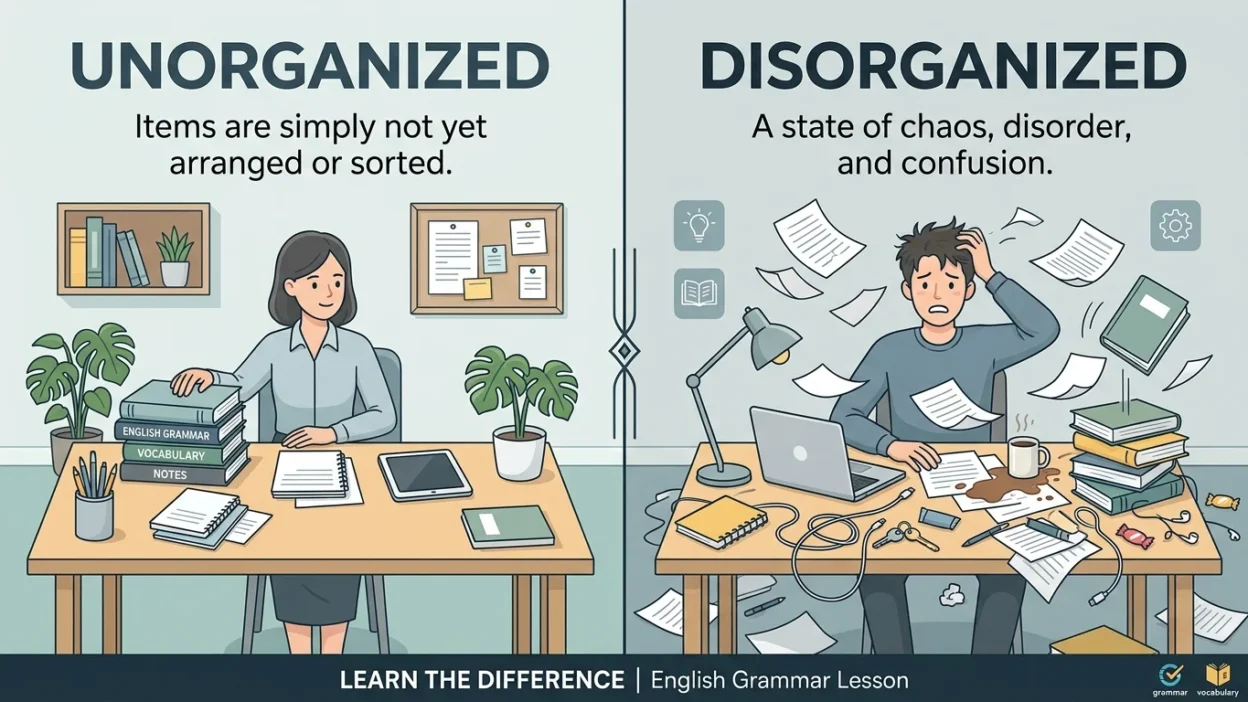
The main difference is one of emphasis and usage. Unorganized generally means not organized or not arranged in an organized way. Disorganized often suggests a stronger sense of disorder, confusion, poor planning, or a lack of structure. In everyday English, however, the two words frequently overlap, and either one may be appropriate depending on the context.
Quick Answer
Unorganized means not organized or not arranged systematically. Disorganized usually suggests a greater lack of order, structure, planning, or coordination. The words can overlap, but disorganized is often more natural when describing confusion, poor planning, or a chaotic situation.
Why People Confuse Unorganized and Disorganized
The confusion comes from the fact that both words are formed from organized.
We have:
organized → unorganized
and:
organized → disorganized
Both forms indicate a lack of organization.
The prefixes un and dis can both create words with negative meanings, but they do not always create exactly the same shade of meaning.
Unorganized usually focuses on the absence of organization.
Disorganized often focuses on disorder, confusion, or ineffective organization.
For example:
The files are unorganized.
This simply means the files are not arranged in an organized way.
The office is disorganized.
This may suggest that the office is messy, poorly managed, or lacking a clear system.
Unorganized Meaning
Unorganized is an adjective meaning not organized.
It can describe something that has not been arranged systematically or something that lacks a clear organizational structure.
Examples
The documents are unorganized.
Her notes are unorganized.
The books were left unorganized on the shelves.
We have an unorganized collection of photographs.
The word is relatively neutral. It does not necessarily suggest serious confusion or incompetence.
For example:
The files are unorganized, but we can easily sort them.
This simply tells us that the files lack organization.
Unorganized for People
Unorganized can also describe a person who does not organize things well.
I am usually unorganized when it comes to paperwork.
He is unorganized with his schedule.
She can be unorganized at times.
However, when describing someone’s habits, disorganized is also very common.
Disorganized Meaning
Disorganized means lacking order, structure, planning, or effective organization.
It can describe objects, places, systems, activities, people, and situations.
For example:
The office is completely disorganized.
This may mean the office is messy, poorly arranged, or difficult to manage.
You can also say:
His schedule is disorganized.
This suggests that his schedule lacks a clear structure or that his plans are poorly coordinated.
Disorganized for People
When describing a person’s habits, disorganized is especially common.
He is very disorganized.
This can suggest that he frequently loses things, forgets appointments, fails to plan, or struggles to keep things in order.
Compare:
She is unorganized.
This means she is not organized.
She is disorganized.
This can suggest a broader pattern of disorder or poor organization.
Unorganized vs Disorganized
| Word | Basic Meaning | Common Emphasis | Example |
|---|---|---|---|
| Unorganized | Not organized | Absence of organization | The files are unorganized. |
| Disorganized | Lacking order or structure | Disorder, confusion, poor planning | The office is disorganized. |
| Organized | Arranged systematically | Order and structure | The files are organized. |
The two words are often interchangeable, especially when describing physical objects or collections.
However, disorganized often sounds stronger when describing a person’s habits, a workplace, a process, or a situation.
When to Use Unorganized
Use unorganized when you simply want to say that something is not organized.
1. Files
The files are unorganized.
This means they have not been arranged systematically.
2. Notes
My notes are completely unorganized.
The notes lack a clear arrangement.
3. Information
The information is unorganized and difficult to search.
The information has not been arranged into a clear system.
4. Collection
He has an unorganized collection of old photographs.
The photographs have not been sorted or arranged.
5. Materials
The materials were unorganized after the move.
They were not arranged properly.
When to Use Disorganized
Use disorganized when you want to emphasize disorder, confusion, poor planning, or ineffective organization.
1. A Person
He is extremely disorganized.
This suggests that organization is generally a problem for him.
2. An Office
The office is disorganized.
This can suggest that the workplace is messy or poorly managed.
3. A Schedule
My schedule has become disorganized.
This suggests that plans or appointments lack structure.
4. A Meeting
The meeting was disorganized.
This suggests that the meeting lacked planning, coordination, or a clear structure.
5. A Process
The hiring process was disorganized.
This suggests that the process was poorly planned or coordinated.
12 Examples of Unorganized
Here are natural examples using unorganized:
- The documents are unorganized.
- My desk is unorganized after a busy week.
- The files were completely unorganized.
- She keeps her notes in an unorganized folder.
- The photographs are unorganized and need to be sorted.
- We found an unorganized collection of records.
- His books are unorganized on the shelf.
- The information is unorganized and difficult to review.
- The data was unorganized before we created a proper system.
- The materials were unorganized when we arrived.
- Her workspace is often unorganized.
- The list is unorganized and needs to be rearranged.
12 Examples of Disorganized
Here are natural examples using disorganized:
- The office is extremely disorganized.
- He is too disorganized to keep track of his appointments.
- The meeting was disorganized from beginning to end.
- Her schedule has become disorganized.
- The company has a disorganized management system.
- The project became disorganized after several people left the team.
- His thoughts seemed disorganized during the presentation.
- The event was poorly planned and disorganized.
- The classroom looked disorganized after the activity.
- Their filing system is completely disorganized.
- The discussion became disorganized and difficult to follow.
- She is creative but sometimes disorganized.
Are Unorganized and Disorganized Interchangeable?
Sometimes, yes.
For example:
The files are unorganized.
and:
The files are disorganized.
Both can mean that the files are not properly arranged.
However, disorganized may carry a stronger suggestion of disorder or poor organization.
Compare:
The papers are unorganized.
This simply says that the papers are not organized.
The office is disorganized.
This may suggest that the entire workplace lacks order or structure.
The context determines how strong the difference feels.
Which Is More Common?
Disorganized is very common in everyday English, especially when describing people, workplaces, schedules, meetings, systems, and situations.
Unorganized is also correct and useful, particularly when the simple meaning is “not organized.”
For example:
The files are unorganized.
is perfectly understandable.
But:
The manager is disorganized.
is generally more natural than:
The manager is unorganized.
When describing a person’s general organizational ability, disorganized is often the more natural choice.
Common Mistakes
Mistake 1: Thinking Unorganized Is Always Wrong
It is not wrong.
Unorganized is a legitimate adjective meaning not organized.
The documents are unorganized.
is grammatically correct.
Mistake 2: Thinking Disorganized Always Means Messy
Not necessarily.
A person can be disorganized because of poor planning, unclear systems, missed deadlines, or confusion, even if the physical environment is clean.
For example:
The project was disorganized.
This does not necessarily mean the project area was physically messy.
Mistake 3: Assuming the Words Always Have Completely Different Meanings
They often overlap.
In many contexts, either word can communicate the basic idea that something lacks organization.
Mistake 4: Using Unorganized When Describing Poor Planning
When describing a meeting, project, event, or person’s general habits, disorganized is often more natural.
The meeting was disorganized.
sounds more natural than:
The meeting was unorganized.
Mistake 5: Confusing Disorganized With Unorganized
Both are related to organization, but disorganized often emphasizes disorder or ineffective organization, while unorganized can simply emphasize the absence of organization.
Memory Trick
Use this simple rule:
Unorganized = not organized.
Disorganized = organization is lacking or has broken down.
Think of unorganized as a basic absence of organization.
Think of disorganized as disorder, confusion, or poor structure.
For example:
The papers are unorganized.
They have not been arranged.
The entire office is disorganized.
There is a broader problem with order or management.
American vs British English
Both unorganized and disorganized are used in American and British English.
There is no major American versus British distinction in meaning.
However, disorganized is widely used in both varieties when describing people, workplaces, schedules, systems, and situations.
You may also encounter the British spelling disorganised, with s instead of z.
Similarly, unorganised can occur in British English.
The meaning remains essentially the same.
Similar Words
Organized
Means arranged systematically or managed in an orderly way.
She is very organized.
Disordered
Means lacking order or arrangement.
The files were disordered.
Messy
Usually describes something untidy or physically lacking cleanliness or order.
His room is messy.
Chaotic
Means extremely confused or lacking order.
The situation became chaotic.
Unsystematic
Means lacking a clear or organized system.
Their approach was unsystematic.
Unstructured
Means lacking a clear structure.
The discussion was unstructured.
Scattered
Means spread around rather than gathered or arranged together.
Her notes were scattered across the desk.
Unorganized vs Disorganized: Which Should You Choose?
Choose unorganized when you simply mean something has not been organized.
The files are unorganized.
Choose disorganized when you want to emphasize disorder, confusion, poor planning, or a broader lack of organization.
The entire project is disorganized.
When describing a person’s general habits or organizational ability, disorganized is often the more natural choice.
Neither word is automatically more correct. The best choice depends on what you want to emphasize.
Final Verdict
Unorganized and disorganized are both correct English words, and they frequently overlap.
Unorganized generally means simply not organized. It is useful when you want to describe something that has not been arranged systematically.
Disorganized often suggests disorder, confusion, poor planning, or ineffective organization. It is especially common when describing people, workplaces, schedules, meetings, projects, and systems.
The easiest rule is:
Unorganized = not organized.
Disorganized = lacking order or structure.
If you are describing a person’s general organizational habits, disorganized will often sound more natural.
Frequently Asked Questions
Is unorganized a correct word?
Yes. Unorganized is a correct adjective meaning not organized or not arranged systematically.
Is disorganized better than unorganized?
Neither is automatically better. Both are correct. Disorganized often carries a stronger sense of disorder or poor planning, while unorganized can simply mean not organized.
What is the difference between unorganized and disorganized?
Unorganized emphasizes the absence of organization. Disorganized often emphasizes disorder, confusion, poor planning, or ineffective organization.
Is it correct to say “I am unorganized”?
Yes. The sentence is grammatically correct. However, “I am disorganized” is often more natural when describing a person’s general difficulty with organization.
Is “disorganized” negative?
It can have a negative meaning because it suggests a lack of order, planning, or structure. The strength of the negative meaning depends on context.
Can I use unorganized for a person?
Yes.
She is unorganized.
However, disorganized is often more natural when describing someone’s general organizational habits.
Is disorganized the opposite of organized?
Yes, in many contexts. Organized means having order and structure, while disorganized means lacking order, structure, or effective organization.
What is the British spelling of disorganized?
British English commonly uses disorganised, while American English generally uses disorganized. Both forms have the same basic meaning.
Conclusion
The difference between unorganized and disorganized is mainly about emphasis rather than completely different meanings. Unorganized means that something is not organized, while disorganized often suggests a broader problem involving disorder, confusion, poor planning, or lack of structure.
Both words are correct, and they can often be used interchangeably. However, when talking about a person’s habits, a poorly planned meeting, a confusing process, or a workplace lacking structure, disorganized is usually the more natural choice. When you simply want to say that something has not been arranged, unorganized works well.
Remember This
Unorganized = not organized.
Disorganized = lacking order, structure, or effective organization.
For a person’s general organizational habits, disorganized is often the more natural choice.
For something that simply has not been arranged, unorganized is perfectly correct.

Daniel Charles is a dedicated author and dream interpretation enthusiast at DrameyHut. He specializes in analyzing dream symbols and meanings, offering clear and insightful content for readers. His work aims to help individuals understand their subconscious thoughts, gain clarity, and explore the deeper messages hidden within their dreams.