“Is used,” “has been used,” and “was used” are all grammatically correct, but they describe actions in different ways. The main difference is tense and if you are focusing on a present fact, a past action, or an action that began or occurred in the past and is relevant to the present.
Understanding these forms is especially useful in academic, technical, professional, and everyday English.
Quick Answer
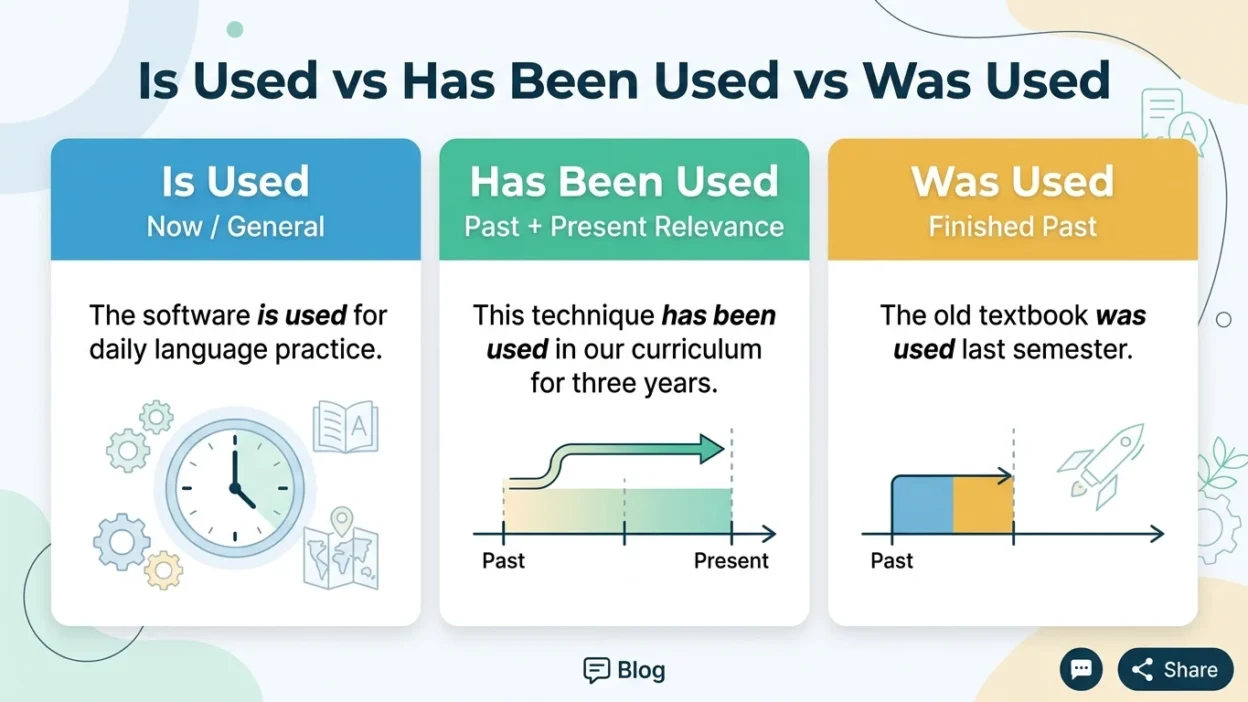
Is used = describes a present or general use.
This tool is used to analyze data.
Has been used = describes something that has been used in the past, with a connection to the present.
This tool has been used for many years.
Was used = describes something that was used at a particular time or during a completed past situation.
This tool was used during the experiment.
Easy Rule
Is used → present/general
Has been used → past + present relevance
Was used → completed past
Is Used
Is used is the passive form of the present simple.
We use it when something is generally used for a particular purpose or when describing a current fact, rule, method, or practice.
Examples
English is used around the world.
This machine is used to produce electricity.
Water is used for many purposes.
This word is used in formal English.
The software is used by thousands of people.
These sentences describe general or current facts, rather than one specific completed event.
Common Pattern
Subject + is used + to + verb
This tool is used to measure temperature.
Or:
Subject + is used + for + noun/gerund
This tool is used for measuring temperature.
Has Been Used
Has been used is the present perfect passive.
It describes something that happened in the past but has a connection to the present. The exact time may be unknown, unimportant, or may extend up to the present.
Examples
This method has been used for decades.
The software has been used by researchers around the world.
This technique has been used successfully in several studies.
The word has been used in English for centuries.
The equipment has been used several times.
The focus is not necessarily on one particular past moment. Instead, the speaker is emphasizing the experience, history, or present relevance of the action.
Was Used
Was used is the simple past passive.
Use it when the action happened in the past and is viewed as finished or connected to a specific past event or period.
Examples
The machine was used yesterday.
This method was used during the experiment.
The car was used by the previous owner.
The term was used in the article.
The equipment was used to complete the project.
The action belongs to a completed past situation.
Comparison Table
| Form | Tense | Main Use | Example |
|---|---|---|---|
| Is used | Present simple passive | General/current use | This method is used in science. |
| Has been used | Present perfect passive | Past use with present relevance | This method has been used for years. |
| Was used | Simple past passive | Completed past use | This method was used in the experiment. |
Compare These Three Sentences
Consider:
This software is used by researchers.
This means researchers generally use the software. It is a current or general fact.
This software has been used by researchers.
This tells us that researchers have used it at some point or over a period of time. The past use is relevant to the present.
This software was used by researchers.
This refers to a completed past situation. The context may tell us when or during what event it was used.
Example With Time
Time expressions can make the difference much clearer.
Is Used
This system is used every day.
This describes a regular or current practice.
Has Been Used
This system has been used since 2020.
The use began in the past and continues or remains relevant now.
Was Used
This system was used from 2020 to 2023.
The period is finished.
“Has Been Used” vs “Was Used”
This is one of the most important distinctions.
Compare:
The method was used in 2022.
The sentence refers to a specific completed past period.
The method has been used since 2022.
The sentence connects the past with the present. It may mean the method continues to be used.
Another example:
The car was used by John.
This describes a completed past situation.
The car has been used by John.
This tells us that John has used the car at some point, without necessarily specifying when.
“Is Used” vs “Has Been Used”
Compare:
This word is used in formal English.
This is a general statement about current usage.
This word has been used in formal English for centuries.
This emphasizes its history of usage.
The first focuses on what is true now.
The second focuses on what has happened over time.
“Is Used” vs “Was Used”
Compare:
This machine is used to make paper.
This describes its normal or current function.
This machine was used to make paper.
This suggests the machine had that function in a particular past situation or period.
For example:
The old machine was used to make paper before it was replaced.
Here, the use is clearly finished.
Passive Voice
All three expressions use the passive voice.
Active
People use this method.
Passive
This method is used by people.
For the other forms:
Active: Researchers have used the method.
Passive: The method has been used by researchers.
Active: Researchers used the method.
Passive: The method was used by researchers.
The passive voice puts the focus on the thing being used, rather than the person doing the action.
Common Mistakes
Using “was used” for a general fact
❌ This tool was used to measure temperature.
If you’re describing its general function, this may be misleading.
✅ This tool is used to measure temperature.
But if you’re talking about a particular past experiment:
✅ This tool was used to measure the temperature during the experiment.
Using “has been used” with a finished past time
A specific finished time normally calls for the simple past.
❌ The method has been used in 2020.
✅ The method was used in 2020.
But:
✅ The method has been used since 2020.
Using “is used” for a completed past event
❌ The machine is used yesterday.
✅ The machine was used yesterday.
The word yesterday clearly refers to a completed past time.
Important Time Expressions
Certain expressions often help you choose the correct form.
Is Used
Common with:
- Usually
- Generally
- Normally
- Often
- Every day
- Nowadays
- Commonly
This word is commonly used in English.
Has Been Used
Common with:
- Since
- For
- Already
- Recently
- Several times
- Over the years
- So far
This method has been used for many years.
Was Used
Common with:
- Yesterday
- Last year
- In 2020
- During the experiment
- At that time
- Earlier
- When…
The method was used in 2020.
Quick Memory Trick
Ask yourself three questions:
Is it a general or current fact?
→ Is used
Did it happen in the past and does it matter now?
→ Has been used
Did it happen during a finished past event or time?
→ Was used
Simple Formula
Now/general → is used
Past + connection to now → has been used
Finished past → was used
More Examples
Technology
Smartphones are used for communication.
Smartphones have been used for communication for many years.
The smartphone was used during the demonstration.
Education
This textbook is used in many schools.
This textbook has been used by the school since 2018.
This textbook was used in last year’s course.
Research
This technique is used in scientific research.
This technique has been used in numerous studies.
This technique was used in the 2024 study.
Language
This expression is used in informal English.
This expression has been used for centuries.
This expression was used in the original text.
Final Verdict
All three forms are correct, but they have different meanings:
Is used describes a present, current, or general use.
This method is used in modern medicine.
Has been used describes past use that has a connection to the present.
This method has been used for many years.
Was used describes use during a completed past situation or period.
This method was used in the experiment.
The easiest way to remember them is:
Is used = generally/currently
Has been used = past + present connection
Was used = completed past
FAQs
What is the difference between “is used” and “was used”?
Is used describes current or general use, while was used describes use in a completed past situation.
This machine is used to make cars.
This machine was used in yesterday’s demonstration.
What is the difference between “has been used” and “was used”?
Has been used connects a past action to the present, while was used normally refers to a completed past situation.
The method has been used since 2020.
The method was used in 2020.
Is “has been used” present or past tense?
It is present perfect passive. Although the action happened in the past, the construction connects that past action to the present.
Is “is used” passive voice?
Yes. Is used is the present simple passive form of use.
People use this tool.
This tool is used by people.
Is “was used” correct?
Yes. Was used is the simple past passive form of use.
The equipment was used during the experiment.
Can I say “has been used for years”?
Yes. This is a very common and correct construction.
This method has been used for years.
It indicates that the method has a history of use extending from the past toward the present.
Which is better: “is used” or “has been used”?
Neither is universally better. Choose based on meaning. Use is used for a general/current fact and has been used when emphasizing past use and its connection to the present.
Conclusion
“Is used,” “has been used,” and “was used” are all correct passive constructions, but they express different relationships with time. Is used is best for general facts and current practices, has been used emphasizes past use that remains relevant to the present, and was used describes a completed past event or period.
A simple rule can help you choose: is used for now or generally, has been used for past plus present relevance, and was used for a finished past situation. Once you identify the time and context of the action, choosing the correct form becomes much easier.

Christopher Thomas is a passionate writer and dream researcher dedicated to exploring the meanings behind dreams. As an author at DrameyHut, he creates insightful and easy-to-understand interpretations that help readers connect with their subconscious mind. His work focuses on guiding individuals toward self-discovery, clarity, and a deeper understanding of their inner thoughts.