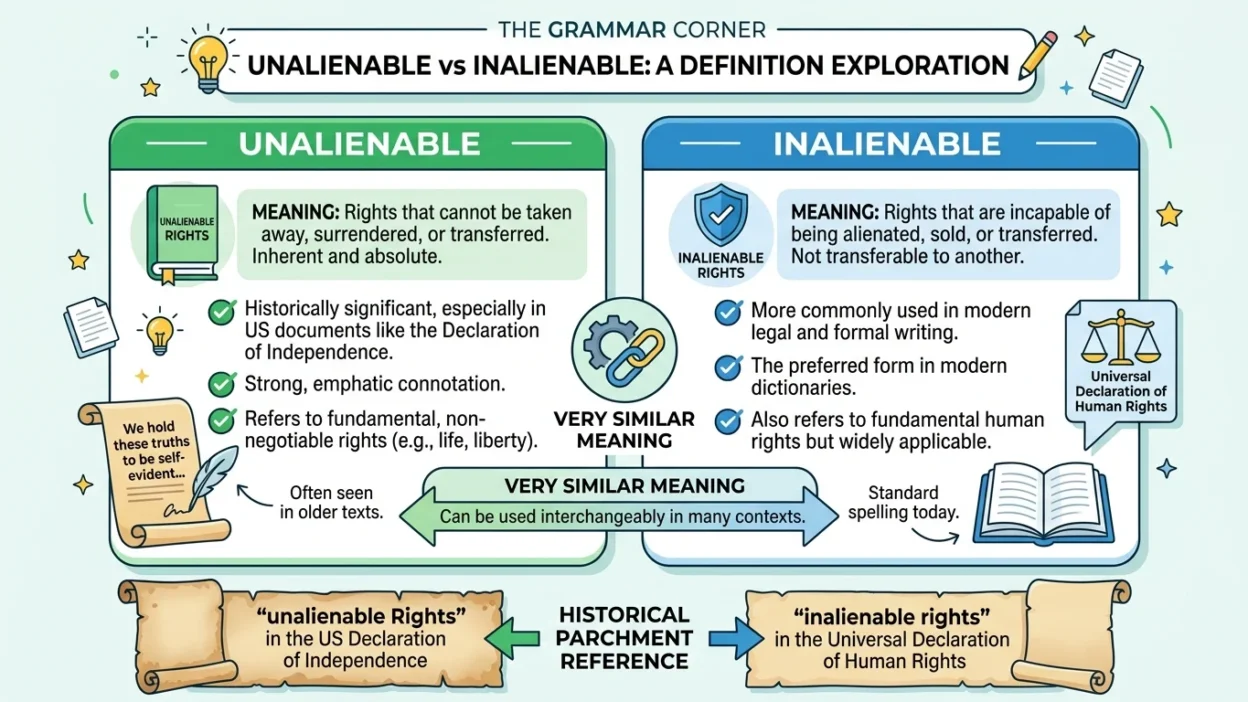
Unalienable and inalienable are both correct English words, and they have essentially the same meaning. Both describe something that cannot be taken away, transferred, surrendered, or given up.
The main difference is usage and preference. Inalienable is much more common in modern English, while unalienable is less common and is strongly associated with the famous phrase “unalienable Rights” in the United States Declaration of Independence.
Quick Answer
Inalienable and unalienable both mean impossible to take away, transfer, or surrender.
Inalienable rights are rights that cannot legitimately be taken away.
Unalienable rights has the same meaning, but this spelling is less common in modern English.
For most modern writing, inalienable is the more common choice.
Inalienable
Inalienable means something that cannot be transferred to another person or taken away from its rightful holder.
It is especially common when discussing rights, freedoms, dignity, and human qualities.
Examples
Everyone has inalienable rights.
Freedom is considered an inalienable right.
Human dignity is an inalienable part of human existence.
The Constitution protects certain inalienable rights.
The word is particularly common in legal, political, philosophical, and human rights contexts.
Unalienable
Unalienable has essentially the same meaning as inalienable.
It means something that cannot be alienated, meaning it cannot be transferred, surrendered, or taken away.
The word is famously associated with the United States Declaration of Independence:
“unalienable Rights”
This phrase refers to rights that are understood as inherent and incapable of legitimate transfer or removal.
Examples
People are born with unalienable rights.
The document refers to certain unalienable rights.
Freedom was described as an unalienable right.
The Main Difference
There is little difference in meaning between the two words.
The biggest distinction is their frequency and stylistic association.
| Word | Meaning | Modern Usage |
|---|---|---|
| Inalienable | Cannot be taken away or transferred | Very common |
| Unalienable | Cannot be taken away or transferred | Less common, often historical or traditional |
Inalienable is generally the safer choice for modern writing.
Why Are There Two Forms?
The words are formed with different negative prefixes:
in + alienable → inalienable
un + alienable → unalienable
Both prefixes can create a negative meaning.
Alienable means capable of being transferred or given away.
Therefore:
Inalienable / unalienable means not capable of being transferred or surrendered.
What Does “Alienable” Mean?
Understanding alienable makes the difference easier to remember.
Something alienable can be transferred from one person to another.
For example, property is generally alienable:
The owner can transfer the property to another person.
An inalienable right, however, is understood as something that cannot legitimately be transferred or taken away.
Simple Pattern
Alienable = can be transferred
Inalienable = cannot be transferred
Unalienable = cannot be transferred
Inalienable Rights
One of the most common phrases is:
inalienable rights
An inalienable right is a right considered inherent to a person and not something that can legitimately be surrendered or removed.
Examples might include:
the right to human dignity
basic freedoms
fundamental human rights
The exact rights considered inalienable can depend on a particular legal, philosophical, or political framework.
Unalienable Rights
Unalienable rights means essentially the same thing.
However, this form is especially associated with historical and American political language.
The Declaration of Independence famously uses:
“unalienable Rights”
Because of this historical association, unalienable may sound more traditional or archaic to modern readers.
Inalienable vs Unalienable Examples
Example 1
Human beings possess inalienable rights.
Modern and natural.
Human beings possess unalienable rights.
Also correct, but somewhat less common.
Example 2
Freedom is an inalienable right.
Natural modern usage.
Freedom is an unalienable right.
Correct, but more traditional in tone.
Example 3
The document recognizes inalienable human rights.
Common modern phrasing.
The document recognizes unalienable human rights.
Grammatically correct, but less common.
Which Is More Common?
Inalienable is considerably more common in contemporary English.
You will frequently see phrases such as:
- Inalienable rights
- Inalienable dignity
- Inalienable freedom
- Inalienable human rights
- Inalienable claims
Unalienable occurs much less frequently and is particularly likely to appear in historical quotations or discussions of the Declaration of Independence.
Common Mistakes
Thinking “unalienable” is incorrect
It is not incorrect.
Unalienable is a legitimate English word.
It simply has less common modern usage than inalienable.
Thinking “inalienable” means “unrelated”
It does not.
The word comes from alienable, where alienate has the sense of transferring ownership or giving something up.
So inalienable means something that cannot be transferred or surrendered.
Using “unalienable” in modern writing without considering style
Although correct, unalienable may sound historical or old-fashioned in some contexts.
For contemporary general writing, inalienable is usually the more natural choice.
American vs British English
Both inalienable and unalienable can be found in American and British English.
However, unalienable has a particularly strong association with American historical writing because of the Declaration of Independence.
In contemporary English, inalienable is generally the more widely used form.
Is “Inalienable” More Correct?
Not exactly.
Inalienable is more common and generally preferred in modern usage, but unalienable is also correct.
Therefore:
Inalienable rights ✅
Unalienable rights ✅
The first is usually the better choice for contemporary writing unless you are intentionally using historical wording.
Memory Trick
Remember:
Inalienable = cannot be transferred
Unalienable = cannot be transferred
Both words contain alienable, which means capable of being transferred.
So:
Alienable → can be given or transferred
Inalienable → cannot be given or transferred
Unalienable → cannot be given or transferred
Final Verdict
Unalienable and inalienable are synonyms. Both mean unable to be taken away, transferred, surrendered, or given up.
However, inalienable is much more common in modern English and is generally the better choice for contemporary writing.
Unalienable is perfectly correct but is often associated with historical or traditional language, particularly the phrase “unalienable Rights” from the Declaration of Independence.
The easiest rule
Use “inalienable” for most modern writing.
Use “unalienable” when referring to historical wording or when you specifically prefer that form.
FAQs
Is unalienable the same as inalienable?
Yes. They have essentially the same meaning: unable to be taken away, transferred, or surrendered.
Which is more common, inalienable or unalienable?
Inalienable is much more common in modern English.
Is “unalienable” a correct word?
Yes. Unalienable is a legitimate English word and is especially well known from the phrase “unalienable Rights” in the Declaration of Independence.
Should I say “inalienable rights” or “unalienable rights”?
Both are correct, but “inalienable rights” is generally more natural in contemporary English. “Unalienable rights” has a more historical or traditional association.
What does inalienable mean?
Inalienable means something cannot be legitimately transferred, surrendered, or taken away.
What is the opposite of inalienable?
The opposite is alienable, meaning capable of being transferred, surrendered, or given to someone else.
Why does the Declaration of Independence say “unalienable”?
The Declaration of Independence uses the historical form “unalienable Rights.” This wording has become particularly famous in American history.
Conclusion
Inalienable and unalienable mean essentially the same thing: something that cannot be taken away, transferred, or surrendered. The important difference is their usage and tone rather than their meaning.
Inalienable is the more common choice in modern English, especially in phrases such as “inalienable rights” and “inalienable human dignity.” Unalienable is also correct but is less common and is strongly associated with historical language, particularly the Declaration of Independence.
If you’re unsure which one to use, inalienable is usually the safest choice for modern writing.

Daniel Charles is a dedicated author and dream interpretation enthusiast at DrameyHut. He specializes in analyzing dream symbols and meanings, offering clear and insightful content for readers. His work aims to help individuals understand their subconscious thoughts, gain clarity, and explore the deeper messages hidden within their dreams.