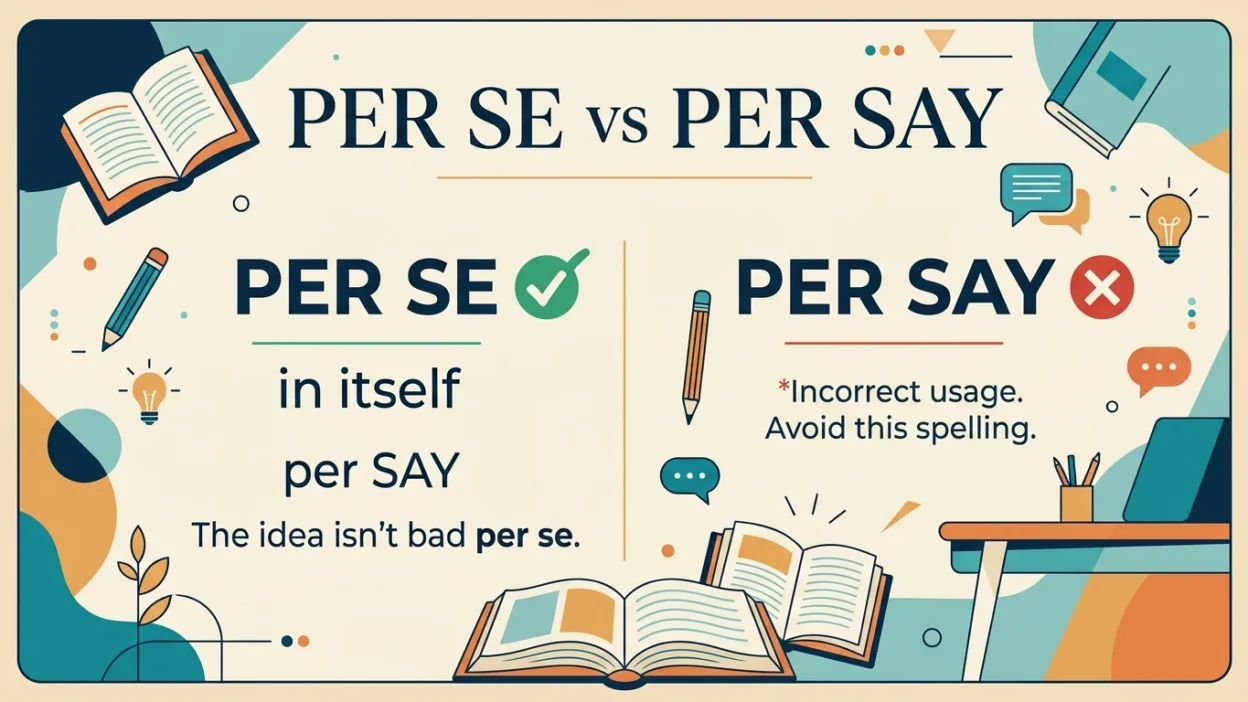
“Per se” and “per say” sound almost identical, which is why they are frequently confused. However, when you mean the common expression meaning “in itself” or “by itself,” the correct spelling is per se.
Per say is generally a misspelling of per se.
Quick Answer
Per se ✅ is correct.
Per say ❌ is incorrect when you mean the expression.
The idea isn’t bad per se, but it needs some improvement.
Here, per se means “in itself.”
You could rewrite the sentence as:
The idea itself isn’t bad, but it needs some improvement.
What Does “Per Se” Mean?
Per se is a Latin expression meaning “in itself,” “by itself,” or “intrinsically.”
In English, it is used when you want to talk about something itself, rather than its effects, circumstances, or related aspects.
Examples
I don’t dislike the job per se, but I hate the long commute.
Meaning:
I don’t dislike the job itself, but I hate the long commute.
Another example:
The movie wasn’t bad per se, but it was too long.
This means the movie itself wasn’t necessarily bad.
What Does “Per Say” Mean?
“Per say” is usually a spelling mistake caused by the pronunciation of per se.
Although per se is spelled with se, it is commonly pronounced approximately like “per say.”
That is why people sometimes write:
❌ per say
instead of:
✅ per se
When you mean “in itself,” always use per se.
Per Se vs Per Say Examples
Correct
The idea isn’t wrong per se.
Incorrect
The idea isn’t wrong per say.
Correct
I’m not opposed to the plan per se.
Incorrect
I’m not opposed to the plan per say.
Correct
The product isn’t expensive per se.
Incorrect
The product isn’t expensive per say.
Why Is “Per Se” Pronounced Like “Per Say”?
The spelling se comes from Latin, while say is an English word.
The expression per se is commonly pronounced:
per SAY
Because the pronunciation sounds like the English word say, people often assume the spelling is per say.
The pronunciation does not change the spelling.
Think of it as a fixed expression:
per se = in itself
Per Se vs Itself
In many cases, per se can be replaced by itself.
The idea isn’t bad per se.
The idea itself isn’t bad.
Both sentences have essentially the same meaning.
However, per se often sounds more formal, analytical, or sophisticated.
Per Se vs In Itself
Per se and in itself are also very similar.
The rule isn’t unreasonable per se.
The rule isn’t unreasonable in itself.
Both mean that the rule itself is not necessarily the problem.
In everyday English, in itself may sound more natural, while per se is common in formal and analytical contexts.
How to Use “Per Se”
A common structure is:
[Something] + isn’t/isn’t necessarily + adjective + per se
For example:
The policy isn’t unfair per se, but it could have unintended consequences.
Another common structure is:
I’m not against [something] per se.
For example:
I’m not against social media per se; I just think people should use it responsibly.
More Examples
There’s nothing wrong with the idea per se.
The technology isn’t dangerous per se.
I’m not criticizing the decision per se.
The food wasn’t bad per se, but it wasn’t very memorable.
Money isn’t the problem per se.
The strategy isn’t ineffective per se, but it could be improved.
Common Mistakes
Mistake 1: Writing “per say”
❌ The plan isn’t bad per say.
✅ The plan isn’t bad per se.
Mistake 2: Thinking “per se” means “for example”
Per se does not mean “for example.”
It means:
in itself
So:
The product isn’t expensive per se.
means:
The product itself isn’t expensive.
Mistake 3: Using “per se” when “itself” is clearer
Although per se is correct, it can sometimes make simple writing sound unnecessarily formal.
Instead of:
The problem isn’t significant per se.
You can simply write:
The problem itself isn’t significant.
Both are correct.
Is “Per Se” Formal?
Per se has a somewhat formal or analytical tone. It is common in:
- Academic writing
- Legal writing
- Business writing
- Journalism
- Philosophy
- Formal discussions
- Analytical writing
It can also appear in casual conversation.
For example:
I’m not angry per se. I’m just disappointed.
This is perfectly natural conversational English for many speakers.
Is “Per Se” Italicized?
Because per se comes from Latin, you may sometimes see it italicized:
The idea isn’t bad per se.
However, per se is now well established in English, so italics are not necessary in ordinary modern writing.
Both are acceptable:
The idea isn’t bad per se.
The idea isn’t bad per se.
Per Se in American and British English
Per se is standard in both American and British English.
The spelling remains the same:
per se ✅
There is no standard modern English spelling per say for this expression.
Comparison Table
| Expression | Correct? | Meaning |
|---|---|---|
| Per se | ✅ | In itself; by itself |
| Per say | ❌ | Common misspelling of per se |
| In itself | ✅ | Essentially the same meaning |
| Itself | ✅ | Often a simpler alternative |
Easy Memory Trick
Remember:
Per se = in itself
If you can replace per se with “itself,” you have the correct expression.
For example:
The idea isn’t bad per se.
→ The idea itself isn’t bad.
Also remember:
It sounds like “per say,” but it is spelled “per se.”
Quick Examples
I don’t dislike him per se. ✅
The idea isn’t wrong per se. ✅
The movie wasn’t bad per se. ✅
I’m not opposed to the proposal per se. ✅
There’s nothing illegal about the action per se. ✅
The product isn’t expensive per se. ✅
But:
❌ I don’t dislike him per say.
❌ The idea isn’t wrong per say.
Final Verdict
When you mean “in itself,” “by itself,” or “intrinsically,” the correct expression is per se.
Per say is a common misspelling caused by the fact that per se is pronounced approximately like “per say.”
So remember:
The idea isn’t bad per se. ✅
The idea isn’t bad per say. ❌
The easiest way to remember it is per se = itself.
FAQs
Is it “per se” or “per say”?
The correct expression is per se. Per say is a common misspelling.
What does “per se” mean?
Per se means “in itself,” “by itself,” or “intrinsically.”
How do you pronounce “per se”?
It is commonly pronounced approximately “per SAY.” This pronunciation is the main reason people sometimes spell it incorrectly as per say.
Is “per se” formal?
It has a somewhat formal or analytical tone, but it is also commonly used in everyday conversation.
Can “per se” be replaced with “itself”?
Usually, yes.
The idea isn’t bad per se.
The idea itself isn’t bad.
The meanings are essentially the same.
Is “per say” ever correct?
Not when you mean the expression per se. In standard English, per say is generally considered a misspelling.
Conclusion
Per se and per say are easy to confuse because they sound alike, but the correct spelling is per se. The expression means “in itself” or “by itself” and is commonly used to distinguish something from its effects, circumstances, or related issues.
For example, “The idea isn’t bad per se” means that the idea itself is not bad, even if there may be problems with its implementation. Whenever you mean “in itself,” remember to use per se, not per say.

Christopher Thomas is a passionate writer and dream researcher dedicated to exploring the meanings behind dreams. As an author at DrameyHut, he creates insightful and easy-to-understand interpretations that help readers connect with their subconscious mind. His work focuses on guiding individuals toward self-discovery, clarity, and a deeper understanding of their inner thoughts.