
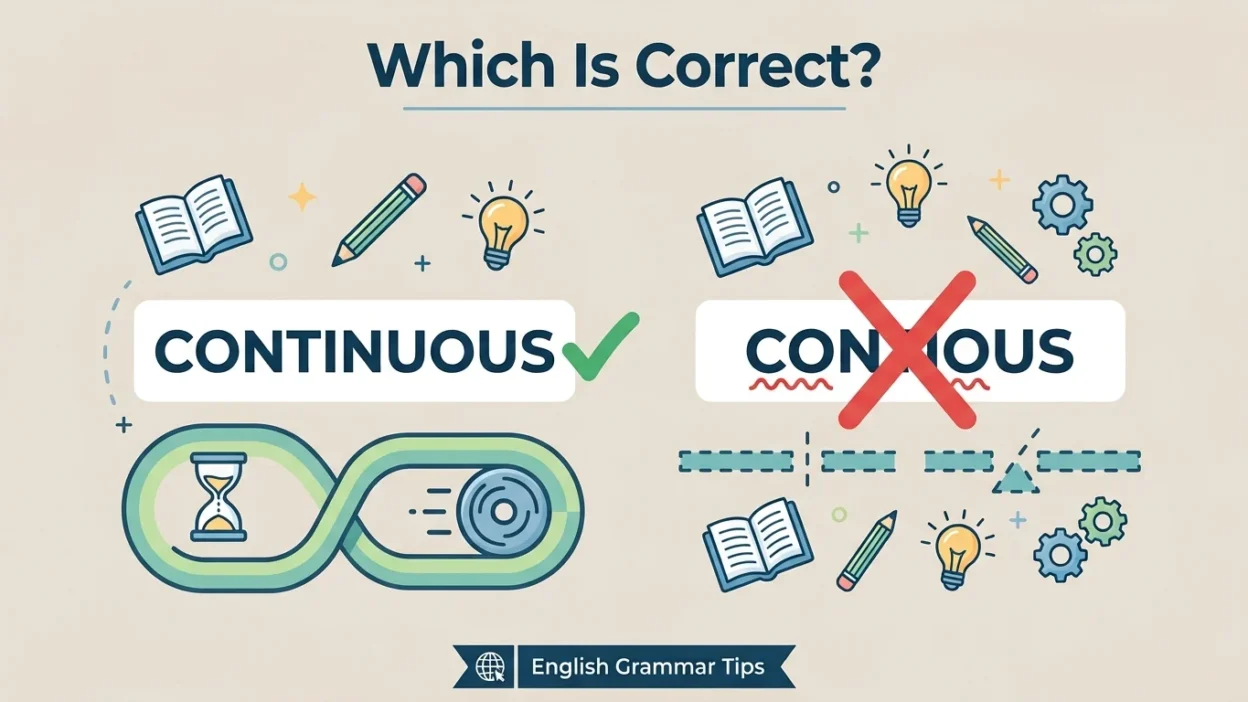
Continuous vs contious is a common English spelling confusion. The two forms may look similar, especially when typed quickly, but only one is correct in standard English: continuous.
Continuous is an adjective that describes something happening without stopping, breaking, or being interrupted. You can talk about continuous rain, continuous noise, continuous improvement, or a continuous process.
Contious, on the other hand, is not a standard English word. It has no accepted meaning or grammatical use. It is simply a misspelling of continuous and should be avoided in academic, professional, and everyday writing.
The confusion often happens because continuous has several letters that are easy to omit. Learning its connection to the word continue makes the correct spelling much easier to remember.
Quick Answer: Continuous vs Contious
Continuous is the correct spelling. It means continuing without interruption, pause, or break.
Contious is incorrect and is not a standard English word.
Easy rule:
Continuous = correct
Contious = misspelling
Remember: If something can continue, it can be continuous.
Why People Confuse Continuous and Contious
The main confusion is caused by spelling. Continuous is a relatively long word, and writers may accidentally leave out letters when typing quickly.
Another reason is pronunciation. When spoken naturally, some of the middle sounds may not be clearly heard, making people spell the word according to how they think it sounds.
Common reasons for the mistake include:
- Typing too quickly
- Omitting letters
- Spelling by sound
- Confusing continuous with similar words
- Not recognizing its connection with continue
The important point is simple: contious is never the correct spelling for continuous.
What Does “Continuous” Mean?
Continuous means happening without stopping or interruption.
It describes something that continues as an unbroken process, action, sound, movement, or condition.
For example:
- We had continuous rain throughout the night.
- The machine requires continuous monitoring.
- There was continuous noise outside.
- She showed continuous improvement.
In each sentence, the word describes something ongoing without a break.
Continuous Meaning in Simple English
If something keeps going and does not stop, it is continuous.
For example:
Continuous rain means rain that continues without stopping.
Continuous noise means noise that keeps going without interruption.
Continuous effort means ongoing effort.
What Does “Contious” Mean?
Contious has no meaning in standard English because it is not a correct English word.
It is usually a spelling error made when someone intends to write continuous.
Incorrect:
- The rain was contious.
- She made contious progress.
- There was contious noise outside.
Correct:
- The rain was continuous.
- She made continuous progress.
- There was continuous noise outside.
There is no situation in standard English where contious should replace continuous.
Continuous vs Contious: Comparison Table
| Feature | Continuous | Contious |
|---|---|---|
| Correct spelling | Yes | No |
| Standard English word | Yes | No |
| Meaning | Without interruption or a break | No standard meaning |
| Part of speech | Adjective | None |
| Use in formal writing | Yes | No |
| Example | Continuous effort is important. | Incorrect spelling |
The verdict is clear: always use continuous when you mean something ongoing or uninterrupted.
When to Use “Continuous”
Use continuous when describing something that happens without stopping or has no interruption.
It can describe:
- Rain
- Noise
- Movement
- Growth
- Improvement
- Monitoring
- Production
- Effort
- Learning
- A process
Examples include:
Continuous rain
Continuous improvement
Continuous support
Continuous monitoring
Continuous growth
Continuous in Everyday English
You might say:
- The baby cried continuously.
- We experienced continuous traffic.
- The company has shown continuous growth.
- The workers provided continuous support.
The related adverb is continuously.
For example:
The machine ran continuously for several hours.
How to Spell “Continuous” Correctly
The correct spelling is:
C O N T I N U O U S
A useful way to understand it is to connect it with the word:
Continue → Continuous
The word contious incorrectly removes important letters from the middle of the word.
So avoid:
❌ Contious
And use:
✅ Continuous
A standard definition of continuous is something forming an unbroken whole or happening without interruption.
Examples of “Continuous” in Sentences
Here are more than 10 examples showing how to use continuous correctly:
- The continuous rain caused flooding in some areas.
- She made continuous efforts to improve her English.
- The machine needs continuous monitoring.
- We heard continuous noise from outside.
- The company has experienced continuous growth.
- He received continuous support from his family.
- The road remained in continuous use throughout the day.
- Continuous learning can help you develop new skills.
- The factory operates through a continuous production process.
- The doctor recommended continuous observation.
- There was a continuous stream of visitors.
- The alarm produced a continuous sound.
- The team worked for several continuous hours.
- The project requires continuous attention.
- She has shown continuous improvement over time.
Common Mistakes with Continuous and Contious
Mistake 1: Writing “Contious”
Incorrect:
The process requires contious monitoring.
Correct:
The process requires continuous monitoring.
Remember that contious is not the correct spelling.
Mistake 2: Dropping Letters from “Continuous”
Some people write variations such as:
- Continous
- Contious
- Continious
- Continuos
These are misspellings when the intended word is continuous.
The correct form is always:
Continuous
Mistake 3: Confusing “Continuous” with “Continual”
These two words are related but have slightly different meanings.
Continuous usually means without interruption.
Continual often means happening repeatedly, possibly with breaks in between.
Compare:
The machine made a continuous sound for ten minutes.
The sound did not stop.
The machine made continual noises throughout the day.
The noises happened repeatedly, possibly with pauses.
This distinction is useful, although everyday usage can sometimes be less strict.
Mistake 4: Using “Continuous” as a Verb
Continuous is an adjective, not the usual verb form.
Incorrect:
She continuous to work.
Correct:
She continues to work.
Or:
She works continuously.
Continuous vs Continual
Continuous and continual are another commonly confused pair.
Continuous
Means happening without stopping.
Example:
The continuous rain lasted for hours.
Continual
Means happening repeatedly or frequently over a period of time.
Example:
His continual interruptions made it difficult to concentrate.
A simple way to remember the difference is:
Continuous = no break
Continual = repeated, often with breaks
Continuous vs Constant
These words can sometimes have similar meanings, but they are not always identical.
Continuous focuses on something happening without interruption.
Constant often means something that happens all the time or remains steady.
For example:
There was continuous noise for three hours.
The noise did not stop.
She is under constant pressure.
The pressure is always present or recurring.
The best choice depends on the exact context.
Continuous vs Contiguous
Another word that sometimes causes spelling confusion is contiguous.
However, contiguous has a completely different meaning.
Continuous means unbroken or uninterrupted.
Contiguous means touching or sharing a common boundary.
Examples:
- The continuous line had no breaks.
- The two contiguous countries share a border.
Do not confuse these words simply because they begin with similar letters.
Memory Trick for Continuous vs Contious
The easiest memory trick is:
Continue + ous = continuous
Think about the word continue.
If something continues, it is continuous.
You can also remember this phrase:
Continuous contains “continue.”
This helps you remember that the correct spelling needs the full middle section that people often accidentally omit.
Another visual trick is to imagine a line that never breaks.
A line that continues without stopping is:
Continuous
Not:
Contious
American vs British English
There is no spelling difference between American and British English for this word.
Both varieties use:
Continuous
The spelling contious is incorrect in both American and British English.
So you do not need to choose between regional spellings here.
Whether you are writing for an American, British, Canadian, Australian, or international audience, use continuous.
Similar Words to Continuous
Depending on the context, several words can have meanings similar to continuous.
Uninterrupted
Means without stopping or being interrupted.
- She worked uninterrupted for two hours.
Unbroken
Means having no gaps, breaks, or interruptions.
- The area forms an unbroken stretch of forest.
Ongoing
Means continuing to happen.
- The investigation is ongoing.
Constant
Means occurring all the time or remaining steady.
- He faced constant pressure.
Continual
Means repeated frequently over a period of time.
- The continual interruptions were frustrating.
Persistent
Means continuing firmly or for a long time.
- She had a persistent cough.
These words are not always exact replacements, so choose according to the context.
Final Verdict: Continuous or Contious?
The answer is simple:
Continuous is correct.
Contious is incorrect.
Use continuous when you mean something that continues without stopping, breaking, or being interrupted.
For example:
Continuous rain
Continuous improvement
Continuous support
Continuous monitoring
Never use contious as a standard English word.
The best way to remember the spelling is to connect it with continue:
Continue → Continuous
Once you remember this connection, the correct spelling becomes much easier to write.
FAQs About Continuous vs Contious
Which is correct, continuous or contious?
Continuous is correct. Contious is an incorrect spelling and should not be used in standard English.
Is “contious” a real word?
No. Contious is not a standard English word. It is usually a misspelling of continuous.
What does continuous mean?
Continuous means happening or existing without interruption, pause, or break.
How do you spell continuous correctly?
The correct spelling is:
C O N T I N U O U S
A helpful trick is to remember the related word continue.
Why do people spell continuous as contious?
People often omit letters when typing quickly or spell the word according to how it sounds. The middle part of continuous can make the word difficult to spell correctly.
What is the difference between continuous and continual?
Continuous usually means without any interruption. Continual usually means happening repeatedly, often with breaks between occurrences.
Can I use contious in informal writing?
No. Contious is still incorrect in informal writing. Use continuous.
What is the adverb form of continuous?
The adverb form is continuously.
Example:
The machine operated continuously throughout the night.
Conclusion
The difference between continuous vs contious is straightforward because only one of them is a correct standard English word.
Continuous is an adjective meaning something that happens without interruption, pause, or break. You can use it to describe continuous rain, continuous effort, continuous improvement, continuous noise, and many other ongoing situations.
Contious is simply a misspelling and has no accepted meaning in standard English. If you are unsure which form to use, always choose continuous.
The easiest way to remember the correct spelling is to connect it with the word continue. If something continues without stopping, it is continuous.
Remember This
Continuous = correct spelling
Contious = incorrect spelling
Continuous = without stopping or interruption
Continuous contains the idea of “continue.”
Think:
Continue → Continuous
If something keeps going without a break, it is continuous.

Christopher Thomas is a passionate writer and dream researcher dedicated to exploring the meanings behind dreams. As an author at DrameyHut, he creates insightful and easy-to-understand interpretations that help readers connect with their subconscious mind. His work focuses on guiding individuals toward self-discovery, clarity, and a deeper understanding of their inner thoughts.