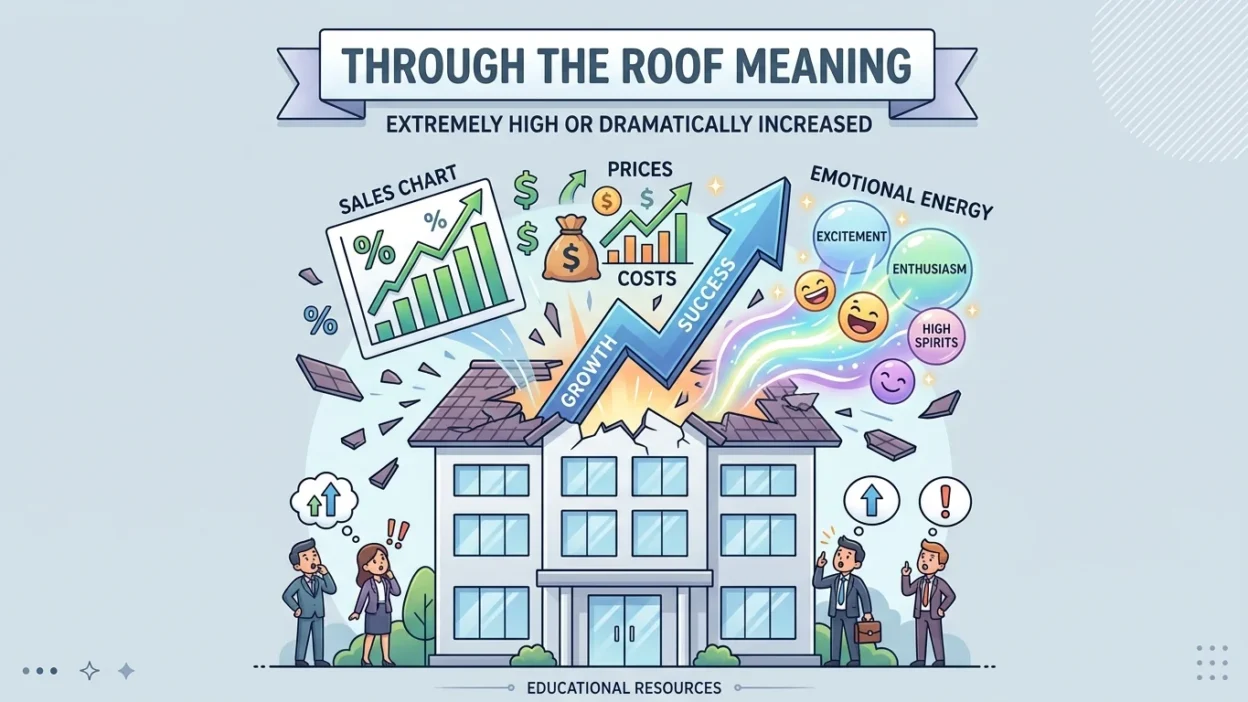
The phrase “through the roof” is a common English idiom used when something rises to an extremely high level. It can describe prices, costs, emotions, numbers, demand, popularity, or other situations that become unusually high or intense.
For example, if someone says, “Gas prices have gone through the roof,” they mean that gas prices have increased dramatically. Similarly, “Her excitement went through the roof” means she became extremely excited.
The expression is usually figurative rather than literal. Although something can physically go through a roof, everyday uses of “through the roof” normally communicate the idea of something becoming exceptionally high, excessive, or intense.
Quick Answer: Through the Roof Meaning
“Through the roof” means extremely high, excessive, or increasing dramatically. It is often used for prices, costs, demand, numbers, emotions, and other things that reach an unusually high level.
What Does “Through the Roof” Mean?
The idiom “through the roof” generally means very high, extremely high, or higher than normal.
It is especially common when something has increased significantly.
For example:
“House prices have gone through the roof.”
This means house prices have become extremely expensive.
The phrase can also describe an emotional state:
“His excitement went through the roof.”
This means his excitement became extremely strong.
Depending on the context, the phrase can therefore describe either a large increase or an extreme level.
Through the Roof Meaning in Simple English
In simple English, “through the roof” means extremely high or much higher than expected.
You can remember it like this:
Through the roof = extremely high
For example:
“The cost of living is through the roof.”
Meaning:
The cost of living is extremely high.
Another example:
“Demand for the new phone went through the roof.”
Meaning:
Demand for the phone increased dramatically.
How to Use “Through the Roof” in a Sentence
The phrase “through the roof” can be used in several common patterns.
Go Through the Roof
Go through the roof usually means that something increases dramatically.
Examples:
“Food prices have gone through the roof.”
“The company’s sales went through the roof.”
“Demand for tickets went through the roof after the announcement.”
In these examples, something is rising to an unusually high level.
Be Through the Roof
The phrase can also describe something that is already extremely high.
Examples:
“Rent is through the roof in this area.”
“The cost of repairs is through the roof.”
“Interest in the product is through the roof.”
Here, the phrase emphasizes the current extremely high level.
Send Something Through the Roof
The expression can also be used with send when something causes another thing to rise dramatically.
For example:
“The announcement sent ticket sales through the roof.”
This means the announcement caused ticket sales to increase dramatically.
Through the Roof Examples
Here are some natural examples of the idiom:
- “Gas prices have gone through the roof.”
Gas prices have increased dramatically. - “Our electricity bill went through the roof this month.”
The electricity bill became extremely high. - “Her excitement went through the roof when she heard the news.”
She became extremely excited. - “Demand for the new product went through the roof.”
Demand increased dramatically. - “The cost of living is through the roof.”
The cost of living is extremely high. - “His popularity went through the roof after the movie was released.”
His popularity increased dramatically. - “The temperature went through the roof during the heat wave.”
The temperature became extremely high. - “My stress levels went through the roof before the exam.”
My stress became extremely high.
Through the Roof Meaning in Different Contexts
The meaning of “through the roof” can change slightly depending on what it describes.
| Context | Meaning | Example |
|---|---|---|
| Prices | Extremely expensive or high | “Rent is through the roof.” |
| Costs | Much higher than normal | “Repair costs went through the roof.” |
| Demand | Increased dramatically | “Demand went through the roof.” |
| Popularity | Became extremely popular | “Her popularity went through the roof.” |
| Excitement | Became extremely intense | “The crowd’s excitement went through the roof.” |
| Anger | Became extremely intense | “His anger went through the roof.” |
| Stress | Became extremely high | “My stress levels went through the roof.” |
| Numbers | Increased dramatically | “The number of visitors went through the roof.” |
Is “Through the Roof” Positive or Negative?
“Through the roof” can be either positive or negative depending on context.
When describing prices, costs, stress, anger, or problems, it is usually negative.
For example:
“Medical expenses have gone through the roof.”
This suggests that the expenses have become excessively high.
However, the expression can have a positive meaning when describing excitement, popularity, sales, success, or demand.
For example:
“Sales went through the roof after the advertisement aired.”
This is positive because the company experienced a major increase in sales.
Similarly:
“The audience’s excitement went through the roof.”
This describes an extremely enthusiastic reaction.
“Through the Roof” vs “Over the Roof”
These phrases may look similar, but they are not normally interchangeable.
Through the roof is the established idiom meaning extremely high or dramatically increased.
Over the roof usually describes something physically moving over a roof rather than reaching an extreme level.
For example:
“The ball flew over the roof.”
This describes physical movement.
But:
“The price of the house went through the roof.”
This is figurative and means the price increased dramatically.
“Through the Roof” vs “Off the Charts”
“Off the charts” and “through the roof” can have similar meanings.
Both can describe something that reaches an extremely high level.
For example:
“Demand went through the roof.”
and
“Demand went off the charts.”
Both suggest exceptionally high demand.
However, “off the charts” often emphasizes that a measurement is beyond the normal scale, while “through the roof” strongly suggests a dramatic rise or extremely high level.
“Through the Roof” vs “Sky-High”
These expressions are also closely related.
Sky-high means extremely high.
Through the roof means extremely high or dramatically increased.
Examples:
“House prices are sky-high.”
“House prices have gone through the roof.”
Both sentences communicate that house prices are very high.
However, through the roof is especially natural when talking about a sharp increase.
Common Mistakes with “Through the Roof”
Mistake 1: Thinking It Always Refers to a Physical Roof
The most common mistake is interpreting the expression literally.
For example:
“Prices went through the roof.”
This does not mean the prices physically passed through a roof. It means prices became extremely high.
Mistake 2: Using “Through the Roof” for Something That Is Only Slightly High
The expression usually suggests an extreme level.
Saying:
“The price went through the roof.”
suggests a substantial increase, not a small change.
For a minor increase, phrases such as “went up slightly” or “increased a little” are more appropriate.
Mistake 3: Assuming It Is Always Negative
The phrase can describe positive situations too.
For example:
“The singer’s popularity went through the roof.”
This is clearly positive.
Similarly:
“Sales went through the roof.”
usually means sales increased dramatically, which is good for a business.
Why Do We Say “Through the Roof”?
The expression creates a vivid image of something rising so high that it breaks through the roof.
Imagine a level increasing and increasing until it reaches the ceiling. If it continues upward, it would metaphorically go through the roof.
This image helps explain why the idiom means extremely high or dramatically increased.
The expression has been used in English for a long time and became a familiar way of describing extreme increases.
Is “Through the Roof” an Idiom?
Yes. “Through the roof” is an English idiom.
Its meaning is usually figurative rather than literal.
The phrase does not normally refer to an object physically passing through a roof. Instead, it communicates that something has reached an exceptionally high level.
Examples include:
“Prices are through the roof.”
“Her excitement went through the roof.”
“Sales went through the roof.”
Through the Roof in American and British English
“Through the roof” is widely understood and commonly used in both American and British English.
There is no major difference in meaning between the two varieties.
Examples:
American English:
“Gas prices have gone through the roof.”
British English:
“House prices have gone through the roof.”
The expression is natural in casual conversations, news writing, business discussions, and everyday English.
Synonyms for “Through the Roof”
Depending on the context, you can replace “through the roof” with several expressions.
When Something Is Extremely High
Very high
Extremely high
Sky-high
Excessively high
Astronomical
Enormous
When Something Increases Dramatically
Soar
Surge
Skyrocket
Shoot up
Increase dramatically
Rise sharply
Go through the ceiling
For example:
“Prices went through the roof.”
can become:
“Prices skyrocketed.”
or:
“Prices soared.”
Memory Trick for “Through the Roof”
Think about a roof as a ceiling.
If something rises so high that it breaks through the ceiling, it has become extremely high.
So remember:
Through the roof = extremely high
A simple example to remember is:
“Prices went through the roof.”
This means:
Prices became extremely high.
Final Verdict
“Through the roof” means extremely high, excessive, or dramatically increased.
It is commonly used for:
• Prices
• Costs
• Demand
• Sales
• Popularity
• Excitement
• Anger
• Stress
• Numbers
• Temperatures
The phrase can be either positive or negative depending on the context.
If you are talking about something becoming exceptionally high, “through the roof” is a natural and widely understood English idiom.
FAQs About “Through the Roof”
What does “through the roof” mean?
“Through the roof” means extremely high or dramatically increased. It is often used for prices, costs, demand, sales, emotions, and other things that reach an unusually high level.
Is “through the roof” a metaphor?
Yes. It is a figurative expression that creates the image of something rising so high that it breaks through a roof.
Is “through the roof” positive or negative?
It can be either. “Prices went through the roof” is negative, while “Sales went through the roof” is usually positive.
What is another word for “through the roof”?
Depending on the context, alternatives include sky-high, extremely high, soaring, skyrocketing, surging, excessive, and dramatically increased.
Can you say “went through the roof”?
Yes. “Went through the roof” is one of the most common forms of the expression.
For example:
“The cost of the project went through the roof.”
What does “my excitement went through the roof” mean?
It means your excitement became extremely strong. The phrase emphasizes an unusually high level of excitement.
Conclusion
The idiom “through the roof” is a useful expression for describing something that becomes extremely high or increases dramatically. It is especially common when discussing prices, costs, demand, sales, popularity, emotions, and numbers.
The easiest way to remember it is simple:
Through the roof = extremely high.
So when someone says “prices have gone through the roof,” they mean prices have increased dramatically. When they say “sales went through the roof,” they mean sales rose sharply.
Once you understand this basic idea, you can recognize and use “through the roof” naturally in everyday English.
Remember This
Through the roof = extremely high or dramatically increased.
“Prices went through the roof.” = Prices became extremely high.
“Sales went through the roof.” = Sales increased dramatically.
“Her excitement went through the roof.” = Her excitement became extremely intense.

Daniel Charles is a dedicated author and dream interpretation enthusiast at DrameyHut. He specializes in analyzing dream symbols and meanings, offering clear and insightful content for readers. His work aims to help individuals understand their subconscious thoughts, gain clarity, and explore the deeper messages hidden within their dreams.