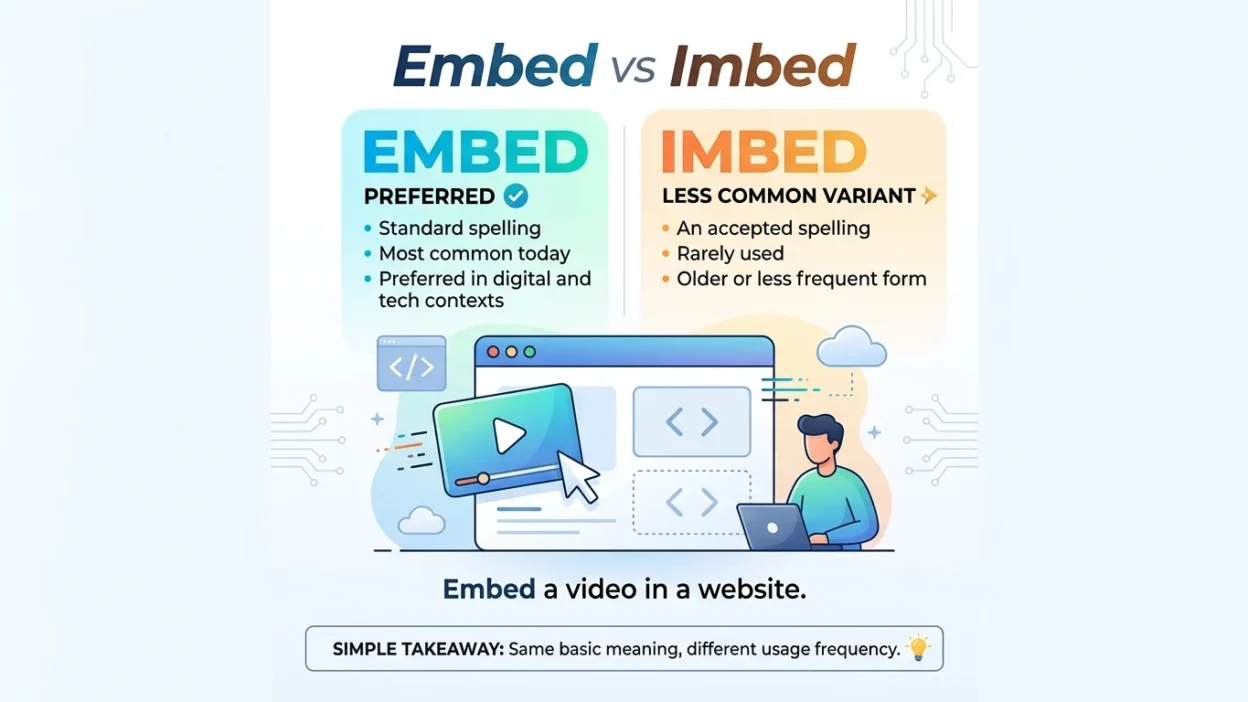
“Embed” and “imbed” are both English words, and they have the same basic meaning. However, embed is by far the more common and preferred spelling in modern English.
Both words can mean to fix, insert, or place something firmly within something else.
For example:
The video is embedded in the article.
The stone was embedded in the wall.
While imbed is not necessarily incorrect, it is much less common. In most situations, embed is the better choice.
Quick Answer
Embed = the standard and much more common spelling.
Imbed = an accepted but uncommon variant.
For modern writing, especially in technology, business, academic writing, and online content, embed is generally the preferred form.
Example
You can embed a YouTube video on your website.
Not:
You can imbed a YouTube video on your website.
Although imbed can be found in dictionaries, embed is overwhelmingly more common.
What Does “Embed” Mean?
Embed means to place or fix something firmly inside another thing.
It can be used literally or figuratively.
Literal Meaning
The workers embedded the metal supports into the concrete.
The supports were placed firmly inside the concrete.
Another example:
A small piece of glass was embedded in the wood.
The glass was firmly stuck inside the wood.
Figurative Meaning
Embed can also describe something deeply established in a situation, system, culture, or memory.
These traditions are deeply embedded in the culture.
The experience became embedded in her memory.
Here, embedded does not necessarily refer to something physically placed inside something else.
What Does “Imbed” Mean?
Imbed is a variant spelling of embed.
It can also mean:
to place or fix something firmly within something else
For example:
The stone was imbedded in the wall.
This has essentially the same meaning as:
The stone was embedded in the wall.
However, imbed is considerably less common in contemporary English.
Embed vs Imbed: Main Difference
| Word | Meaning | Usage |
|---|---|---|
| Embed | Place or fix something firmly within something | Very common |
| Imbed | Same meaning as embed | Less common variant |
So the main difference is frequency and preference, rather than meaning.
Is “Embed” or “Imbed” Correct?
Both can be considered correct, but embed is the standard choice for most modern writing.
If you are unsure which one to use, choose:
Embed ✅
This is especially true for:
- Websites
- Technology
- Software
- Digital media
- Business writing
- Academic writing
- General English
Embed vs Imbed in Technology
In technology, embed is overwhelmingly preferred.
For example:
You can embed a video in your website.
The developer embedded the image into the webpage.
This code allows users to embed the widget.
The platform supports embedded content.
Using imbed in these contexts may look unusual to many readers.
So:
Embed a video ✅
Embed a YouTube video ✅
Embedded code ✅
Embedded content ✅
These are the standard forms.
Embed vs Imbed in HTML
Embed is also an important technical term in web development.
For example:
You can embed an image using HTML.
The website contains an embedded video.
There is also an HTML element called the <embed> element.
Because embed is the established technical spelling, imbed should generally be avoided in web development contexts.
Embed vs Imbed Examples
Embed
The journalist embedded a video in the article.
Imbed
The journalist imbedded a video in the article.
The second sentence can be understood, but embedded is much more natural and conventional.
Embed
The company embedded the payment system into its website.
Imbed
The company imbedded the payment system into its website.
Again, embedded is the preferred form.
Embed vs Imbed: Verb Forms
If you choose embed, its common forms are:
embed
embeds
embedded
embedding
Examples:
We embed the video.
She embeds the video.
They embedded the video.
He is embedding the video.
A useful spelling point is that embed doubles the final d before -ed and -ing:
embed → embedded
embed → embedding
Is It “Embedded” or “Imbedded”?
Embedded is much more common and is the preferred spelling.
The image is embedded in the document. ✅
The image is imbedded in the document. ⚠️ Less common
Although imbedded appears in some dictionaries and published writing, embedded is the standard modern choice in most contexts.
Is It “Embedding” or “Imbeding”?
The preferred form is:
embedding ✅
Not:
imbeding ❌
When embed takes the -ing ending, the final consonant is doubled:
embed → embedding
Common Mistakes
Mistake 1: Assuming “imbed” is always wrong
Imbed does exist as a word. It is an accepted variant of embed, although it is much less common.
So it is better to say:
Embed is preferred.
rather than:
Imbed is always incorrect.
Mistake 2: Using “imbedded” in technical writing
While imbedded can be found in English, modern technical writing strongly favors:
embedded
For example:
Embedded video
Embedded software
Embedded systems
Embedded content
Mistake 3: Writing “imbeding”
The standard spelling is:
embedding
The final consonant is doubled.
Embed vs Insert
Embed and insert can be similar, but they are not always interchangeable.
Insert means to put something into something else.
Insert the card into the machine.
Embed often suggests that something becomes firmly integrated into or contained within something else.
The video is embedded in the webpage.
The video is not merely placed there temporarily. It is integrated into the page.
Embed vs Integrate
These words can overlap in some contexts.
The company embedded the payment system into its website.
The company integrated the payment system into its website.
Integrate emphasizes making something work as part of a larger system.
Embed emphasizes placing something within another thing or making it an inherent part of it.
“Embedded” Meaning
Embedded is the past participle and adjective form of embed.
It can mean:
firmly placed inside something
or:
deeply established within something
Examples:
The image is embedded in the document.
The journalist was embedded with the military unit.
The belief is deeply embedded in the culture.
“Embedded” in Journalism
In journalism, embedded has a specialized meaning.
An embedded journalist is a journalist who accompanies and reports alongside a military unit or other organized group.
For example:
The reporter was embedded with the troops.
This usage comes from the broader idea of someone being placed within a group or environment.
“Embedded in” vs “Embedded into”
Both embedded in and embedded into can be correct, but they can emphasize slightly different ideas.
Embedded in
The image is embedded in the document.
This describes its location.
Embedded into
The feature was embedded into the software.
This can emphasize the process of incorporating something into a system.
In many contexts, embedded in is the more natural choice.
“Embed in” vs “Embed into”
You can use both constructions.
Embed the video in the webpage.
Embed the video into the webpage.
However, embed in is often the more concise and natural choice.
Easy Way to Remember
If you’re unsure between embed and imbed, remember:
Choose EMBED.
It is the overwhelmingly more common spelling and is the standard choice in modern technical and general English.
Think of:
embedded video
embedded image
embedded content
embedded system
All of these use embed.
Quick Comparison Table
| Expression | Preferred? | Example |
|---|---|---|
| Embed | ✅ Yes | Embed the video. |
| Imbed | ⚠️ Less common | Imbed the video. |
| Embedded | ✅ Yes | The video is embedded. |
| Imbedded | ⚠️ Less common | The video is imbedded. |
| Embedding | ✅ Yes | Embedding a video is easy. |
| Imbeding | ❌ Standard spelling | — |
Final Verdict
Embed and imbed have essentially the same meaning: to place or fix something firmly within something else.
However, embed is the much more common and preferred spelling in modern English.
Embed ✅
Imbed ⚠️ Less common variant
This distinction is especially important in technology, where embed is the established form:
embed a video
embedded content
embedded software
embedded system
So, if you’re writing an article, website content, technical documentation, or professional communication, use “embed.”
FAQs
Is “imbed” a correct word?
Yes. Imbed is an accepted variant of embed, but it is much less common.
Which is correct, embed or imbed?
Both can be found in English, but embed is the standard and preferred spelling in most modern contexts.
Is it “embedded” or “imbedded”?
Embedded is the preferred form. Imbedded is a less common variant.
Is “embedding” spelled with two d’s?
Yes.
embedding ✅
The verb embed doubles the final consonant before -ing.
What does “embed” mean?
Embed means to place or fix something firmly within something else.
The video is embedded in the webpage.
Is “embed” used in technology?
Yes. Embed is extremely common in technology and web development.
You can embed a video in your website.
What is the difference between embed and insert?
Insert generally means to put something into something else, while embed often suggests that something becomes firmly incorporated or integrated into its surroundings.
Conclusion
The difference between embed vs imbed is mainly one of usage and popularity, not meaning.
Both words can mean to place or fix something firmly within something else, but embed is overwhelmingly more common in modern English.
For general writing and especially for technology, websites, software, and digital content, use:
Embed ✅
For example:
You can embed a video in your article.
Although imbed is an accepted variant, it is uncommon enough that embed is almost always the better choice.
Easy rule: When in doubt, use “embed.”

Christopher Thomas is a passionate writer and dream researcher dedicated to exploring the meanings behind dreams. As an author at DrameyHut, he creates insightful and easy-to-understand interpretations that help readers connect with their subconscious mind. His work focuses on guiding individuals toward self-discovery, clarity, and a deeper understanding of their inner thoughts.